A MOBILE CINEMA: NOTES TOWARDS A SEASON—PART ONE

I’d like to propose a season of films—The City, the Country, the River & the Road.  The title is unashamedly poetic, and if I’m honest I’m not quite sure where it came from, or how it suggested itself.  Was I influenced by the fact that I was coming to Dublin?  I think I was.  But I was also thinking about cinema itself and its capacity for taking us to all of these places—often within the course of a single narrative.  Think of Truffaut’s Les 400 coups, which starts in a grey and overcast Paris and ends as its young truant embarks on one of the great runs in all of cinema, his momentum halted only by the sight of the ocean. Truffaut’s film was auto-biographical, his truancy redeemed by his discovery of cinema and by his befriending Andre Bazin. Well, not everyone can call upon such a friend, though we all should have access to the cinema and its treasures.

This started me thinking about the role of your organization—its mission, its goals—with its roots in Dublin but its remit to travel far and wide.  So I wanted to propose a season that might on one level enact this very goal, this on-going journey—or at least try to: a season that begins in the city—about the city, about what movies mean to the city, and cities to the movies—and then moves out to the regions, to the country, with films that reflect this movement, picking up passengers along the way.  And so I have selected some films that not only live up to the rich possibilities of my title but that might talk to one another in some way, if that is not too abstract a notion.  (I wonder how much I was influenced by my own beginnings: when I was younger, we took movies to the people: Consett Mobile Cinema.)

There is fiction and non-fiction.  From the latter I have chosen a particular strand—the essay film.  This is partly due to my love of the essay form itself; it also stems from my interest in the idea of the flaneur.  The essay-films that I would like to play are notable not only for the metaphorical stroll each director takes around their city but for the quality of the words as well as the images: Thom Anderson’s Los Angeles Plays Itself, Terence Davies’ Of Time and the City, and Guy Maddin’s My Winnipeg.  To this short list I have added Kieran Hickey’s documentary about James Joyce’s Dublin, Faithful Departed (1967), and a programme the New Yorker writer Adam Gopnik wrote and presented for the BBC—Lighting Up New York.  The reason for choosing Hickey’s film is in some ways because it is a bridge to one of my fiction choices—Richard Linklater’s Before Sunrise.  (And where there are rivers and roads there should be bridges.)  Before Sunrise is set in Vienna, but its narrative unfolds over twenty-four hours on the 16th June—or Bloomsday as it is otherwise known.  Thematically, both films play on the idea of absence, or the eventual absence of the protagonists, while absence—“What happened to my city?—is surely the defining characteristic, and lament, of the other films I’ve already mentioned.  This is certainly true of the Davies, the Maddin, and the Gopnik.

But there is another, more recent film about New York that I have included: James Marsh’s Man On Wire.  One, I think it makes a perfect companion to Lighting Up New York.  But I also like the way it deliberately withholds—yet somehow redeems—a city’s overwhelming absence.  And nothing gets absence, or transience, like the cinema.  One only has to think of Andy Goldsworthy’s Rivers & Tides, Wenders’ Alice in the Cities, Wong Kar Wai’s In the Mood for Love and another Linklater film, Before Sunset.  Even Chris Petit’s Radio On, which began as an Englishman’s attempt at a Wenders-like road movie, now seems like an historical document of how certain parts of England used to be.

(To be continued…)

—MM


Boyhood: Richard Linklater’s Ongoing Moment

Unfolding like one of Frederick Wiseman’s longitudinal portraits, and with the same cumulative force, Boyhood enacts a miracle. Over the course of its duration, a leisurely 166 minutes, we see a boy age from six to eighteen. There is no CGI or digital manipulation, as there was in, say, David Fincher’s The Curious Case of Benjamin Button. Fincher used motion capture, as well as prosthetics, to render the effects of age over time. Richard Linklater went about things in true Linklater fashion: he shot the film over a twelve year period with the same cast, including Ethan Hawke and Patricia Arquette, who play the boy’s parents. Hawke has likened the process and the resulting film to time-lapse photography, though it’s time-lapse without dissolves. Chapters begin and end without fanfare. Change is registered by a hair-cut or a growth spurt: inches for years, if you like; while revolutions in technology or the swell of a new cultural moment—yet more revolutions—provides us with further evidence that time has passed. Rich in feeling and ravishing to look at, Boyhood is both universal in its themes and distinctly American: it could easily have been called Family or Motherhood or This American Life.

How many films leave you truly satisfied? And how many contemporary filmmakers attempt what Linklater does here: to show you a person grow and change so that not only do you feel altered in some immeasurable way but actually feel concerned about that person’s future? At the end of Boyhood, which is as full and as rich as a great novel, yet as delicate as a poem, I wondered: what will become of Mason Evans? He doesn’t exist, of course. But our investment in Mason’s progress is deep, while our feelings are surely influenced by the knowledge that the young actor who plays him, Ellar Coltrane, has put in the hours. To paraphrase Godard, talking about Jean Rouch’s Gare du Nord: years reinforce years; when they really pile up, they begin to be impressive…

http://anosamoursblog.weebly.com/blog/boyhood-richard-linklaters-ongoing-moment-by-mick-mcaloon


“Think of this as time travel…” —extended take

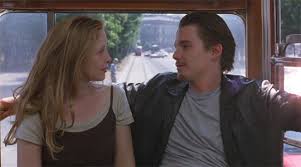
Who could have guessed at the impact of such a casual encounter?  In Richard Linklater’s Before Sunrise (1995), Jesse, an idealist young American travelling through Europe, tries to persuade Celine, a French woman he has just met, to spend the day with him in Vienna. Crucial to his line of reasoning is the idea of regret: what if they let this moment go and spend the rest of their lives wondering, well, “what if?”  So Jesse asks Celine to imagine a point in the future, ten or twenty years down the line, when life is no longer filled with the promise of youth:  “Think of this as time travel”, he tells her, “from then till now.” What might this potentially life-changing encounter, this interruption of the quotidian, mean to them as they approached middle age?

It’s a good question, and one that Linklater and his actors, Julie Delpy and Ethan Hawke, have attempted to answer on two further occasions: Before Sunset picked up Celine and Jesse’s story nine years later, while the third film in the series, Before Midnight, is scheduled for release in June of this year. With almost another decade since elapsed, Jesse’s remark—“Think of this as time travel”—now takes on an even deeper resonance—and not only for the film’s protagonists.

Not that we could have known—my wife and I—that a film we watched on a Saturday night, in April, 1995, would end up serving as a marker in our own lives.  How could we?  Back then, we were still ten years off being married. Not only that, but I doubt the filmmakers themselves had at that point conceived of returning to their fictional creations. Besides, Before Sunrise was not the kind of film that spawned sequels, and certainly not in the mid-1990s: studio-backed but “personal” and “independent”; episodic rather than plot-driven; and with long, languorous takes—it lived out of a backpack, as it were. But from the start it had the one special effect intrinsic to cinema itself: the concept of time.  Which makes it make it sound “heavy” for a Saturday night at the movies, though it was anything but.

In those (pre-congestion zone) days, we thought nothing of driving into the West End to see a movie.  And on the following Monday morning, when I returned to my job as a video buyer for HMV…Well, there you go: perhaps you can see what I’m getting at: video, HMV—how much has already gone to the wall. Or as Celine tells Jesse (in Before Sunset): “It’s about that moment in time that’s forever gone.”

Of course, it was only with the arrival of the second film that Linklater revealed the hand that had been there all along.  It took Before Sunset for me to see it. The actors had noticeably aged, especially Hawke, who looked as though the interim years had not been kind: the boyishness was gone, and when Jesse spoke of a marriage failing and of the love he felt for his son, it was as though Hawke was speaking, or at least writing, from experience. (Hawke is a co-writer on the film, along with Delpy and Linklater.) The euphoria and sense of possibility that the first film engendered had been replaced by a feeling of disappointment that is Chekhovian in its lament for lost time and unrealized dreams.
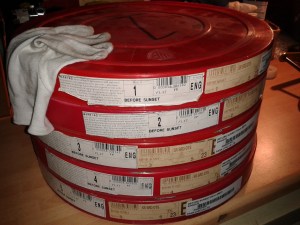
Before Sunset print

Photo: Steve Rooney

By the time Before Sunset came out (2004), I was working in cinema exhibition—cinema management, film programming and projection—and on at least three occasions screened the films in a double bill.  So I could see how each film deepened and enriched the other.  But even to write these words is to realize how much has changed in such a short span of time.  The idea of a “double bill” is almost a thing of the past. Since the release of Before Sunset, the cinema I manage has undergone both a name-change and, like many cinemas, its own technological revolution: films nowadays are rarely screened on 35mm prints.  When Before Midnight is finally released in June, it will almost certainly be digitally projected, with reels replaced by a DCP (digital content package). And where is the romance—the loveliness—in that?  But that is where we are: things change, losses accrue. We go on.

Before Sunset DCP

Photo: Matt Whitehead

In 2005 my wife moved to New York (for work), while I remained in London, which seemed—on the surface, anyway—a Jesse and Celine type predicament.  In reality, it meant I made numerous trips to New York, eventually moving there in the summer of 2007.  I spent a year walking the streets, exploring the canyon avenues (my own version of a long and languorous take). I went to the movies, subscribed to American magazines, looked after our old cat, and enjoyed a different kind of existence.  A friend asked if I was “re-inventing myself”.  I told him no, but I knew what he meant: I was exploring the “what if” of my own life.

In his review of Before Sunrise, The New Yorker’s Anthony Lane pointed out that Linklater had “managed to pull us back into that wordy, pleasantly confused moment of youth when people have the nerve—the pretension, maybe, but also the wit—to envisage their lives as a kind of literature, to imagine themselves sauntering gaily, or grimly, through one short story or another.”   I’ve never gone that far, though I certainly understand the impulse: the need to lose oneself, if only for an extended moment, in something other than reality: be it a movie, a three-minute pop song, or, in my case, books.  In New York, I spent an awful lot of time in second-hand bookshops, incorporating them into my daily routine, making my rounds like a doctor visiting his ailing patients: Skyline Books, East 12th Street Books—both now gone.  But the Strand Book Store is still there and I feel about The Strand the way E.B. White felt about New York: “If it were to go, all would go—this city, this mischievous and marvellous monument which not to look upon would be like death.” That is the kind of literary reference that Jesse would have reached for 18 years ago, as the sun came up in Vienna.  Back then, Jesse quoted Auden—As I Walked Out One Evening—but the sentiment is the same: time and mortality are the enemies.

I must have gone to the Strand at least once a week for an entire year, not always with the intention of buying something. Accounting for my hours-at-a-time absence, I referred to it as being “lost-in-Strand time”.  (I like to think that Linklater and his time-travellers might approve of such a concept.) But then I recalled—belatedly and after repeated viewings of Before Sunset—that Celine had once lived at 11th & Broadway, one block down from The Strand.  (She gives Jesse this information in the back of a car, in one of the series’ most heart-breaking moments.) Surely it was within the realm of possibilities—within fiction’s remit—that they’d come close to meeting each other here on previous occasions. (Jesse looks like a Strand kind-of-guy.) Or perhaps they’d even picked up the same book, seconds apart?  Or is that crazy? Is that just me, running away with the possibilities of “what if”? But one has only to look at some of the great writing the films have inspired to see I’m not alone in imagining a life (or several lives) for Celine and Jesse away from the screen. After seeing Before Sunrise, film critic Robin Wood wrote that “…the longing for permanence is so powerful that one would love to see a sequel (Celine and Jesse Go Boating perhaps) in which they did keep the appointment, returned together to…France? America?…and tried to work out ways in which ‘commitment’ is still feasible.”  Wood died in 2009, though his questions and insights are remarkably prescient: 18 years later, it looks as though they’re still trying to work it all out. Which is to say: is commitment ever feasible?

So perhaps you can see why this most casual of trilogies might exert a grip on its original audience. And why, from time to time, we like to check in on Celine and Jesse, with the corollary being: we’re checking in on ourselves. These films walk beside us, so to speak, echoing our concerns, while enacting and enjoying a flaneur’s privileges: walking, talking, dreaming—or “just bullshitting”.  Is it any wonder that, if you are a certain age and of a similar disposition, Linklater’s films occupy so much head space?  Or to put it another way: walking life as Waking Life.

In May 2008, as my year in New York was coming to its visa-imposed end—as London and “real-time” beckoned (and Celine hates “real-time”, though Before Sunset revels in it)—I stepped out of yet another bookshop, this time in Chelsea: 192 Books. As I walked up 10th Avenue I recognised a man in his late thirties; he was with his son. It was Ethan Hawke, or Jesse if you are given to speculating about fictional characters. He looked well, which made me think that Celine was back in his life.  At that point, I had no idea if another film was in the works; there were only rumours of a reunion. But here we are in 2013 and I’m not sure what to expect.

—Mick McAloon

Midnight ruins

“Think of this as time travel…”


In Richard Linklater’s 1995 film Before Sunrise, Jesse, an idealist young American travelling through Europe, tries to persuade Celine, a French woman he has just met, to spend the day with him in Vienna. Crucial to his line of reasoning is the idea of regret: what if they let this moment go and spend the rest of their lives wondering “what if?”  So Jesse asks Celine to imagine a point in the future, ten or twenty years down the line, when life is no longer filled with the promise of youth:  “Think of this as time travel”, he tells her, “from then till now.” What might this potentially life-changing encounter, this interruption of the quotidian, mean to them as they approached middle age? It’s a good question, and one that Linklater and his actors, Julie Delpy and Ethan Hawke, have attempted to answer on two further occasions: Before Sunset picked up Celine and Jesse’s story nine years later, while the third film in the series, Before Midnight, is scheduled for release in June of this year.  Jesse’s remark—“Think of this as time travel”— now takes on an even deeper resonance—and not only for the film’s protagonists.

Not that we could have known—my wife and I—that a film we watched on a Saturday night, in April, 1995, would end up serving as a marker in our own lives.  How could we?  Back then, we were still ten years off being married. Not only that, but I doubt the filmmakers themselves had at that point conceived of returning to their fictional creations. Besides, Before Sunrise was not the kind of film that spawned sequels, and certainly not in the mid- 1990s: studio-backed but “personal” and “independent”; episodic rather than plot-driven; and with long, languorous takes—it lived out of a backpack, as it were. But from the start it had the one special effect intrinsic to cinema itself: the concept of time.  Which makes it make it sound “heavy” for a Saturday night at the movies, though it was anything but.

In those (pre-congestion zone) days, we thought nothing of driving into the West End to see a movie.  And on the following Monday morning, when I returned to my job as a video buyer for HMV…Well, there you go: perhaps you can see what I’m getting at: video, HMV—how much has already gone to the wall. Or as Celine tells Jesse (in Before Sunset): “It’s about that moment in time that’s forever gone.”

Of course, it was only with the arrival of the second film that Linklater revealed the hand that had been there all along.  It took Before Sunset for me to see it. The actors had noticeably aged, especially Hawke, who looked as though the interim years had not been kind: the boyishness was gone, and when Jesse spoke of a marriage failing one felt that Hawke was speaking from experience. (Hawke is a co-writer on the film, along with Delpy and Linklater.) The euphoria and sense of possibility that the first film engendered had been replaced by a feeling of disappointment that is positively Chekhovian in its lament for lost time and unrealized dreams.

By the time Before Sunset came out (2004), I was working in cinema exhibition—cinema management, film programming and projection—and on at least three occasions screened the films in a double-bill.  So I could see how each film deepened and enriched the other. But even to write these words is to realize how much has changed in such a short span of time. The idea of a double-bill is almost a thing of the past.  Since the release of Before Sunset, the cinema I manage has undergone both a name-change and, like many cinemas, its own technological revolution: films nowadays are rarely screened on 35mm prints.  When Before Midnight is finally released in June, it will almost certainly be digitally projected, with reels replaced by a DCP (digital content package). And where is the romance—the loveliness—in that?  But that is where we are: things change, losses accrue. We go on.

In 2005 my wife moved to New York (for work), while I remained in London, which seemed—on the surface, anyway—a Jesse and Celine type predicament.  In reality, it meant I made numerous trips to New York, eventually moving there in the summer of 2007.  When I wasn’t applying for jobs I spent a year walking the streets, exploring the canyon avenues.  I went to the movies, subscribed to American magazines, looked after our old cat, and enjoyed a different kind of existence.  A friend asked if I was “re-inventing myself”.  I told him no, but I knew what he meant: I was exploring the “what if” of my own life.

And then in May 2008, as my year in New York was coming to its visa-imposed end, I stepped out of a bookshop in Chelsea and recognised a man in his late thirties, walking up 10th Avenue, his son beside him.  It was Ethan Hawke, or Jesse if you are given to speculating about fictional characters. He looked well, which made me think that Celine was back in his life.  At that point, I had no idea if another film was in the works; there were only rumours of a reunion. But here we are in 2013 and I’m not sure what to expect.

—MM

Before Midnight (2013) Ethan Hawk Juli Delpy