MM: I’d like to read you something from your novel Suspects that I think applies to the Biographical Dictionary of Film. “There can be a lurking poetry in reference-book style…” Poetry lurks on every page—was this always the intention?
DT: Not originally. The dictionary was a very important book for me in that it was a learning experience about how to find a new voice for writing about films. The book, when it was planned, was meant to be a much more conventional reference book, to have a much more neutral, objective tone. But once I started working on it, I became bored with that, or I didn’t like it. So I began to generate a new voice, I suppose. And what I came to, I think, is a tone of voice that is much more like that of fiction, or maybe gossip. It’s as if the book is sort of saying, “We all know these people, let’s talk about them, let’s dish a little bit …. Let’s say what we really think about them.” It’s sort of like that. So I would say now, looking back on the Dictionary, it’s kind of somewhere between a memoir and a novel disguised as a reference book. It’s meant to be read, in a way that you would read fiction. And it’s very definitely, for good or ill—you might not like it always—it’s very definitely written. It’s quite mannered in terms of the way it’s written.
MM: Can you remember which entry first galvanised you, made you think that such a venture was possible?
DT: I think there were probably several. I knew increasingly as I went along on the book, and this was in the early 1970s really, that I was trying to get away from the voice of film criticism as known in England at that time. I wanted it to be more passionate. I wanted it to be funnier. I didn’t want it to be respectable. You ask about particular entries. I think that people like Cary Grant, Mitchum, John Wayne were helpful—and also I think the Marx Brothers. That was an entry I puzzled over a lot, because I’m a great lover of Groucho and I wanted to do something that was Grouchoesque. And I remember taking several shots at it before I got it right, and once I got it, there was a tone that I knew was going to help in other entries. So that was important. Also, a silly thing but not unimportant, the Angie Dickinson entry. I was crazy about her. I realise it was a daft sexual obsession, but why not say it? You know, because all of us I think have somebody like that—maybe more than one person—that we’re just daft about, and we know it’s not really entirely defensible or rational, but I think that’s how people are at the movies: we’re in love with certain people. So those entries, I would say, were all very helpful in getting towards a style of voice.
MM: Of course they’re all American. Was the fact that they were American influence the way you approached them in terms of the energy of the prose? Because there’s quite a marked difference between the style of your first book, Movie Man, and the Biographical Dictionary. What liberated you? Were there any English entries where you felt held back?
DT: Oh God, it’s a crucial question. You see, there was a very strange thing happened. When I undertook to do the book in the early Seventies, I had not been to America at all. I had the kind of sense of America that anyone has from Hollywood films, which is not necessarily accurate but quite deep. However, as I began working on this book, I began teaching American students—and these were students who had been sent over to England for a year abroad, that kind of program from a college in New England. I was teaching them film on an English campus …
MM: Where was this?
DT: The English Campus of the New England College in Arundel, Sussex. So I was suddenly in the middle of classes of American kids. And I had in my life before then encountered a few Americans—only a few. Now suddenly I was reading papers by, and talking to, people who talked American. Now that meant that they did not often talk very good English. And in terms of their being students, I was having to work on their English a lot. BUT it was wonderful because there was a return reward. Because the very language that when they served it up in papers I would say, “No,no, no, there’s no verb in that sentence…”, I was actually feasting on it, because of the very things you’re talking about: that there is a kind of idiomatic immediacy that is wonderfully liberating. So it was a rich experience, and had a lot to do with the book. And then, of course, just after the first edition was published, I actually went to America. That was the beginning of what would become living there. When I went to America, I suddenly realised that if I was going to stay there, then I really faced seriously the question that I had discovered back in England: was I going to write English or American? Well, I think now I write something that’s in between, but I know that by the Eighties— it took that me long, it took five or six years—I felt I could write American talk, American dialogue. So that I couldn’t have written a book like Suspects until then because I just did not have the confidence to invent American voices and American talk. Now I’m not saying that all the American voices in Suspects are right, and that an American reader wouldn’t know it was an Englishman trying on the style. But I had got the confidence to do it, you know. And, for me, over the years, learning how to use American-English has been a tremendously exciting thing, because all those things—the wildness, the irreverence, the humour, the passion— it sort of helps them all [the entries]. And Americans interrupt each other a bit more than English people do—they shouldn’t, it’s rude in a lot of ways—but there’s an energy and an excitement. So you’ve put your finger on a very big thing for me. That’s sort of an explanation of the way the Dictionary’s gone.
MM: There seems to have been a split early on: Having to chose between going to Oxford or Film School. England and America. And clearly a love of literature and writing and a love of film. When you made the decision to turn down Oxford, did that trouble you at all?
DT: Yes, partly because it clearly troubled everyone else. My schoolteachers, who’d been preparing me to go to Oxford, and were doing a good job, were amazed and they thought it was crazy. And in a way it was, because the film school I went to—this was the London School of Film Technique—it’s improved, I think, a lot—but when I went there it wasn’t a very respectable school in that it was really up to the students to make the best of it. The teaching was not first rate, the equipment was not, and it was just not very well organised. And I know when I first got there—I knew what Oxford teaching was like because I’d been up there and taken some exams—I thought, “Oh my God, did I make the wrong decision here?” And also I would have to say for a long time afterwards, I was in a lot of ways set back a step, because the people I had grown up with, in three years, had university degrees which could get them jobs of the kind I couldn’t get. And there were times when I regretted it, when I thought I’d made a crazy decision. I certainly from the beginning had many arguments offered to me about how it was the wrong thing to do. But I’ll tell you frankly, I was just a bit bored with the way things were taught in school, and I thought three more years of that is not what I’m looking forward to. And although film school was a very chancy and inefficient place, the truth is I learned an amazing amount there. I fell in with a group of students, a lot of whom were older than I was—the students were often mature students. They had many more technical skills than I had. Many of them had done a lot of camera work and editing and sound. But the one thing I could do in this group that no one else in the group could do was think of a story. It was the thing that pointed me to the way writing might be where I should go. You know, I made a very big discovery in just a year. But yes, I had many doubts, and I still regret that I didn’t have those three years where you can read far and wide and the way you could just experiment. The split between a love of film and literature is still there.
I love films still. And I look forward, every time I go to the movies, to that great experience. I think I get it less often than I used to. So that when you go to the movies, it’s a bit more of a gamble. But overall I am very suspicious about what over 100 years of film has done to our culture and our education. When I think of my own young children, TV obsessed, taking in an enormous amount of TV but not reading very much, it troubles me. And when I think of the whole culture, it troubles me. And I’m not sure when it is all said and done that it has been a great, good thing. And historically, I think that’s one of the most interesting questions. It’s a very old fashioned question, but I think it’s really worth asking. Something like: After 100 years do we think that movies have been for the good or for the bad? I think that’s a fascinating question. And I could go on arguing that with people for a long time, and I don’t know the answer. But I increasingly feel that while I can, I’d like to write a few more books, and they don’t have to be about film. I’d like to try and put them on the shelf. And yes, it’s been a great delight in recent years to begin to discover some writers I neglected probably because I was so into films.
MM: You talk about what 100 years of film has done to the culture. Martin Amis says Andy Warhol got it wrong: people won’t be famous for 15 minutes, they’ll be famous all of the time, in their own heads. Do you think that’s a condition directly related to the movies?
DT: I think that is a very good comment, and that is certainly something I was trying to get at at the thing at the ICA. I do think film has permitted and offered the ways and strategies for all of us to live in fantasy. And … when you see a thing like the sniper in the Washington area recently, I think that’s a very good example, because I think that’s probably an unhappy fantasist who gets pushed to the point of acting out. And America’s a country where that sort of thing happens a lot. Why it should be so is a huge question— you’d need an awful lot of space to go into it. But there’s something about the opportunity that America has offered to hitherto deprived or oppressed or underprivileged people that really seems to say, “You could be a contender, you could be big.” It’s like ‘the pursuit of happiness’. European countries that are much more cynical and seasoned and experienced wouldn’t dream of using a phrase like ‘the pursuit of happiness’ in their plans for how to live. Americans do it absolutely: they think they’ve got it. That’s the question: the pursuit of happiness. And for a lot of people who are never going to be rich—and by definition only a few can be rich—never going to be beautiful, the same thing, never going to be famous—fantasy is the realm in which happiness is most possible. If you can believe you’re happy, in other words, if you’re king in your fantasy world, then you’ve made it, you’ve got somewhere. And, you know, this guy is famous now. I thought that Bonnie and Clyde was a movie that got it beautifully. I don’t know if the real Bonnie and Clyde were like this necessarily, but I think that Beatty got the way in which these were kids who wanted to be in the papers, who wanted to be famous, they wanted to get out of that anonymity. That’s a real ongoing drama in America, and fantasy—living out your dreams and sort of almost hardly realising how damaging the reality of your dreams maybe to others. I’m not defending this sniper, but I can believe that he hardly grasped the damage he was doing. He looked at those figures in the distance he was just dropping. And we’ve all seen movies that do that.
MM: Talking of fantasy and living in your head, were you ever tempted to include an entry on Bill Clinton?
DT: That is a brilliant question. I wish to God I’d thought of it, because I’d do it like a shot now. But what a great idea. I wasn’t smart enough to think about it. I’ve written about Clinton, but that would be so suggestive of where we are now in the way in which public figures are actors, and he’s as good an actor as there’s ever been, in a way. God, next edition, he’s in.
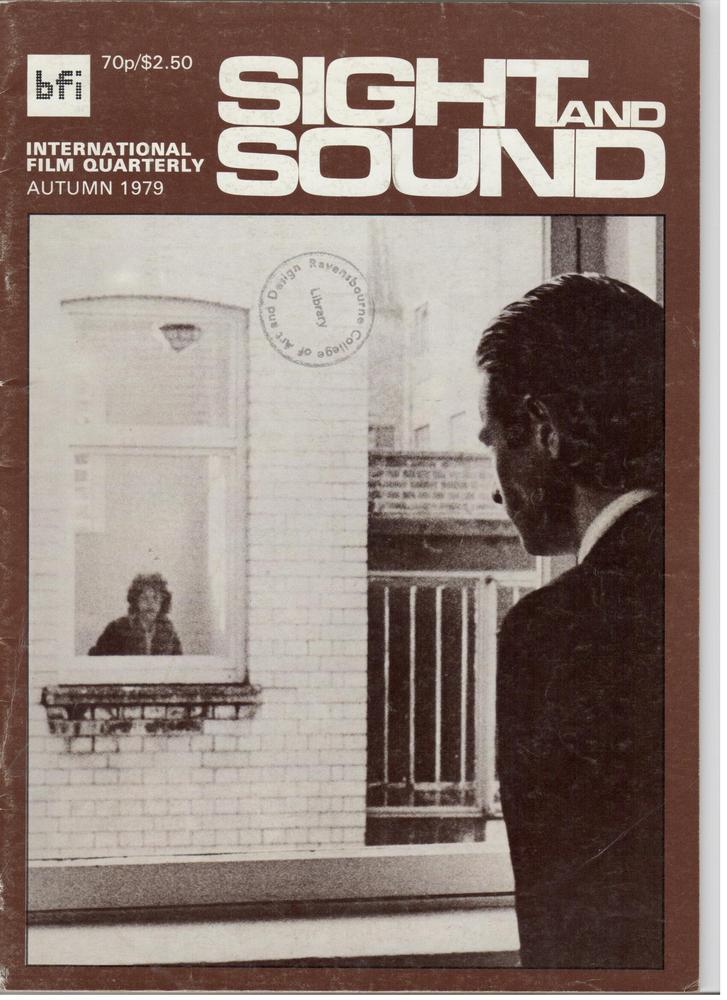
MM: Do you remember this Sight & Sound? It’s a piece on Nicholas Ray. [Autumn, 1979]
DT: Yes, sure.
MM: It starts in a very personal vein where you reveal your unhappiness with writing and movies, and you reveal the content of a letter from the then editor of Sight & Sound, Penelope Houston. For someone who has professed to being so shy, where does that urge come from to reveal oneself in criticism, and do you like to read it in others?
DT: Yes, I do. Where it comes from is…I don’t know that I can explain it. Something I didn’t say in the thing on Sunday [at the ICA], but which if I were to do it again I think I would because I think it’s important. As a child I stammered very, very badly and it was a real problem at school. It held me back a lot and I was naturally timid, shy—that sort of personality—but this intensified it. But I really got to the point where I didn’t want to go to school because I was just so worn out with being laughed at and being in these situations where I had to speak and the humiliation of it. Although I never wanted to be an actor, I do think that the fluency that actors have with words fascinated me and appealed to me enormously. And I think that most shy people long to tell their story. I think it can be overdone. I think that you have to be very careful. I think there’s a point at which the vanity of it becomes tedious and boring and you really have to keep a very sharp eye on it to keep it under control. But, for myself as a reader, I do love writing where the author somehow— and there’s a lot of different ways it can be done—where the author takes you, or plays the game of taking you, into their confidence—because it may be just a trick—about what they were thinking and feeling and what this piece or story meant to them. I’ll tell you a book that had a very big impact on me. Norman Mailer did a collection of his own writing in the Sixties called Advertisements for Myself. Do you know this book? Because I loved the way there was a kind of life story so that you had placed in perspective, in context, what these pieces had meant to him. And I met Mailer— later on, not until the Eighties—and we’re not close at all but I think we would think of each other as on good terms. But I’ve had a couple of really good conversations with him and I like him very much. I don’t think he’s the great American writer, but I love the way he works at writing and the way he’s happy to let that show.
MM: Did Mailer’s style influence you. I’m thinking particularly of his review of Last Tango in Paris, his book on Ali-Foreman The Fight and Marilyn, where he does certain things that remind me of you.
DT: Definitely. Once I found Advertisements for Myself, which I think was the very first Mailer book I read—I might be wrong—which obviously had extracts from a lot of the earlier books, I just went back and read everything, and discovered The Deer Park. Do you know The Deer Park?
MM: I’ve got it. I’ve never read it.
DT: Well, I think you’d like it. It’s one of the best Hollywood novels. So I read everything, and I was very much under his influence for a while. You know, I think always when a writer immerses himself in some other writer’s work, you’ve got to be very careful—you’ve got to keep a towel with you to dry it off. Yeah, he meant a lot to me. There were a few American writers like that. He’s certainly one of them.
MM: At the end of your essay “In A Lonely Place” you write, “I was dismayed by the wave of shallow energy in young directors.” If you felt that then, in 1978/1979, when you were at the tail end of what is now considered a golden age in American cinema—how do you feel now?
DT: (laughs ruefully) Well, I … it’s horribly prophetic, it’s ghastly. I think that shallowness has become a personal style. It’s not just a handicap of character—it is actually brandished as a sign of virtue. There are people who believe to be shallow and to be flip about it is post-modern, ironic. And I think it’s horrible. There are some exceptions. I think there are some people around now who are different. But a lot of those directors of the 1970s burned out one way or another. And I think you can make a very fair case that the general factor that contributed to it was that they weren’t mature enough. They never found a way to mature. And I would say this: that I know more film-makers than writers probably, but the writers I know, and have known for a time—not always happily and well—they really have matured. They’ve grown sadder, wiser, darker—but they’ve grown. And you feel they’ve grown older. And you feel that the whole burden of experience has contributed to what you’re getting. And there’s a wonderful thing with a guy like Mailer, where you see his own youth bruised and battered. Whereas with the film-makers—there are exceptions—but with a lot of them you feel the grisliness with which they’ve tried to cling on to youth, to resist the growing older.
MM: He’s a great film-maker, but you’re tough on Martin Scorsese. Stephen Frears recently said in an interview that Scorsese had been heroic to have made the films he has within the Hollywood system. Do you agree?
DT: Yes. (pause) But I don’t think that’s the whole story. I think that he has also been tortured by not being able to make hits, by not being recognised by the Academy, by the box office at the level of, say, someone like Spielberg and Lucas. I think there is a very brave, almost reckless, side in Scorsese, but I do think also that he remains locked in this subject matter of wild young men, and as that he gets older, it begins to look and feel a bit more contrived. So, you know, with Gangs of New York—which I think is a really hugely important test film in so many ways—I would love to think that [it] will have the energy, the violence, the danger of Taxi Driver, say, and at the same time give you a real understanding of how a big American city evolved, so that you feel the history of it. I fear that it could be just another rhapsodising over wild young men. And I think he needs to get past that to make something else. So I am tough on him because I think he’s the very best. Mean Streets, Taxi Driver, New York, New York—a film I love—Raging Bull—great films, great films.
MM: You’ve said elsewhere that you’ve feared you were like Orson Welles, but in some ways do you see yourself in Scorsese—the child attracted to Hollywood. In America in the Dark, you describe Hollywood as a “fraudulent Eden” and talk of movies and the rapturous effect they had on you, and yet this seems to have troubled you, and in some ways your work is defined by this life long scepticism about movies. Scorsese seems to have had a similar experience, but whereas his rapture/love turned to making films, you turned to writing. Could you have gone down that route?
DT: I don’t know. I don’t have the constant, unflagging, outward energy that you need to get a film set up. I don’t have the patience to stick with a project for years when everything’s against it, and I’m probably not as natural collaborator in the way any film-maker has to be. But I’ve been drawn to that. I mean, I went to film school thinking in a very vague, idealistic way that that’s what I was going to do. I think I discovered that I was a much more solitary person, who works best on his own. But I think the task of making a film is fascinating. I love to watch the people who are doing it, see what happens to them. And I think it’s a very tough to sustain a career. When you look back to the so called golden days when people like Hawks just kept going, went from one studio to another, but it doesn’t seem to have effected him too much. I think what you forget is they had the assistance of a system. Every film now is set up uniquely, and so laborious. I like to curl up with a pad and a pen, you know, and start to invent. I’m not suited to that. I’ve done some directing of actors in the theatre and I’ve loved it. I would say it’s one of the most enjoyable experiences I’ve ever had.
MM: You made some films with your friend Kieran Hickey, who is one of the entries in the Biographical Dictionary. Are they available?
DT: They’re in the Irish Film Archive. I know you can get them… I also did a documentary about the making of Gone With the Wind, which I enjoyed doing very much, although it was a different kind of film.
MM: In America in the Dark, you write of Citizen Kane ” I wandered into it because it happened to be showing at a local cinema” and that “It was like seeing the ocean for the first time…” There’s your physical response to it—you didn’t wander into the theatre, you wandered into Kane…
DT: I had heard about Kane. I had been trying to read about the history of film and I had found a book that talked about it, and it sounded amazing. And all of a sudden the Classic in Tooting—it doesn’t exist anymore, I don’t think—suddenly announced—this was the mid- 1950s and I think it was because—I didn’t know this at the time—Orson Welles was in London working on stage and I suspect it was because he was causing a bit of a stir on stage that someone thought, “Let’s bring that film back”, you know. But, in those days, old films didn’t get revived very much. So if you hadn’t seen it when it came out, you went on hearsay. And I went down to this theatre the very first screening, and I was the only person there. But it was—I’m not the only person in the world of film who will tell you about the way their life was changed the first time they saw that film.
MM: You say” I wandered into Kane.” How can anyone of a certain age now wander into Kane with the same sense of surprise given its reputation and the Sight & Sound lists etc?
DT: Of course. And it’s the saddest thing about Citizen Kane that it’s become “Oh, that film.” And kids probably feel, “Well everyone knows that’s great, I’m not going to bother with it”, because kids like to discover things for themselves, and they should. It’s a real problem, and I don’t know what you do about it. I’m not saying that it shouldn’t be the best film. It’s a silly game, but it’s as good a candidate as any you’re going to find. And yet it’s turning the film into the very opposite of what it is. It’s turning it into a statue; it’s turning it into a dead monument. A young generation is going to suffer from that and probably, ultimately, it’s going to forsake the film, abandon it so that then in another—I don’t know how many years— it will be rediscovered. I think it has to happen. Because I agree with you entirely. A film only stays alive if enough young people are crazy about it. And at the moment, Kane has got such a vast cloak of respectability and prestige attached to it, that you can’t get at the real thing.
MM: In Rosebud you write: “I fear I’m like him. That Orson Welles took my life. By the time I realised it was too late to go back.” In what sense do you think you’re like him?
DT: The sort of jokey, playful, teasing manner that actually gets bored quickly with people. I always found Welles, from the first time I saw him on screen as a person—which I think must have been Harry Lime—I found him an unbelievably charming figure. He just seemed to me so seductive and appealing. And I collected Welles’ appearances, many of which are not very good in the obvious sense. But I loved him as a person and it has to be some very primitive response. I cannot verbalise it. There were ways in which I saw myself—in the youthfulness that has a hard time growing up, the charm that can turn very cold and bored: defects that I recognise in myself. Things like that. Immense concentration followed by irresponsibility. I’ve got some of those things. I don’t know… I’ve always felt an intimate involvement with him.
MM: When I saw you at the ICA, I was interested to hear you say that you do not consider yourself a film critic. I was talking to a friend about Jonathan Rosenbaum’s digs at you in Movie Wars, and I said, “Well, I think Rosenbaum’s missing the point: Thomson’s not strictly a film critic.” Then I saw the new entry on Graham Greene where you say of Greene’s film criticism that “the films were a trigger for life, or for novelising alchemy.” Could the same be said of you?
DT: I know that’s why I’m drawn to Greene, and so on. You know, I don’t know Jonathan, I’ve met him once or twice. He has a taste in films that is more avant garde than mine and I admire him for that, although we have some tastes that overlap. I think what he says is fair enough, because I lament the poor quality of many American films and don’t in turn spend enough time praising and sending people to the very experimental and non-English language films he loves. It’s a fair point; I accept it. But the fact is that I don’t like all of those films as much as he does, and also I’m very interested in mainstream films. I think that if film becomes as rarefied a form as, say, painting or theatre, then film will have lost a great deal. The question behind film and cinema is can it usefully and well serve everybody. I think that was always the great excitement in film at the beginning, and I think it’s vital to what it could do still.
MM: This time round, there are entries on film critics: James Agee, Graham Greene, Pauline Kael, Andre Bazin. What about Manny Farber and Robert Warshow?
DT: Manny Farber nearly went in. I mean, Warshow, again, could have been. When you’re doing this book, there’s always a deadline moment when they say “come on, come on, we’ve got to go, we’ve got to really put this in type.” And you race to get as many in as
you can, and there’s always someone left out. And I apologise for the omissions. I think Manny Farber should be in the book. He’s a wonderful writer. I’ve met him and I like him very much, and if I do it again there’d be some more people like that in there, and he would be there for sure. But I’ve begun to include film critics.
MM: Of Pauline Kael, you say you didn’t like her as a person but you loved her work. What did she think of your work? Did she ever comment on your work?
DT: No. She did not comment on my work, not that I’m aware of, not publicly. She didn’t like me; we didn’t get on. She, quite early when I was at Dartmouth, she came up to lecture to a basic film history class. She had been invited by someone else on the campus she was friendly with. She lived close to Dartmouth, and I drove down to Massachusetts to pick her up, because I really wanted to meet her. So I drove her up—it was a several hour journey— but we were talking all the way and it seemed to be a perfectly agreeable conversation. And she came up to the class and she spoke—she spoke wonderfully—and then there was a sort of tea/meeting after the class, informal, not the lecture situation, where she was taking more sustained questions from people. And it was a conversation, you know, and I chipped in a few times and disagreed with her a couple of times, and she really didn’t like it. Well, you know, I think in an academic setting you’ve got to be able to handle disagreement. When I ran a classroom, I tried not to run the classroom. I wanted the kids to say what they thought. I didn’t want them to feel like, “I can’t say that because I know he doesn’t agree and he’ll make fun of me”, and that sort of thing. That’s the very opposite of education. And I was really startled at her sort of nasty response, and we fell out from then on. She had a great need for followers who were obedient, and some young film writers went along with it, and they were on the phone to her all the time, and they echoed her views. And I just didn’t like that. I have never done anything to encourage that kind of following. You know, there are some young film writers—I think they like what I do a lot and we talk and that’s great; but, you know, I wouldn’t dream of the kind of policy statements she effectively issued. And I didn’t like it, and I thought that the more I learned about her, the less I liked her personally. BUT: she was a fabulous writer—I loved her writing very much. I didn’t always agree, but, you know, I don’t think that matters. I think that if you read something that’s well written, and if you disagree with every thought, you’re having a great time.
MM: The literary critic James Wood says that there’s a certain kind of novelist/critic who cannot resist “showing a little plumage” towards their subject.” Does that go with the territory?
DT: There are some critics who are encouraged to be more showy than they ought to be.
MM: This is where I act like an aggrieved parent. Wes Anderson—only three lines, yet he’s made the same number of films as Tarantino, one less than PT Anderson.
DT: I miscalculated that. What I was trying to say was, “I think this guy is going to be wonderful.” But it came off with a different tone that was just bad writing. I know a couple of people who have said to me that what I’ve said is a little bit mean about him. And I didn’t mean that. I meant to say, “You like what you’ve seen so far? Yeah, me too. But it’s going to be better.” I think the two Andersons, I would say, are great reasons for hope. I think very highly of both of them.
MM: Do film-makers ever get in touch regarding things you’ve written about their work? I’m thinking in particular of a piece on Leaving Las Vegas, which was in Film Comment a few years back. Did Mike Figgis ever get in touch?
DT: He did. He was very grateful. [the studio] thought it was impossibly dark. And it happened at that time there was a publicist, a woman called Susan Pile, who was one of the great studio publicists in the game, with whom I’d worked in the past. And she got a notion to show me the film early. And she said, “I’m going to show you the film early, and if you don’t like it, ok, forget it, but if you like it—and I think you might—will you do an early piece on it that would give us a chance; because I need a strong piece in defence of the film to make the studio believe in it.” And I loved the film. And I did the piece, and it came out in the magazine, and she took the piece to the studio: “Look, we can build a campaign around this.” You know, they got three Oscar nominations. It didn’t work out badly. That was one of those moments when I felt I served a real purpose, but which I don’t think critics do often.
—Mick McAloon
©





 Running From The Reels