
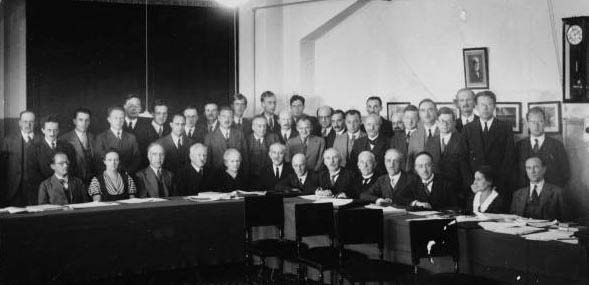
It is always dangerous to read too much into a photograph, especially when one is armed with the facts of how it all turned out. But it’s hard not to look at a picture taken by Benjamin Couprie, in 1933, at the seventh annual Solvay conference, without imposing some kind of narrative on the woman seated in the front row, second from the left. Flanked by Nobel Prize winning physicists James Chadwick and Louis de Broglie, Lise Meitner looks as though she is ready to absent herself not only from those assembled in the room, but from the picture itself, as though in anticipation of what the future held for her. Like a Polaroid in reverse, Meitner seems on the verge of vanishing.
Already in her mid-fifties when this picture was taken, so much of Meitner’s life and brilliant career—even up to this day in 1933, when she shared the platform with the most eminent practitioners in her field—was one of recognition withheld and titles rescinded (or belatedly bestowed.) For Meitner, the reasons for her being discriminated against on account of her gender would have been nothing new, despite being among the first generation of Viennese women to be educated beyond the age of 14; she was also one of the first women to study physics in Vienna, and the second to complete her doctoral thesis in theoretical physics. But in 1933, when Meitner and her long-time collaborator Otto Hahn headed up the Department of Chemistry at the Kaiser Wilhelm Institute, in Berlin, the prejudice was doubled on account of her race. Part of what Meitner would have encountered, which included the withdrawal of her professorship, is described by Clive James in the introduction to his book Cultural Amnesia:
“Even in Germany, where the Jews had full civil rights until Hitler repealed them, there was a de facto quota system in academic life which made it hard for people of Jewish background to be appointed to the faculty, no matter how well qualified they were. (The prejudice affected priorities even within the faculty: nuclear physics, for example, featured so many Jewish personnel mainly because it was considered a secondary field.)”
Thinking that her Austrian nationality would protect her, Meitner stayed in Berlin for a further five years, a decision she later referred to as “stupid” and “wrong”. Five months after her escape to Sweden via the Netherlands, Hahn published their simultaneous findings on nuclear “fission”: there was no mention of Meitner.
Eventually, recognition would be forthcoming; history would right the wrong. Albert Einstein referred to her as “our Marie Curie”, which is surely a more benign epitaph than “the Mother of the A Bomb”, especially as Meitner had been unequivocal in rejecting President Truman’s invitation to participate in the Manhattan Project: “I will have nothing to do with a bomb!” (She also rejected Hollywood’s advances.) For Meitner, science was a means for “people to reach selflessly for truth and objectivity; it teaches people to accept reality, with wonder and admiration, not to mention the deep awe and joy that the natural order of things brings to the true scientist.”
—MM
 Running From The Reels