ROBERT DE NIRO: DETAIL IN SERVICE OF THE TRUTH

Robert De Niro is regarded as one of the finest actors of his generation, but why was he so compelling?


Dear S,

It’s interesting how you frame the question in the past tense, as if De Niro no longer compels our attention. You’re not alone: David Thomson has spoken of De Niro’s “grievous decline”.  Perhaps it’s true and for me to insist otherwise would be foolish and sentimental.   I do know that your question is sincere.  You’re a lot younger than me and I guess you’re genuinely curious about De Niro’s early appeal.  Not that my youth coincided with De Niro’s great years: I came in at the tail-end—Once Upon A Time in America, Falling In Love—when video stores were in the ascendant, and it seemed as if there was an inexhaustible supply of great performances, in great films, that one could rent night after night. I remember being thrilled by each new discovery and buoyed by the prospect of there still being more to come. It was an education, of sorts.  Already you can see that I am being sentimental; I’m certainly romanticising my youth and the great days of Selecta Video.  So perhaps you were right to use the past tense. So where do we start?

De Niro was the A-list anti-star, but a star nonetheless. His reputation is built on that great run of films beginning with Mean Streets and ending with Once Upon A Time in America.  In between came The Godfather II, Taxi Driver, New York, New York, The Deer Hunter, 1900, Raging Bull, and The King of Comedy.  You have to admit that’s a hell of a run.  And it’s not that he hasn’t done good work in the years since—Brazil, Falling in Love, Midnight Run, Heat, Casino, Jackie Brown, Silver Linings Playbook—it’s just that decade-long run was truly special. For one thing, he worked less, averaging a film about every eighteen months.  He was more selective about who he worked with: Scorsese x 5, Coppola, Cimino, Bertolucci, Leone.  The climate encouraged maverick talent; novelists and filmmakers were central to the culture; film critics had influence—and an audience.  (Or should that be the other way round?)

But what was it about De Niro that made him so compelling? On screen, he seemed incapable of false moments (he still does), even in films that are beneath him, such as New Year’s Eve.  Off screen, he made himself scarce, rarely doing press.  Of course, like most well-known actors or movie stars, especially those with long careers, he can be reduced to a set of ticks and mannerisms.  But can’t we all?

When I think of De Niro, I think of his fierce artistic will—how else do you account for that great run of films as well as the physical transformations? And I think of his soulfulness. There was something mysterious about him—his stillness, his watchfulness.    I think of his eyes, particularly in Taxi Driver and Once Upon A Time in America. And I think of the choices he makes within a given role, which speaks of his special insight into the character he’s playing, or perhaps I should say “becoming”. It could be an item of clothing, a gesture, or simply his way of listening to another person. Over the years I got so bored with journalists’ tired run-throughs of De Niro’s method acting resume, but without any corresponding insights. So they might tell you that he learned to play saxophone for New York, New York, but they never point out that his timing is off when he counts in the band—a rare lapse. Or that he trained to be a boxer for Raging Bull, without acknowledging the way he moves when he’s not in the ring. And all that tired talk of De Niro’s weight-gain but no mention of Jake’s laboured breathing. (De Niro is one of cinema’s great listeners and breathers.)

So perhaps the best thing I can do is refer you to the films themselves, and to some of his most inspired choices, where De Niro is more than just the actor of his generation.  He’s that rare beast—the actor as artist, where the choices he makes are invariably true, unerringly specific, and so vital to these movies’ artistic accomplishments that it’s hard to imagine them having been made with anybody else.  Would it be wrong to say that he’s as much a presiding intelligence in these films as his directors? De Niro as auteur?  I’ve heard Tarantino make that argument—and he’s not far wrong.

Mean Streets (1973) —

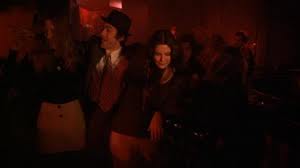
Did he ever act with such wild abandon again?  Of course, Scorsese gives him a helping hand, not one explosive entrance, but two: the first, literally, as Johnny blows up a mailbox, and the second to Jumping Jack Flash: Has there ever been a character in all of Scorsese’s oeuvre and his extensive use of the Stones back-catalogue more suited to their ramshackle symmetry?

clownish swagger

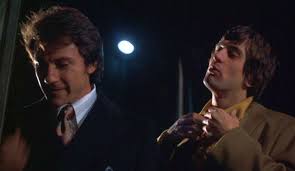
Inspired moment #1: Johnny Boy dancing to Mickey’s Monkey outside the car when it’s all falling apart.  Johnny Boy’s the joker in the pack, and De Niro the movie’s wild card! Sometimes, even Harvey Keitel can only look on in astonishment and wonder at De Niro, as if to say, where did this kid come from? But it would be wrong to talk about De Niro’s performance here without acknowledging Keitel’s great work, his simplicity and rock-solid presence.  The entire movie is a beautiful duet, best summed up by two scenes: the ‘improv’ in the “back room” early on, and the way they each lay out handkerchiefs on the gravestones in the cemetery—the Abbot and Costello of the Lower East Side.

bob & harvey

De Niro & Costume

De Niro’s choice of costume for his characters has always been impeccable. Johnny Boy may be wild, but he’s fastidious about the way he looks, and you can see this is not only in the way Johnny Boy dresses but in the way he readies himself in preparation to greet his friends in that second entrance—that is, once he’s put his trousers back on.  But there are countless examples of De Niro’s great costume choices: in Goodfellas, for example, when De Niro’s Jimmy Conway is arrested.  What struck me about De Niro’s costume choice here—a yellow jersey, jeans—was the level of detail for such a seemingly offhanded moment that takes place within a montage of arrests.  It can only be for a few seconds of screen time, but that yellow jersey speaks volumes.

De Niro & Detail

tan jacket

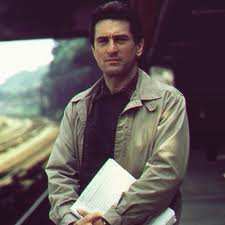
Talking about De Niro’s wardrobe tests for Falling in Love, and how he finally decided on the type of jacket his character would wear, Meryl Streep said… “[the jacket] was tan, it was ignorable, but that’s different from unimportant. Details are important, and Bob knows that.”

Taxi Driver (1976) —

Inspired moment #2: After shooting Sport (Keitel), Travis sits down in the middle of the street, between parked cars; it’s a strange and disconcerting moment—Travis’s body descending into trauma?—all the more so for being so unexpected.  Where did this detail come from? It seems so unforced: an actor’s truth transcending genre and pulp style.  In Scorsese’s early movies, life is always intervening and his actors respond in kind—at least that’s what it feels like.  But we’re also watching hungry, ambitious actors at the top of their game. Manny Farber and Patricia Patterson described Taxi Driver as “buzzing with star-turn acting”, which it is, though I’d call it an anti-star-turn very much attuned to a specific time and place: New York, 1970s, the Actor’s Studio: from street to (acting) class to screen, and hipper than anything Hollywood had to offer.   It was Farber/Patterson, in the same article, who wrote one of the best things I’ve ever read about De Niro: they refer to him as “a high-class actor…whose acting range is always underscored by a personal dignity.”  We must not forget that Farber, a great painter and critic, moved in the same circles as De Niro’s artist parents and would have recognised a fellow artist’s dedication to the truth: Negative Space, Farber’s singular collection of film writing, is dedicated to De Niro’s mother, Virginia Admiral; while De Niro, in those days, was the actor as termite-artist, prestige-resistant, burrowing through the Hollywood canvas.  (cf. New York, New York.)

Raging Bull (1980) —

Bouncer

Inspired moment #3:  When Jake and his brother Joey (Joe Pesci) attend St Clare’s annual summer dance, Jake sees Vicky (Cathy Moriarty) leave with a local mobster (Frankie Vincent). But it’s what happens next, when Jake helps a doorman evict someone from the club: it’s another lovely detail—casual, off the cuff, and exquisitely judged—that tells us about Jake’s place and standing within the community.  Detail in service of the truth. And let’s not forget Jake’s culinary advice—written or improvised?—to his first, beleaguered wife, as she cooks a steak: “don’t overcook it—it defeats its own purpose.” 

The King of Comedy (1983) —

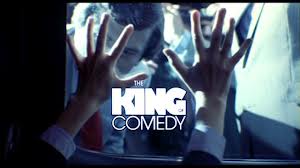
King of Comedy limo

From its homage to John Cassavetes’ Opening Night—a freeze-frame of a fan’s hands pressed against the window of a limousine—to its dissection of fame in the 20th Century post John Lennon’s assassination, The King of Comedy is a forerunner to Larry Sanders, with its behind-the-scenes look at a talk-show, and celebrities playing versions of themselves. Which makes Rupert Pupkin the patron saint of cable and reality television. So an argument could be made that Scorsese and De Niro’s fifth collaboration—and a commercial failure on its release—is the cornerstone of HBO’s present dominance. And—Hey Now!—don’t we see traits of Rupert Pupkin in Jeffrey Tambor’s Hank?  (Check out Season 2 episode Hank’s Wedding.) Rupert could certainly have played the role of Larry’s sidekick, if he hadn’t harboured such crazy ambitions to be out there on his own.  And Rupert is out there—a more psychotic version of David Brent, which brings us back to Larry Sanders (cf. The Office), HBO and the question of influence. (And I haven’t even mentioned The Sopranos.)   This is one of De Niro’s greatest performances, perhaps his best: inspired, uncompromising and—pre Midnight Run—very funny.

True Confessions (1981) —

Falling in Love (1984) —

Two Ulu Grosbard films. True Confessions was written by husband and wife team John Gregory Dunne and Joan Didion, and based on Dunne’s novel. Tonally it belongs to the 1970s—Chinatown is in its sights. You believe De Niro’s priest has said a thousand masses, and heard a thousand confessions; while Falling in Love is like a made-for-television movie devised by Lee Strasberg. Which is to say that Grosbard, a man of the theatre, is an actors’ director: the performances are full, rich, nuanced and textured. De Niro and Streep are heavy-weights in fluff and the film as comfort-inducing as the best carrot cake and coffee, but I much prefer it to Brief Encounter, to which it is often, and unfavourably, compared.

Heat (1995) —

Talking about the differences between De Niro and Pacino, Michael Mann described them in terms of colours: Pacino is “deep red”, De Niro “cool blue”.  For me, “cool blue” takes it. Pacino rips and roars—“Sit down, Ralph!”— while De Niro gives one of his great minimalist performances: his presence balancing Mann’s tendency towards verbosity: who needs Mann’s inflated dialogue when you’ve got De Niro? Mann certainly doesn’t.  But then the abiding impression the film leaves is a wash of “cool blue”.

Casino (1995)

Aside from a rare moment of levity—once again suited up but with his trousers off (cf. Mean Streets)—De Niro’s Ace Rothstein is cold, dead-eyed, cool and controlling, and Sharon Stone’s Ginger like a slot machine that can’t stop giving out, much to Ace’s displeasure. Was this his last great leading role?

Jackie Brown (1997)

“Sadness” is not a word one normally associates with the exuberant Quentin Tarantino, but there it is…Jackie Brown is both lovely and tough and features one of De Niro’s (and Tarantino’s) saddest characters.  Louis Gara (De Niro) gives off a sadness that I don’t remember from Elmore Leonard’s novel, Rum Punch.  It’s as if he’s experienced so great an internal collapse—too many joints, too much time in the joint—that death would be a welcome relief.  And when it comes, it’s heartbreaking: filmed from behind, a static camera, we don’t even see De Niro’s face: it’s all in his back and shoulders—forfeit, collapse, resignation.

—MM

“Think of this as time travel…” —extended take

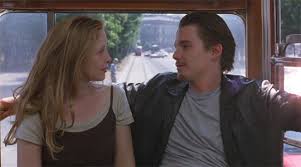
Who could have guessed at the impact of such a casual encounter?  In Richard Linklater’s Before Sunrise (1995), Jesse, an idealist young American travelling through Europe, tries to persuade Celine, a French woman he has just met, to spend the day with him in Vienna. Crucial to his line of reasoning is the idea of regret: what if they let this moment go and spend the rest of their lives wondering, well, “what if?”  So Jesse asks Celine to imagine a point in the future, ten or twenty years down the line, when life is no longer filled with the promise of youth:  “Think of this as time travel”, he tells her, “from then till now.” What might this potentially life-changing encounter, this interruption of the quotidian, mean to them as they approached middle age?

It’s a good question, and one that Linklater and his actors, Julie Delpy and Ethan Hawke, have attempted to answer on two further occasions: Before Sunset picked up Celine and Jesse’s story nine years later, while the third film in the series, Before Midnight, is scheduled for release in June of this year. With almost another decade since elapsed, Jesse’s remark—“Think of this as time travel”—now takes on an even deeper resonance—and not only for the film’s protagonists.

Not that we could have known—my wife and I—that a film we watched on a Saturday night, in April, 1995, would end up serving as a marker in our own lives.  How could we?  Back then, we were still ten years off being married. Not only that, but I doubt the filmmakers themselves had at that point conceived of returning to their fictional creations. Besides, Before Sunrise was not the kind of film that spawned sequels, and certainly not in the mid-1990s: studio-backed but “personal” and “independent”; episodic rather than plot-driven; and with long, languorous takes—it lived out of a backpack, as it were. But from the start it had the one special effect intrinsic to cinema itself: the concept of time.  Which makes it make it sound “heavy” for a Saturday night at the movies, though it was anything but.

In those (pre-congestion zone) days, we thought nothing of driving into the West End to see a movie.  And on the following Monday morning, when I returned to my job as a video buyer for HMV…Well, there you go: perhaps you can see what I’m getting at: video, HMV—how much has already gone to the wall. Or as Celine tells Jesse (in Before Sunset): “It’s about that moment in time that’s forever gone.”

Of course, it was only with the arrival of the second film that Linklater revealed the hand that had been there all along.  It took Before Sunset for me to see it. The actors had noticeably aged, especially Hawke, who looked as though the interim years had not been kind: the boyishness was gone, and when Jesse spoke of a marriage failing and of the love he felt for his son, it was as though Hawke was speaking, or at least writing, from experience. (Hawke is a co-writer on the film, along with Delpy and Linklater.) The euphoria and sense of possibility that the first film engendered had been replaced by a feeling of disappointment that is Chekhovian in its lament for lost time and unrealized dreams.

Before Sunset print

Photo: Steve Rooney

By the time Before Sunset came out (2004), I was working in cinema exhibition—cinema management, film programming and projection—and on at least three occasions screened the films in a double bill.  So I could see how each film deepened and enriched the other.  But even to write these words is to realize how much has changed in such a short span of time.  The idea of a “double bill” is almost a thing of the past. Since the release of Before Sunset, the cinema I manage has undergone both a name-change and, like many cinemas, its own technological revolution: films nowadays are rarely screened on 35mm prints.  When Before Midnight is finally released in June, it will almost certainly be digitally projected, with reels replaced by a DCP (digital content package). And where is the romance—the loveliness—in that?  But that is where we are: things change, losses accrue. We go on.

Before Sunset DCP

Photo: Matt Whitehead

In 2005 my wife moved to New York (for work), while I remained in London, which seemed—on the surface, anyway—a Jesse and Celine type predicament.  In reality, it meant I made numerous trips to New York, eventually moving there in the summer of 2007.  I spent a year walking the streets, exploring the canyon avenues (my own version of a long and languorous take). I went to the movies, subscribed to American magazines, looked after our old cat, and enjoyed a different kind of existence.  A friend asked if I was “re-inventing myself”.  I told him no, but I knew what he meant: I was exploring the “what if” of my own life.

In his review of Before Sunrise, The New Yorker’s Anthony Lane pointed out that Linklater had “managed to pull us back into that wordy, pleasantly confused moment of youth when people have the nerve—the pretension, maybe, but also the wit—to envisage their lives as a kind of literature, to imagine themselves sauntering gaily, or grimly, through one short story or another.”   I’ve never gone that far, though I certainly understand the impulse: the need to lose oneself, if only for an extended moment, in something other than reality: be it a movie, a three-minute pop song, or, in my case, books.  In New York, I spent an awful lot of time in second-hand bookshops, incorporating them into my daily routine, making my rounds like a doctor visiting his ailing patients: Skyline Books, East 12th Street Books—both now gone.  But the Strand Book Store is still there and I feel about The Strand the way E.B. White felt about New York: “If it were to go, all would go—this city, this mischievous and marvellous monument which not to look upon would be like death.” That is the kind of literary reference that Jesse would have reached for 18 years ago, as the sun came up in Vienna.  Back then, Jesse quoted Auden—As I Walked Out One Evening—but the sentiment is the same: time and mortality are the enemies.

I must have gone to the Strand at least once a week for an entire year, not always with the intention of buying something. Accounting for my hours-at-a-time absence, I referred to it as being “lost-in-Strand time”.  (I like to think that Linklater and his time-travellers might approve of such a concept.) But then I recalled—belatedly and after repeated viewings of Before Sunset—that Celine had once lived at 11th & Broadway, one block down from The Strand.  (She gives Jesse this information in the back of a car, in one of the series’ most heart-breaking moments.) Surely it was within the realm of possibilities—within fiction’s remit—that they’d come close to meeting each other here on previous occasions. (Jesse looks like a Strand kind-of-guy.) Or perhaps they’d even picked up the same book, seconds apart?  Or is that crazy? Is that just me, running away with the possibilities of “what if”? But one has only to look at some of the great writing the films have inspired to see I’m not alone in imagining a life (or several lives) for Celine and Jesse away from the screen. After seeing Before Sunrise, film critic Robin Wood wrote that “…the longing for permanence is so powerful that one would love to see a sequel (Celine and Jesse Go Boating perhaps) in which they did keep the appointment, returned together to…France? America?…and tried to work out ways in which ‘commitment’ is still feasible.”  Wood died in 2009, though his questions and insights are remarkably prescient: 18 years later, it looks as though they’re still trying to work it all out. Which is to say: is commitment ever feasible?

So perhaps you can see why this most casual of trilogies might exert a grip on its original audience. And why, from time to time, we like to check in on Celine and Jesse, with the corollary being: we’re checking in on ourselves. These films walk beside us, so to speak, echoing our concerns, while enacting and enjoying a flaneur’s privileges: walking, talking, dreaming—or “just bullshitting”.  Is it any wonder that, if you are a certain age and of a similar disposition, Linklater’s films occupy so much head space?  Or to put it another way: walking life as Waking Life.

In May 2008, as my year in New York was coming to its visa-imposed end—as London and “real-time” beckoned (and Celine hates “real-time”, though Before Sunset revels in it)—I stepped out of yet another bookshop, this time in Chelsea: 192 Books. As I walked up 10th Avenue I recognised a man in his late thirties; he was with his son. It was Ethan Hawke, or Jesse if you are given to speculating about fictional characters. He looked well, which made me think that Celine was back in his life.  At that point, I had no idea if another film was in the works; there were only rumours of a reunion. But here we are in 2013 and I’m not sure what to expect.

—Mick McAloon

Midnight ruins

LISE MEITNER: TRUE SCIENTIST


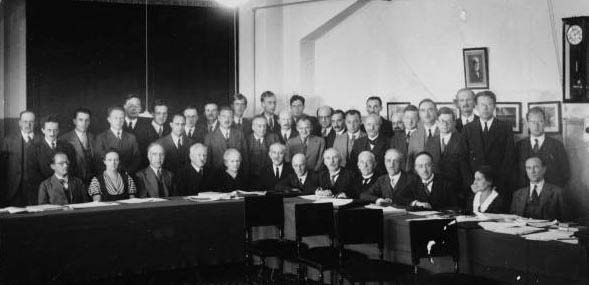
It is always dangerous to read too much into a photograph, especially when one is armed with the facts of how it all turned out.  But it’s hard not to look at a picture taken by Benjamin Couprie, in 1933, at the seventh annual Solvay conference, without imposing some kind of narrative on the woman seated in the front row, second from the left.  Flanked by Nobel Prize winning physicists James Chadwick and Louis de Broglie, Lise Meitner looks as though she is ready to absent herself not only from those assembled in the room, but from the picture itself, as though in anticipation of what the future held for her.  Like a Polaroid in reverse, Meitner seems on the verge of vanishing.

Already in her mid-fifties when this picture was taken, so much of Meitner’s life and brilliant career—even up to this day in 1933, when she shared the platform with the most eminent practitioners in her field—was one of recognition withheld and titles rescinded (or belatedly bestowed.) For Meitner, the reasons for her being discriminated against on account of her gender would have been nothing new, despite being among the first generation of Viennese women to be educated beyond the age of 14; she was also one of the first women to study physics in Vienna, and the second to complete her doctoral thesis in theoretical physics.  But in 1933, when Meitner and her long-time collaborator Otto Hahn headed up the Department of Chemistry at the Kaiser Wilhelm Institute, in Berlin, the prejudice was doubled on account of her race. Part of what Meitner would have encountered, which included the withdrawal of her professorship, is described by Clive James in the introduction to his book Cultural Amnesia:

“Even in Germany, where the Jews had full civil rights until Hitler repealed them, there was a de facto quota system in academic life which made it hard for people of Jewish background to be appointed to the faculty, no matter how well qualified they were.  (The prejudice affected priorities even within the faculty: nuclear physics, for example, featured so many Jewish personnel mainly because it was considered a secondary field.)”

Thinking that her Austrian nationality would protect her, Meitner stayed in Berlin for a further five years, a decision she later referred to as “stupid” and “wrong”.  Five months after her escape to Sweden via the Netherlands, Hahn published their simultaneous findings on nuclear “fission”: there was no mention of Meitner.

Eventually, recognition would be forthcoming; history would right the wrong. Albert Einstein referred to her as “our Marie Curie”, which is surely a more benign epitaph than “the Mother of the A Bomb”, especially as Meitner had been unequivocal in rejecting President Truman’s invitation to participate in the Manhattan Project: “I will have nothing to do with a bomb!” (She also rejected Hollywood’s advances.) For Meitner, science was a means for “people to reach selflessly for truth and objectivity; it teaches people to accept reality, with wonder and admiration, not to mention the deep awe and joy that the natural order of things brings to the true scientist.”

—MM

“Think of this as time travel…”


In Richard Linklater’s 1995 film Before Sunrise, Jesse, an idealist young American travelling through Europe, tries to persuade Celine, a French woman he has just met, to spend the day with him in Vienna. Crucial to his line of reasoning is the idea of regret: what if they let this moment go and spend the rest of their lives wondering “what if?”  So Jesse asks Celine to imagine a point in the future, ten or twenty years down the line, when life is no longer filled with the promise of youth:  “Think of this as time travel”, he tells her, “from then till now.” What might this potentially life-changing encounter, this interruption of the quotidian, mean to them as they approached middle age? It’s a good question, and one that Linklater and his actors, Julie Delpy and Ethan Hawke, have attempted to answer on two further occasions: Before Sunset picked up Celine and Jesse’s story nine years later, while the third film in the series, Before Midnight, is scheduled for release in June of this year.  Jesse’s remark—“Think of this as time travel”— now takes on an even deeper resonance—and not only for the film’s protagonists.

Not that we could have known—my wife and I—that a film we watched on a Saturday night, in April, 1995, would end up serving as a marker in our own lives.  How could we?  Back then, we were still ten years off being married. Not only that, but I doubt the filmmakers themselves had at that point conceived of returning to their fictional creations. Besides, Before Sunrise was not the kind of film that spawned sequels, and certainly not in the mid- 1990s: studio-backed but “personal” and “independent”; episodic rather than plot-driven; and with long, languorous takes—it lived out of a backpack, as it were. But from the start it had the one special effect intrinsic to cinema itself: the concept of time.  Which makes it make it sound “heavy” for a Saturday night at the movies, though it was anything but.

In those (pre-congestion zone) days, we thought nothing of driving into the West End to see a movie.  And on the following Monday morning, when I returned to my job as a video buyer for HMV…Well, there you go: perhaps you can see what I’m getting at: video, HMV—how much has already gone to the wall. Or as Celine tells Jesse (in Before Sunset): “It’s about that moment in time that’s forever gone.”

Of course, it was only with the arrival of the second film that Linklater revealed the hand that had been there all along.  It took Before Sunset for me to see it. The actors had noticeably aged, especially Hawke, who looked as though the interim years had not been kind: the boyishness was gone, and when Jesse spoke of a marriage failing one felt that Hawke was speaking from experience. (Hawke is a co-writer on the film, along with Delpy and Linklater.) The euphoria and sense of possibility that the first film engendered had been replaced by a feeling of disappointment that is positively Chekhovian in its lament for lost time and unrealized dreams.

By the time Before Sunset came out (2004), I was working in cinema exhibition—cinema management, film programming and projection—and on at least three occasions screened the films in a double-bill.  So I could see how each film deepened and enriched the other. But even to write these words is to realize how much has changed in such a short span of time. The idea of a double-bill is almost a thing of the past.  Since the release of Before Sunset, the cinema I manage has undergone both a name-change and, like many cinemas, its own technological revolution: films nowadays are rarely screened on 35mm prints.  When Before Midnight is finally released in June, it will almost certainly be digitally projected, with reels replaced by a DCP (digital content package). And where is the romance—the loveliness—in that?  But that is where we are: things change, losses accrue. We go on.

In 2005 my wife moved to New York (for work), while I remained in London, which seemed—on the surface, anyway—a Jesse and Celine type predicament.  In reality, it meant I made numerous trips to New York, eventually moving there in the summer of 2007.  When I wasn’t applying for jobs I spent a year walking the streets, exploring the canyon avenues.  I went to the movies, subscribed to American magazines, looked after our old cat, and enjoyed a different kind of existence.  A friend asked if I was “re-inventing myself”.  I told him no, but I knew what he meant: I was exploring the “what if” of my own life.

And then in May 2008, as my year in New York was coming to its visa-imposed end, I stepped out of a bookshop in Chelsea and recognised a man in his late thirties, walking up 10th Avenue, his son beside him.  It was Ethan Hawke, or Jesse if you are given to speculating about fictional characters. He looked well, which made me think that Celine was back in his life.  At that point, I had no idea if another film was in the works; there were only rumours of a reunion. But here we are in 2013 and I’m not sure what to expect.

—MM

Before Midnight (2013) Ethan Hawk Juli Delpy

MY FIRST ACQUAINTANCE WITH FILM CRITICS

There is no one clear route as to how a person becomes a reader and a lover of great literature; which is just as well, as I came to literature relatively late and in a rather roundabout way.  My route was via the cinema, and specifically the work of two film critics—Pauline Kael and David Thomson. I encountered them both when I was in my early twenties, at a crucial time in my life, and just prior to going to university.  Their work ignited something in me, and fired my imagination: how to think and talk about a work of art. But more than that, their work led me to other writers, as I began to discover, sometimes inadvertently, who had influenced them.  Reading became a way of connecting the dots, of tracing literary style across generations and genres. The field of my interest opened up: fiction, poetry, criticism, essays. And so did my life.

Although I read Kael before I read Thomson, and for many years would speak of Kael as my favourite critic, it is Thomson who has had the most lasting impact. Why this should be the case, I’m not so sure: I’m still trying to figure it out.  Kael’s style was conversational and had great immediacy, though I would later learn that she worked hard on these aspects of her writing.  Kael also benefited, especially in her early days, from writing film reviews for her own radio show; so from the start her writing had tremendous clarity and was geared to conversation. Here she is in 1963 ostensibly writing about the film Hud:

“The summer nights are very long on a western ranch. As a child I could stretch out on a hammock on the porch and read an Oz book from cover to cover while my grandparents and uncles and aunts and parents didn’t stir from their card game. The young men get tired of playing cards. They think about sex or try to do something about it. There isn’t much else to do—the life doesn’t exactly stimulate the imagination, though it does stimulate the senses.”

Like Hemingway and Raymond Carver, her style did not daunt those readers-cum-admirers hoping to emulate her—she seemed within reach. But for those very same admirers, the problem of influence arose later. For there was something about Kael’s rhythms—at once muscular and brusque and easy-going—that seeped into her protégés’ writings: not only did they ‘sound’ like her, it seemed as though they thought like her, too. Whereas Kael didn’t ‘sound’ or think like anyone except herself.  (Indeed, whenever I read Kael I am reminded of Saul Bellow’s The Adventures of Augie March and its famous opening sentence: “I am an American, Chicago born…and go at things as I have taught myself, free-style, and will make the record in my own way.”  Kael certainly did that—go at things her own way, and her record is considerable—though she was born not in Chicago but thirty miles north of San Francisco.)

But when it comes to writing—or anything creative for that matter—we’ve all got to start somewhere; I started with Kael. What I admired—and loved—about Kael’s writing was its idiomatic verve, its freedom, its lack of strain: her relaxed learning. For a long time, I didn’t read any other film critic. But I realized early on that I was susceptible to her influence: fledgling attempts at writing film reviews for the college magazine were full of Kael’s cadences.  My brother must also have recognised that I had a problem. As though staging a literary intervention, he bought me Thomson’s biography of Warren Beatty, though initially I would have read it only because in those days I was more interested in movie stars than in books—which is something I  later came to regret. But reading, and then re-reading, Warren Beatty and Desert Eyes: A Life and a Story, something clicked.  What was it?  Kent Jones, another great American film critic, says that Thomson’s is the “most seductive voice in film criticism.” So let’s just say that I was seduced, and that Thomson’s gorgeous style took hold: the warm and intimate tone; the playfulness and provocative re-imagining of film-makers and movie stars.  Here is Thomson on James Cagney:

“Cagney is charged with restlessness, and yet he always contrives to discharge the agitation daintily or with conscious style…No one could move so arbitrarily from tranquillity to dementia, because Cagney was a dancer responding to a melody that he alone heard.  Like a sprite or a goblin he seemed in touch with an occult source of vitality.”

But unlike Kael, Thomson has rarely held a regular film reviewing position, though he has written on and about film for numerous publications (The Guardian, Independent on Sunday, and The New Republic).  Indeed, I once heard Thomson publicly declare that he is “not a film critic”, which might seem perverse given his status within film criticism circles.  So what does he do, exactly? Perhaps the answer can be found in his most famous and influential book, A Biographical Dictionary of Film, and the entry on Graham Greene.  Of Greene’s film criticism, Thomson writes: “The reviews are good reading still because of Greene’s range and the bite of his observations. The films were a trigger for life, or for his novelizing alchemy.”  It’s that “novelising alchemy” that is at the heart of what Thomson does—that “trigger for life.” He’s said as much himself. Referring to the Dictionary’s beginnings and its continuing appeal, Thomson described it as “somewhere between a memoir and a novel disguised as a reference book.  It’s meant to be read, in a way that you would read fiction.”  Or as the unreliable narrator in Thomson’s 1985 novel Suspects would have it: “poetry lurks in reference-book style.”

Of course, when I first read Thomson I was unaware of all this.  I simply fell under his spell.  I was also in that great position of discovering a writer in mid-career, so not only could I look forward to his new books (of which there have been many), but there was a back catalogue that I could work my way through.  I was able to see how he arrived at…himself.   So a new influence took root in the garden that Kael cultivated.  But as Thomson himself once told me, as if sensing how much his work meant to me:  “I think when a writer immerses himself in some other writer’s work, you’ve got to be very careful—you’ve got to keep a towel with you to dry it off.”

—Mick McAloon

THE MASTER: ALL AT SEA

Paul Thomas Anderson’s new film is another strange masterpiece about two men who fulfil a mutual need. But unlike the wildcatter and the preacher in Anderson’s previous film, There Will Be Blood, the two protagonists here—a demagogue and a drifter—never quite stake a claim on what it is they actually want.  Lancaster Dodd (Philip Seymour Hoffman) takes to Freddie Quell (Joaquin Phoenix) as though he were a long lost brother, while Freddie seems bemused, if not entirely seduced, by the man known as “Master”.  And without seduction, where does that leave betrayal? Besides, Freddie just wants to believe in something, as his own self-belief seems to have been obliterated even before he saw action in WWII. That their paths should cross at all has the ring of a fairy tale, given that Freddie happens upon Dodd’s moored yacht, the Alethia, late one night. Dodd’s ship is certainly alluring—bright lights, music, revellers—and to a troubled soul such as Freddie, the promise of all of these things is enough for him to jump aboard, which Anderson covers in a lovely, fluid tracking shot that takes in Freddie’s somnambulant approach, the blur of the ship’s lights (or Freddie’s blurred vision), as well as his leap into the unknown.  “You’re at sea”, he is told on waking.

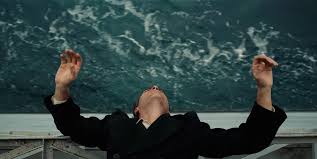
But then so much of Anderson’s movie takes place on the ocean, beginning with an image of swirling, turquoise water: hypnotic and dream-like, it’s utterly ravishing. Anderson will return to this image like a man fixated—like Freddie, perhaps—using it as a kind of poetic punctuation and as a way of binding his story’s seemingly disparate elements—its abrupt and bold narrative shifts, its sense of journeys undertaken. But the more I thought about Anderson’s film afterwards—and it’s a film that stays with you—I kept coming back to this moment. For in the context of the story he’s telling, and its deft, almost musical placement within the film’s gorgeous flow, it is arguably the film’s most essential image. Sure, there are greater sequences—as you’d expect from the director of Boogie Nights, Magnolia and There Will Be Blood. But none are as potent as this one. What is Anderson suggesting? That some people are destined to remain adrift—caught up in the current of their own longing.

—MM

GETTING PERSONAL

What is a “personal film”?  Is it simply a question of autobiography, a branch of life writing? Or do these so-called personal works transcend autobiography by using the tricks of fiction as a way to obscure—or enhance—the personal nature of the work?  And in the end, does it matter?  All artists draw from their lives, searching for ways to make sense of their experience: life becomes redeemed—and transformed—by art.    For certain types of artist—the confessional poet and the personal essayist, say—the task is unambiguous, though not without ambivalence: the poet and the essayist are at the centre of their work.  They know it, and so does the reader, even though the poet and the essayist might employ sleight of hand as much as any creator of fiction. But what about the “personal filmmaker”, who at the outset almost has to claim her vision as “personal”, as if this declaration in itself was a way of vouching for the legitimacy of their work: it’s personal, therefore it must be true.  While those filmmakers that do not announce the personal nature of their films—Stanley Kubrick’s Eyes Wide Shut, Terrence Malick’s The Tree of Life—are subjected to intense speculation anyway, because of their reticence: what are they hiding?

Unlike the poet and the essayist the personal filmmaker rarely works alone. Financial and technical concerns affect aesthetics.  Casting choices simultaneously enhance and obscure first-person strategies.  So how does the work remain “personal” when so many people, and so many factors, are involved? And how does a critic write about “personal films” knowing that a moment they single out might be “the flash-bomb vitality that one scene, actor, or technician injects across the grain of film” (Manny Farber)?

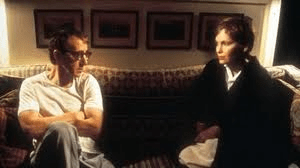
Getting Personal, a virtual season, sets out to cover the terrain of the “personal film” as practiced by a new generation of filmmakers—Noah Baumbach (The Squid and the Whale), Lena Dunham (Creative Non-fiction, Tiny Furniture, Girls); Mia Hansen-Love (Goodbye, First Love) and Joanna Hogg (Unrelated, Archipelago)—while drawing on the work of the “personal film’s” progenitors: Woody Allen’s “novels on film”, John Cassavetes’ psychodramas, and the essay-films of Chris Petit and Agnes Varda. It examines the way literature—particularly the essay—continues to influence movies, though not necessarily because of screen adaptations of books.  It asks the questions: why are these filmmakers flourishing now?  And what does our appetite for—and response to—works of a personal nature say about us?

—MM

Archipelago

Before I Forget

Content

Distant Voices, Still Lives

Goodbye First Love

Husbands and Wives

Jacquot de Nantes

Keep the Lights On

My Winnipeg

Something in the Air

The Squid and the Whale

Synecdoche, New York

Tiny Furniture

The Tree of Life

Unrelated

Weekend

AVAILABLE LIGHT

All of the faculty were excited, none more so than David.   He’d volunteered to make the six- hour round trip from Dartmouth to Great Barrington. It would be no trouble, he told his colleagues.  Besides, it would give him a chance to get to know Pauline.

He loved driving, especially the longer journeys.  Indeed, since arriving in America, it was one of the things he loved most, the feeling of no limits, expansiveness, freedom.  Back home, a journey like this—London to Birmingham, say—would have filled him with dread, but not here, in New Hampshire.  For one thing, the quality of light was different, and he had always loved American light, even though it meant he’d had to spend too much time in the dark in order to see it.  You see, in England he went to the movies; in America he took to the road.

As he followed the signs for the Berkshire Trail, David thought of Howard Hawks’s Red River.  He’d seen the film as a boy, but felt its impact all his adult life.  Pauline, he knew, was not a fan of westerns.  He guessed it was a question of temperament—plus, she had grown up in the real west. Still, she liked Hawks, particularly the comedies, and so did he; there’d be common ground. 

In one sense he felt as though he already knew her.  After all, he’d been reading her for years, first in Sight & Sound, where she would appear sporadically but always with an attendant fuss in the following month’s letters page—mostly by earnest young men offended by the force and confidence of her opinions. And he’d seized upon her first book, with its delicious, punning title. Now that he was in America, and she was at The New Yorker, he could pretty much read her every week and usually did. It wasn’t as though he always agreed with her—far from it—but she was lively and provocative and seemed—on the page, at least—to have nothing between herself and her voice: she came through unmediated.  He wondered where this quality came from—was it inherently American?  He had wanted to do something similar with his own writing—had longed to—but felt, until recently, that he was holding back.  Still, he was getting used to driving on the other side of the road… He caught himself in the mirror. One thing he was sure about: as much as he loved her work, he never felt the need—unlike some—to imitate her; he had his own thing going on and it had brought him this far: a new life in America, and all that that entailed—upheaval, people left behind, pain certainly, but most of all a newfound sense of himself. Besides, his book was out—his crazy book!—and it was causing a stir.  Elia Kazan had threatened to sue—now that was inherently American—while Michael Powell felt that, finally, someone understood him.  Both responses thrilled him, especially Mickey Powell’s, though he felt, mischievously perhaps, that Kazan’s litigious response was actually tacit confirmation of David’s instincts: he’d nailed the son of a bitch!

He’d had such a blast in the writing, though there were times when he thought the publisher might turn it down, that it was not what they’d signed up for—what kind of dictionary is this?—that it was not what he’d signed up for, but he couldn’t stop writing, making it more personal.  Night after night he acquired more pages, new entries, and all after long days spent teaching—and American students at that, far from home, as if in anticipation of his life to come.  And now the book was out there, blazing a trail, picking up its own passengers.

Had Pauline read it, he wondered. They’d spoken briefly on the phone the night before—she hadn’t mentioned his book, nor had he—but their conversation was just enough to get a further sense of the woman behind that voice.  He liked her, or so he thought. And it made him almost giddy to think he was going to have her all to himself for however long the journey took.  He couldn’t help but frame their imminent trip as a scene in a film.  He had always done this—life as movie, singular.  He chuckled to himself. He knew that Pauline was more “It Happened One Night” than “Journey to Italy”.  Still, it was the latter he had in mind as he turned down Route 102, deep in the heart of the Berkshires, with the rear projection for once looking like the real thing.  

—MM

AN INTERVIEW WITH DAVID THOMSON

MM: I’d like to read you something from your novel Suspects that I think applies to the Biographical Dictionary of Film. “There can be a lurking poetry in reference-book style…” Poetry lurks on every page—was this always the intention?

DT: Not originally. The dictionary was a very important book for me in that it was a learning experience about how to find a new voice for writing about films. The book, when it was planned, was meant to be a much more conventional reference book, to have a much more neutral, objective tone. But once I started working on it, I became bored with that, or I didn’t like it. So I began to generate a new voice, I suppose. And what I came to, I think, is a tone of voice that is much more like that of fiction, or maybe gossip. It’s as if the book is sort of saying, “We all know these people, let’s talk about them, let’s dish a little bit …. Let’s say what we really think about them.” It’s sort of like that. So I would say now, looking back on the Dictionary, it’s kind of somewhere between a memoir and a novel disguised as a reference book. It’s meant to be read, in a way that you would read fiction. And it’s very definitely, for good or ill—you might not like it always—it’s very definitely written. It’s quite mannered in terms of the way it’s written.

MM: Can you remember which entry first galvanised you, made you think that such a venture was possible?

DT: I think there were probably several. I knew increasingly as I went along on the book, and this was in the early 1970s really, that I was trying to get away from the voice of film criticism as known in England at that time. I wanted it to be more passionate. I wanted it to be funnier. I didn’t want it to be respectable. You ask about particular entries. I think that people like Cary Grant, Mitchum, John Wayne were helpful—and also I think the Marx Brothers. That was an entry I puzzled over a lot, because I’m a great lover of Groucho and I wanted to do something that was Grouchoesque. And I remember taking several shots at it before I got it right, and once I got it, there was a tone that I knew was going to help in other entries. So that was important. Also, a silly thing but not unimportant, the Angie Dickinson entry. I was crazy about her. I realise it was a daft sexual obsession, but why not say it? You know, because all of us I think have somebody like that—maybe more than one person—that we’re just daft about, and we know it’s not really entirely defensible or rational, but I think that’s how people are at the movies: we’re in love with certain people. So those entries, I would say, were all very helpful in getting towards a style of voice.

MM: Of course they’re all American. Was the fact that they were American influence the way you approached them in terms of the energy of the prose? Because there’s quite a marked difference between the style of your first book, Movie Man, and the Biographical Dictionary. What liberated you? Were there any English entries where you felt held back?

DT: Oh God, it’s a crucial question. You see, there was a very strange thing happened. When I undertook to do the book in the early Seventies, I had not been to America at all. I had the kind of sense of America that anyone has from Hollywood films, which is not necessarily accurate but quite deep. However, as I began working on this book, I began teaching American students—and these were students who had been sent over to England for a year abroad, that kind of program from a college in New England. I was teaching them film on an English campus …

MM: Where was this?

DT: The English Campus of the New England College in Arundel, Sussex. So I was suddenly in the middle of classes of American kids. And I had in my life before then encountered a few Americans—only a few. Now suddenly I was reading papers by, and talking to, people who talked American. Now that meant that they did not often talk very good English. And in terms of their being students, I was having to work on their English a lot. BUT it was wonderful because there was a return reward. Because the very language  that when they served it up in papers I would say, “No,no, no, there’s no verb in that sentence…”, I was actually feasting on it, because of the very things you’re talking about: that there is a kind of idiomatic immediacy that is wonderfully liberating. So it was a rich experience, and had a lot to do with the book. And then, of course, just after the first edition was published, I actually went to America. That was the beginning of what would become living there. When I went to America, I suddenly realised that if I was going to stay there, then I really faced seriously the question that I had discovered back in England: was I going to write English or American? Well, I think now I write something that’s in between, but I know that by the Eighties— it took that me long, it took five or six years—I felt I could write American talk, American dialogue. So that I couldn’t have written a book like Suspects until then because I just did not have the confidence to invent American voices and American talk. Now I’m not saying that all the American voices in Suspects are right, and that an American reader wouldn’t know it was an Englishman trying on the style. But I had got the confidence to do it, you know. And, for me, over the years, learning how to use American-English has been a tremendously exciting thing, because all those things—the wildness, the irreverence, the humour, the passion— it sort of helps them all [the entries].  And Americans interrupt each other a bit more than English people do—they shouldn’t, it’s rude in a lot of ways—but there’s an energy and an excitement. So you’ve put your finger on a very big thing for me. That’s sort of an explanation of the way the Dictionary’s gone.

MM: There seems to have been a split early on: Having to chose between going to Oxford or Film School. England and America. And clearly a love of literature and writing and a love of film. When you made the decision to turn down Oxford, did that trouble you at all?

DT: Yes, partly because it clearly troubled everyone else. My schoolteachers, who’d been preparing me to go to Oxford, and were doing a good job, were amazed and they thought it was crazy. And in a way it was, because the film school I went to—this was the London School of Film Technique—it’s improved, I think, a lot—but when I went there it wasn’t a very respectable school in that it was really up to the students to make the best of it. The teaching was not first rate, the equipment was not, and it was just not very well organised. And I know when I first got there—I knew what Oxford teaching was like because I’d been up there and taken some exams—I thought, “Oh my God, did I make the wrong decision here?” And also I would have to say for a long time afterwards, I was in a lot of ways set back a step, because the people I had grown up with, in three years, had university degrees which could get them jobs of the kind I couldn’t get. And there were times when I regretted it, when I thought I’d made a crazy decision. I certainly from the beginning had many arguments offered to me about how it was the wrong thing to do. But I’ll tell you frankly, I was just a bit bored with the way things were taught in school, and I thought three more years of that is not what I’m looking forward to. And although film school was a very chancy and inefficient place, the truth is I learned an amazing amount there. I fell in with a group of students, a lot of whom were older than I was—the students were often mature students. They had many more technical skills than I had. Many of them had done a lot of camera work and editing and sound. But the one thing I could do in this group that no one else in the group could do was think of a story. It was the thing that pointed me to the way writing might be where I should go. You know, I made a very big discovery in just a year. But yes, I had many doubts, and I still regret that I didn’t have those three years where you can read far and wide and the way you could just experiment. The split between a love of film and literature is still there.

I love films still. And I look forward, every time I go to the movies, to that great experience. I think I get it less often than I used to.  So that when you go to the movies, it’s a bit more of a gamble. But overall I am very suspicious about what over 100 years of film has done to our culture and our education. When I think of my own young children, TV obsessed, taking in an enormous amount of TV but not reading very much, it troubles me. And when I think of the whole culture, it troubles me. And I’m not sure when it is all said and done that it has been a great, good thing. And historically, I think that’s one of the most interesting questions. It’s a very old fashioned question, but I think it’s really worth asking. Something like: After 100 years do we think that movies have been for the good or for the bad? I think that’s a fascinating question. And I could go on arguing that with people for a long time, and I don’t know the answer. But I increasingly feel that while I can, I’d like to write a few more books, and they don’t have to be about film. I’d like to try and put them on the shelf. And yes, it’s been a great delight in recent years to begin to discover some writers I neglected probably because I was so into films.

MM: You talk about what 100 years of film has done to the culture. Martin Amis says Andy Warhol got it wrong: people won’t be famous for 15 minutes, they’ll be famous all of the time, in their own heads. Do you think that’s a condition directly related to the movies?

DT: I think that is a very good comment, and that is certainly something I was trying to get at at the thing at the ICA. I do think film has permitted and offered the ways and strategies for all of us to live in fantasy. And … when you see a thing like the sniper in the Washington area recently, I think that’s a very good example, because I think that’s probably an unhappy fantasist who gets pushed to the point of acting out. And America’s a country where that sort of thing happens a lot. Why it should be so is a huge question— you’d need an awful lot of space to go into it. But there’s something about the opportunity that America has offered to hitherto deprived or oppressed or underprivileged people that really seems to say, “You could be a contender, you could be big.” It’s like ‘the pursuit of happiness’. European countries that are much more cynical and seasoned and experienced wouldn’t dream of using a phrase like ‘the pursuit of happiness’ in their plans for how to live. Americans do it absolutely: they think they’ve got it. That’s the question: the pursuit of happiness.  And for a lot of people who are never going to be rich—and by definition only a few can be rich—never going to be beautiful, the same thing, never going to be famous—fantasy is the realm in which happiness is most possible. If you can believe you’re happy, in other words, if you’re king in your fantasy world, then you’ve made it, you’ve got somewhere. And, you know, this guy is famous now. I thought that Bonnie and Clyde was a movie that got it beautifully. I don’t know if the real Bonnie and Clyde were like this necessarily, but I think that Beatty got the way in which these were kids who wanted to be in the papers, who wanted to be famous, they wanted to get out of that anonymity. That’s a real ongoing drama in America, and fantasy—living out your dreams and sort of almost hardly realising how damaging the reality of your dreams maybe to others. I’m not defending this sniper, but I can believe that he hardly grasped the damage he was doing. He looked at those figures in the distance he was just dropping. And we’ve all seen movies that do that.

MM: Talking of fantasy and living in your head, were you ever tempted to include an entry on Bill Clinton?

DT: That is a brilliant question. I wish to God I’d thought of it, because I’d do it like a shot now. But what a great idea. I wasn’t smart enough to think about it.  I’ve written about Clinton, but that would be so suggestive of where we are now in the way in which public figures are actors, and he’s as good an actor as there’s ever been, in a way. God, next edition, he’s in.

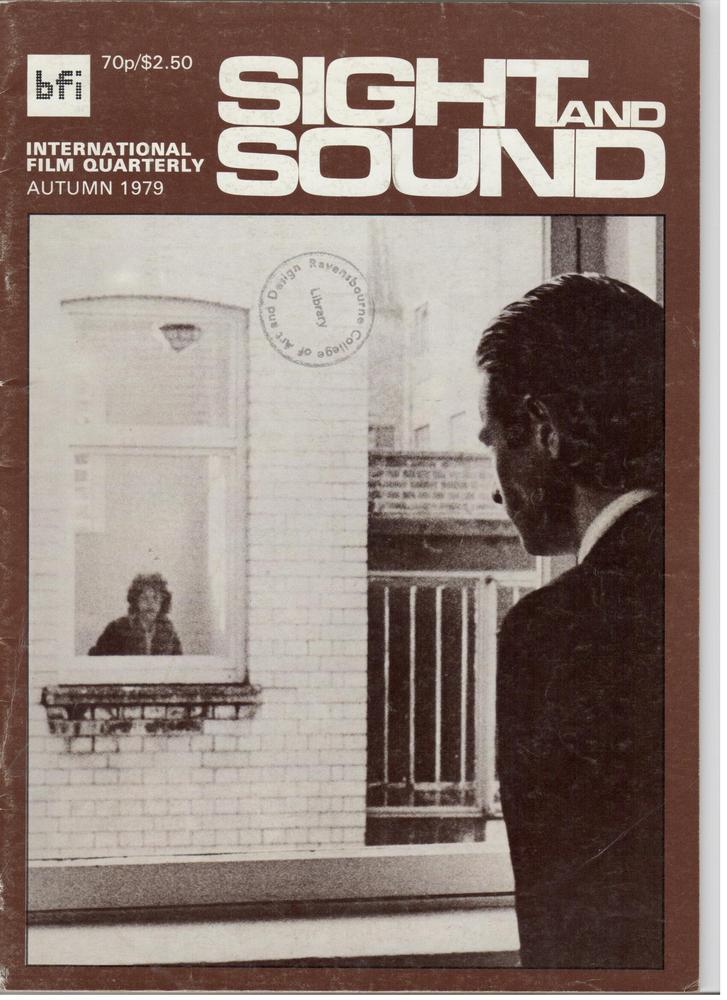
MM: Do you remember this Sight & Sound? It’s a piece on Nicholas Ray. [Autumn, 1979]

Sight__sound_autumn_1979_001
In_a_lonely_place_-_david_thomson_001

DT: Yes, sure.

MM: It starts in a very personal vein where you reveal your unhappiness with writing and movies, and you reveal the content of a letter from the then editor of Sight & Sound, Penelope Houston. For someone who has professed to being so shy, where does that urge come from to reveal oneself in criticism, and do you like to read it in others?

DT: Yes, I do. Where it comes from is…I don’t know that I can explain it. Something I didn’t say in the thing on Sunday [at the ICA], but which if I were to do it again I think I would because I think it’s important. As a child I stammered very, very badly and it was a real problem at school. It held me back a lot and I was naturally timid, shy—that sort of personality—but this intensified it. But I really got to the point where I didn’t want to go to school because I was just so worn out with being laughed at and being in these situations where I had to speak and the humiliation of it. Although I never wanted to be an actor, I do think that the fluency that actors have with words fascinated me and appealed to me enormously. And I think that most shy people long to tell their story. I think it can be overdone. I think that you have to be very careful. I think there’s a point at which the vanity of it becomes tedious and boring and you really have to keep a very sharp eye on it to keep it under control. But, for myself as a reader, I do love writing where the author somehow— and there’s a lot of different ways it can be done—where the author takes you, or plays the game of taking you, into their confidence—because it may be just a trick—about what they were thinking and feeling and what this piece or story meant to them. I’ll tell you a book that had a very big impact on me. Norman Mailer did a collection of his own writing in the Sixties called Advertisements for Myself. Do you know this book? Because I loved the way there was a kind of life story so that you had placed in perspective, in context, what these pieces had meant to him. And I met Mailer— later on, not until the Eighties—and we’re not close at all but I think we would think of each other as on good terms. But I’ve had a couple of really good conversations with him and I like him very much. I don’t think he’s the great American writer, but I love the way he works at writing and the way he’s happy to let that show.

MM: Did Mailer’s style influence you. I’m thinking particularly of his review of Last Tango in Paris, his book on  Ali-Foreman The Fight and Marilyn, where he does certain things that remind me of you.

DT: Definitely. Once I found Advertisements for Myself, which I think was the very first Mailer book I read—I might be wrong—which obviously had extracts from a lot of the earlier books, I just went back and read everything, and discovered The Deer Park. Do you know The Deer Park?

MM: I’ve got it. I’ve never read it.

DT: Well, I think you’d like it. It’s one of the best Hollywood novels. So I read everything, and I was very much under his influence for a while. You know, I think always when a writer immerses himself in some other writer’s work, you’ve got to be very careful—you’ve got to keep a towel with you to dry it off. Yeah, he meant a lot to me. There were a few American writers like that. He’s certainly one of them.

MM: At the end of your essay “In A Lonely Place” you write, “I was dismayed by the wave of shallow energy in young directors.” If you felt that then, in 1978/1979, when you were at the tail end of what is now considered a golden age in American cinema—how do you feel now?

DT: (laughs ruefully) Well, I … it’s horribly prophetic, it’s ghastly. I think that shallowness has become a personal style. It’s not just a handicap of character—it is actually brandished as a sign of virtue. There are people who believe to be shallow and to be flip about it is post-modern, ironic. And I think it’s horrible. There are some exceptions. I think there are some people around now who are different. But a lot of those directors of the 1970s burned out one way or another. And I think you can make a very fair case that the general factor that contributed to it was that they weren’t mature enough. They never found a way to mature. And I would say this: that I know more film-makers than writers probably, but the writers I know, and have known for a time—not always happily and well—they really have matured. They’ve grown sadder, wiser, darker—but they’ve grown. And you feel they’ve grown older. And you feel that the whole burden of experience has contributed to what you’re getting. And there’s a wonderful thing with a guy like Mailer, where you see his own youth bruised and battered. Whereas with the film-makers—there are exceptions—but with a lot of them you feel the grisliness with which they’ve tried to cling on to youth, to resist the growing older.

MM: He’s a great film-maker, but you’re tough on Martin Scorsese. Stephen Frears recently said in an interview that Scorsese had been heroic to have made the films he has within the Hollywood system. Do you agree?

DT: Yes. (pause) But I don’t think that’s the whole story. I think that he has also been tortured by not being able to make hits, by not being recognised by the Academy, by the box office at the level of, say, someone like Spielberg and Lucas. I think there is a very brave, almost reckless, side in Scorsese, but I do think also that he remains locked in this subject matter of wild young men, and as that he gets older, it begins to look and feel a bit more contrived. So, you know, with Gangs of New York—which I think is a really hugely important test film in so many ways—I would love to think that [it] will have the energy, the violence, the danger of Taxi Driver, say, and at the same time give you a real understanding of how a big American city evolved, so that you feel the history of it. I fear that it could be just another rhapsodising over wild young men. And I think he needs to get past that to make something else. So I am tough on him because I think he’s the very best. Mean Streets, Taxi Driver, New York, New York—a film I love—Raging Bull—great films, great films.

MM: You’ve said elsewhere that you’ve feared you were like Orson Welles, but in some ways do you see yourself in Scorsese—the child attracted to Hollywood. In America in the Dark, you describe Hollywood as a “fraudulent Eden” and talk of movies and the rapturous effect they had on you, and yet this seems to have troubled you, and in some ways your work is defined by this life long scepticism about movies. Scorsese seems to have had a similar experience, but whereas his rapture/love turned to making films, you turned to writing. Could you have gone down that route?

DT: I don’t know. I don’t have the constant, unflagging, outward energy that you need to get a film set up. I don’t have the patience to stick with a project for years when everything’s against it, and I’m probably not as natural collaborator in the way any film-maker has to be. But I’ve been drawn to that. I mean, I went to film school thinking in a very vague, idealistic way that that’s what I was going to do. I think I discovered that I was a much more solitary person, who works best on his own. But I think the task of making a film is fascinating. I love to watch the people who are doing it, see what happens to them. And I think it’s a very tough to sustain a career. When you look back to the so called golden days when people like Hawks just kept going, went from one studio to another, but it doesn’t seem to have effected him too much. I think what you forget is they had the assistance of a system. Every film now is set up uniquely, and so laborious. I like to curl up with a pad and a pen, you know, and start to invent. I’m not suited to that. I’ve done some directing of actors in the theatre and I’ve loved it. I would say it’s one of the most enjoyable experiences I’ve ever had.  

MM: You made some films with your friend Kieran Hickey, who is one of the entries in the Biographical Dictionary. Are they available?

DT: They’re in the Irish Film Archive. I know you can get them… I also did a documentary about the making of Gone With the Wind, which I enjoyed doing very much, although it was a different kind of film.

MM: In America in the Dark, you write of Citizen Kane ” I wandered into it because it happened to be showing at a local cinema” and that “It was like seeing the ocean for the first time…” There’s your physical response to it—you didn’t wander into the theatre, you wandered into Kane

DT: I had heard about Kane. I had been trying to read about the history of film and I had found a book that talked about it, and it sounded amazing. And all of a sudden the Classic in Tooting—it doesn’t exist anymore, I don’t think—suddenly announced—this was the mid- 1950s and I think it was because—I didn’t know this at the time—Orson Welles was in London working on stage and I suspect it was because he was causing a bit of a stir on stage that someone thought, “Let’s bring that film back”, you know. But, in those days, old films didn’t get revived very much. So if you hadn’t seen it when it came out, you went on hearsay. And I went down to this theatre the very first screening, and I was the only person there. But it was—I’m not the only person in the world of film who will tell you about the way their life was changed the first time they saw that film.

MM: You say” I wandered into Kane.” How can anyone of a certain age now wander into Kane with the same sense of surprise given its reputation and the Sight & Sound lists etc?

DT: Of course. And it’s the saddest thing about Citizen Kane that it’s become “Oh, that film.” And kids probably feel, “Well everyone knows that’s great, I’m not going to bother with it”, because kids like to discover things for themselves, and they should. It’s a real problem, and I don’t know what you do about it. I’m not saying that it shouldn’t be the best film. It’s a silly game, but it’s as good a candidate as any you’re going to find. And yet it’s turning the film into the very opposite of what it is. It’s turning it into a statue; it’s turning it into a dead monument. A young generation is going to suffer from that and probably, ultimately, it’s going to forsake the film, abandon it so that then in another—I don’t know how many years— it will be rediscovered. I think it has to happen. Because I agree with you entirely. A film only stays alive if enough young people are crazy about it. And at the moment, Kane has got such a vast cloak of respectability and prestige attached to it, that you can’t get at the real thing.

MM: In Rosebud you write: “I fear I’m like him. That Orson Welles took my life. By the time I realised it was too late to go back.” In what sense do you think you’re like him?

DT: The sort of jokey, playful, teasing manner that actually gets bored quickly with people. I always found Welles, from the first time I saw him on screen as a person—which I think must have been Harry Lime—I found him an unbelievably charming figure. He just seemed to me so seductive and appealing. And I collected Welles’ appearances, many of which are not very good in the obvious sense. But I loved him as a person and it has to be some very primitive response. I cannot verbalise it. There were ways in which I saw myself—in the youthfulness that has a hard time growing up, the charm that can turn very cold and bored: defects that I recognise in myself. Things like that. Immense concentration followed by irresponsibility. I’ve got some of those things. I don’t know… I’ve always felt an intimate involvement with him.

MM: When I saw you at the ICA, I was interested to hear you say that you do not consider yourself a film critic. I was talking to a friend about Jonathan Rosenbaum’s digs at you in Movie Wars, and I said, “Well, I think Rosenbaum’s missing the point: Thomson’s not strictly a film critic.” Then I saw the new entry on Graham Greene where you say of Greene’s film criticism that “the films were a trigger for life, or for novelising alchemy.” Could the same be said of you?

DT: I know that’s why I’m drawn to Greene, and so on. You know, I don’t know Jonathan, I’ve met him once or twice. He has a taste in films that is more avant garde than mine and I admire him for that, although we have some tastes that overlap. I think what he says is fair enough, because I lament the poor quality of many American films and don’t in turn spend enough time praising and sending people to the very experimental and non-English language films he loves. It’s a fair point; I accept it. But the fact is that I don’t like all of those films as much as he does, and also I’m very interested in mainstream films. I think that if film becomes as rarefied a form as, say, painting or theatre, then film will have lost a great deal. The question behind film and cinema is can it usefully and well serve everybody. I think that was always the great excitement in film at the beginning, and I think it’s vital to what it could do still.

MM: This time round, there are entries on film critics: James Agee, Graham Greene, Pauline Kael, Andre Bazin. What about Manny Farber and Robert Warshow?

DT: Manny Farber nearly went in. I mean, Warshow, again, could have been. When you’re doing this book, there’s always a deadline moment when they say “come on, come on, we’ve got to go, we’ve got to really put this in type.” And you race to get as many in as
you can, and there’s always someone left out. And I apologise for the omissions. I think Manny Farber should be in the book. He’s a wonderful writer. I’ve met him and I like him very much, and if I do it again there’d be some more people like that in there, and he would be there for sure. But I’ve begun to include film critics.

MM: Of Pauline Kael, you say you didn’t like her as a person but you loved her work. What did she think of your work? Did she ever comment on your work?

DT: No. She did not comment on my work, not that I’m aware of, not publicly. She didn’t like me; we didn’t get on.  She, quite early when I was at Dartmouth, she came up to lecture to a basic film history class. She had been invited by someone else on the campus she was friendly with. She lived close to Dartmouth, and I drove down to Massachusetts to pick her up, because I really wanted to meet her. So I drove her up—it was a several hour journey— but we were talking all the way and it seemed to be a perfectly agreeable conversation. And she came up to the class and she spoke—she spoke wonderfully—and then there was a sort of tea/meeting after the class, informal, not the lecture situation, where she was taking more sustained questions  from people. And it was a conversation, you know, and I chipped in a few times and disagreed with her a couple of times, and she really didn’t like it. Well, you know, I think in an academic setting you’ve got to be able to handle disagreement. When I ran a classroom, I tried not to run the classroom. I wanted the kids to say what they thought. I didn’t want them to feel like, “I can’t say that because I know he doesn’t agree and he’ll make fun of me”, and that sort of thing. That’s the very opposite of education. And I was really startled at her sort of nasty response, and we fell out from then on. She had a great need for followers who were obedient, and some young film writers went along with it, and they were on the phone to her all the time, and they echoed her views. And I just didn’t like that. I have never done anything to encourage that kind of following. You know, there are some young film writers—I think they like what I do a lot and we talk and that’s great; but, you know, I wouldn’t dream of the kind of policy statements she effectively issued. And I didn’t like it, and I thought that the more I learned about her, the less I liked her personally. BUT: she was a fabulous writer—I loved her writing very much. I didn’t always agree, but, you know, I don’t think that matters. I think that if you read something that’s well written, and if you disagree with every thought, you’re having a great time.

MM: The literary critic James Wood says that there’s a certain kind of novelist/critic who cannot resist “showing a little plumage” towards their subject.”  Does that go with the territory?

DT: There are some critics who are encouraged to be more showy than they ought to be.

MM: This is where I act like an aggrieved parent. Wes Anderson—only three lines, yet he’s made the same number of films as Tarantino, one less than PT Anderson.

DT: I miscalculated that. What I was trying to say was, “I think this guy is going to be wonderful.” But it came off with a different tone that was just bad writing. I know a couple of people who have said to me that what I’ve said is a little bit mean about him. And I didn’t mean that. I meant to say, “You like what you’ve seen so far? Yeah, me too. But it’s going to be better.” I think the two Andersons, I would say, are great reasons for hope. I think very highly of both of them.

MM: Do film-makers ever get in touch regarding things you’ve written about their work? I’m thinking in particular of a piece on Leaving Las Vegas, which was in Film Comment a few years back. Did Mike Figgis ever get in touch?

DT: He did. He was very grateful. [the studio] thought it was impossibly dark. And it happened at that time there was a publicist, a woman called Susan Pile, who was one of the great studio publicists in the game, with whom I’d worked in the past. And she got a notion to show me the film early. And she said, “I’m going to show you the film early, and if you don’t like it, ok, forget it, but if you like it—and I think you might—will you do an early piece on it that would give us a chance; because I need a strong piece in defence of the film to make the studio believe in it.” And I loved the film. And I did the piece, and it came out in the magazine, and she took the piece to the studio: “Look, we can build a campaign around this.” You know, they got three Oscar nominations. It didn’t work out badly. That was one of those moments when I felt I served a real purpose, but which I don’t think critics do often.

 —Mick McAloon

©



A HELLRAISER ASCENDS THE PODIUM

He came swaggering in, flanked by security, though I can’t say he looked as if he needed protection.  He looked like he was ready to start a fight himself—with himself.  His talented and beautiful wife was by his side, a picture of graciousness and serenity.  What was she doing with him, embroiled in his drama?  She seemed so much more reasonable than he did.   He was an “ass”; I had heard her say it.  So what was my excuse for being here—professional considerations aside—if not to play some part in his wild circus? 

Well, I thought he was a great actor; I still do.  From a young age he had tremendous presence, though sometimes he could overwhelm a project with his intensity, and also with his sheer unlikability.  Indeed, I admired the way he didn’t attempt to hide his obnoxiousness and actually pushed it out into the world, like it was a good thing; this seemed to make him rather appealing—endearing, even. For it takes great heart to be so unpopular on a global scale, especially in a profession where one of the perks is instant adoration.  But he was having none of that—adoration, I mean—least of all from the festival organizers, of which I was one.  He seemed determined to court unpopularity, controversy, in the same way that I had been willing to court him.  I have to admit that he was my idea.  Why?  I’m still trying to figure it out.  Of course, it boosted my standing within the programming team, gave me a leg up.  But everyone guards their kingdom, and I sensed immediately that some of my colleagues were no longer treating me as they had when I first arrived as a programming associate.  The situation made me think of something my wife said on our honeymoon when we had not yet shed our awkwardness: we were innocents in buffet world, still holding on to our plates, clasping them to our chests, when we should have been looking for knives.