Boyhood: Richard Linklater’s Ongoing Moment

Unfolding like one of Frederick Wiseman’s longitudinal portraits, and with the same cumulative force, Boyhood enacts a miracle. Over the course of its duration, a leisurely 166 minutes, we see a boy age from six to eighteen. There is no CGI or digital manipulation, as there was in, say, David Fincher’s The Curious Case of Benjamin Button. Fincher used motion capture, as well as prosthetics, to render the effects of age over time. Richard Linklater went about things in true Linklater fashion: he shot the film over a twelve year period with the same cast, including Ethan Hawke and Patricia Arquette, who play the boy’s parents. Hawke has likened the process and the resulting film to time-lapse photography, though it’s time-lapse without dissolves. Chapters begin and end without fanfare. Change is registered by a hair-cut or a growth spurt: inches for years, if you like; while revolutions in technology or the swell of a new cultural moment—yet more revolutions—provides us with further evidence that time has passed. Rich in feeling and ravishing to look at, Boyhood is both universal in its themes and distinctly American: it could easily have been called Family or Motherhood or This American Life.

How many films leave you truly satisfied? And how many contemporary filmmakers attempt what Linklater does here: to show you a person grow and change so that not only do you feel altered in some immeasurable way but actually feel concerned about that person’s future? At the end of Boyhood, which is as full and as rich as a great novel, yet as delicate as a poem, I wondered: what will become of Mason Evans? He doesn’t exist, of course. But our investment in Mason’s progress is deep, while our feelings are surely influenced by the knowledge that the young actor who plays him, Ellar Coltrane, has put in the hours. To paraphrase Godard, talking about Jean Rouch’s Gare du Nord: years reinforce years; when they really pile up, they begin to be impressive…

http://anosamoursblog.weebly.com/blog/boyhood-richard-linklaters-ongoing-moment-by-mick-mcaloon


“Think of this as time travel…” —extended take

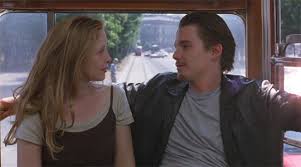
Who could have guessed at the impact of such a casual encounter?  In Richard Linklater’s Before Sunrise (1995), Jesse, an idealist young American travelling through Europe, tries to persuade Celine, a French woman he has just met, to spend the day with him in Vienna. Crucial to his line of reasoning is the idea of regret: what if they let this moment go and spend the rest of their lives wondering, well, “what if?”  So Jesse asks Celine to imagine a point in the future, ten or twenty years down the line, when life is no longer filled with the promise of youth:  “Think of this as time travel”, he tells her, “from then till now.” What might this potentially life-changing encounter, this interruption of the quotidian, mean to them as they approached middle age?

It’s a good question, and one that Linklater and his actors, Julie Delpy and Ethan Hawke, have attempted to answer on two further occasions: Before Sunset picked up Celine and Jesse’s story nine years later, while the third film in the series, Before Midnight, is scheduled for release in June of this year. With almost another decade since elapsed, Jesse’s remark—“Think of this as time travel”—now takes on an even deeper resonance—and not only for the film’s protagonists.

Not that we could have known—my wife and I—that a film we watched on a Saturday night, in April, 1995, would end up serving as a marker in our own lives.  How could we?  Back then, we were still ten years off being married. Not only that, but I doubt the filmmakers themselves had at that point conceived of returning to their fictional creations. Besides, Before Sunrise was not the kind of film that spawned sequels, and certainly not in the mid-1990s: studio-backed but “personal” and “independent”; episodic rather than plot-driven; and with long, languorous takes—it lived out of a backpack, as it were. But from the start it had the one special effect intrinsic to cinema itself: the concept of time.  Which makes it make it sound “heavy” for a Saturday night at the movies, though it was anything but.

In those (pre-congestion zone) days, we thought nothing of driving into the West End to see a movie.  And on the following Monday morning, when I returned to my job as a video buyer for HMV…Well, there you go: perhaps you can see what I’m getting at: video, HMV—how much has already gone to the wall. Or as Celine tells Jesse (in Before Sunset): “It’s about that moment in time that’s forever gone.”

Of course, it was only with the arrival of the second film that Linklater revealed the hand that had been there all along.  It took Before Sunset for me to see it. The actors had noticeably aged, especially Hawke, who looked as though the interim years had not been kind: the boyishness was gone, and when Jesse spoke of a marriage failing and of the love he felt for his son, it was as though Hawke was speaking, or at least writing, from experience. (Hawke is a co-writer on the film, along with Delpy and Linklater.) The euphoria and sense of possibility that the first film engendered had been replaced by a feeling of disappointment that is Chekhovian in its lament for lost time and unrealized dreams.
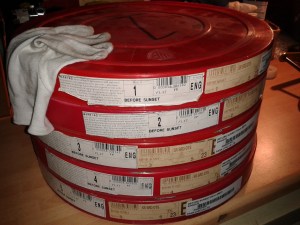
Before Sunset print

Photo: Steve Rooney

By the time Before Sunset came out (2004), I was working in cinema exhibition—cinema management, film programming and projection—and on at least three occasions screened the films in a double bill.  So I could see how each film deepened and enriched the other.  But even to write these words is to realize how much has changed in such a short span of time.  The idea of a “double bill” is almost a thing of the past. Since the release of Before Sunset, the cinema I manage has undergone both a name-change and, like many cinemas, its own technological revolution: films nowadays are rarely screened on 35mm prints.  When Before Midnight is finally released in June, it will almost certainly be digitally projected, with reels replaced by a DCP (digital content package). And where is the romance—the loveliness—in that?  But that is where we are: things change, losses accrue. We go on.

Before Sunset DCP

Photo: Matt Whitehead

In 2005 my wife moved to New York (for work), while I remained in London, which seemed—on the surface, anyway—a Jesse and Celine type predicament.  In reality, it meant I made numerous trips to New York, eventually moving there in the summer of 2007.  I spent a year walking the streets, exploring the canyon avenues (my own version of a long and languorous take). I went to the movies, subscribed to American magazines, looked after our old cat, and enjoyed a different kind of existence.  A friend asked if I was “re-inventing myself”.  I told him no, but I knew what he meant: I was exploring the “what if” of my own life.

In his review of Before Sunrise, The New Yorker’s Anthony Lane pointed out that Linklater had “managed to pull us back into that wordy, pleasantly confused moment of youth when people have the nerve—the pretension, maybe, but also the wit—to envisage their lives as a kind of literature, to imagine themselves sauntering gaily, or grimly, through one short story or another.”   I’ve never gone that far, though I certainly understand the impulse: the need to lose oneself, if only for an extended moment, in something other than reality: be it a movie, a three-minute pop song, or, in my case, books.  In New York, I spent an awful lot of time in second-hand bookshops, incorporating them into my daily routine, making my rounds like a doctor visiting his ailing patients: Skyline Books, East 12th Street Books—both now gone.  But the Strand Book Store is still there and I feel about The Strand the way E.B. White felt about New York: “If it were to go, all would go—this city, this mischievous and marvellous monument which not to look upon would be like death.” That is the kind of literary reference that Jesse would have reached for 18 years ago, as the sun came up in Vienna.  Back then, Jesse quoted Auden—As I Walked Out One Evening—but the sentiment is the same: time and mortality are the enemies.

I must have gone to the Strand at least once a week for an entire year, not always with the intention of buying something. Accounting for my hours-at-a-time absence, I referred to it as being “lost-in-Strand time”.  (I like to think that Linklater and his time-travellers might approve of such a concept.) But then I recalled—belatedly and after repeated viewings of Before Sunset—that Celine had once lived at 11th & Broadway, one block down from The Strand.  (She gives Jesse this information in the back of a car, in one of the series’ most heart-breaking moments.) Surely it was within the realm of possibilities—within fiction’s remit—that they’d come close to meeting each other here on previous occasions. (Jesse looks like a Strand kind-of-guy.) Or perhaps they’d even picked up the same book, seconds apart?  Or is that crazy? Is that just me, running away with the possibilities of “what if”? But one has only to look at some of the great writing the films have inspired to see I’m not alone in imagining a life (or several lives) for Celine and Jesse away from the screen. After seeing Before Sunrise, film critic Robin Wood wrote that “…the longing for permanence is so powerful that one would love to see a sequel (Celine and Jesse Go Boating perhaps) in which they did keep the appointment, returned together to…France? America?…and tried to work out ways in which ‘commitment’ is still feasible.”  Wood died in 2009, though his questions and insights are remarkably prescient: 18 years later, it looks as though they’re still trying to work it all out. Which is to say: is commitment ever feasible?

So perhaps you can see why this most casual of trilogies might exert a grip on its original audience. And why, from time to time, we like to check in on Celine and Jesse, with the corollary being: we’re checking in on ourselves. These films walk beside us, so to speak, echoing our concerns, while enacting and enjoying a flaneur’s privileges: walking, talking, dreaming—or “just bullshitting”.  Is it any wonder that, if you are a certain age and of a similar disposition, Linklater’s films occupy so much head space?  Or to put it another way: walking life as Waking Life.

In May 2008, as my year in New York was coming to its visa-imposed end—as London and “real-time” beckoned (and Celine hates “real-time”, though Before Sunset revels in it)—I stepped out of yet another bookshop, this time in Chelsea: 192 Books. As I walked up 10th Avenue I recognised a man in his late thirties; he was with his son. It was Ethan Hawke, or Jesse if you are given to speculating about fictional characters. He looked well, which made me think that Celine was back in his life.  At that point, I had no idea if another film was in the works; there were only rumours of a reunion. But here we are in 2013 and I’m not sure what to expect.

—Mick McAloon

Midnight ruins

“Think of this as time travel…”


In Richard Linklater’s 1995 film Before Sunrise, Jesse, an idealist young American travelling through Europe, tries to persuade Celine, a French woman he has just met, to spend the day with him in Vienna. Crucial to his line of reasoning is the idea of regret: what if they let this moment go and spend the rest of their lives wondering “what if?”  So Jesse asks Celine to imagine a point in the future, ten or twenty years down the line, when life is no longer filled with the promise of youth:  “Think of this as time travel”, he tells her, “from then till now.” What might this potentially life-changing encounter, this interruption of the quotidian, mean to them as they approached middle age? It’s a good question, and one that Linklater and his actors, Julie Delpy and Ethan Hawke, have attempted to answer on two further occasions: Before Sunset picked up Celine and Jesse’s story nine years later, while the third film in the series, Before Midnight, is scheduled for release in June of this year.  Jesse’s remark—“Think of this as time travel”— now takes on an even deeper resonance—and not only for the film’s protagonists.

Not that we could have known—my wife and I—that a film we watched on a Saturday night, in April, 1995, would end up serving as a marker in our own lives.  How could we?  Back then, we were still ten years off being married. Not only that, but I doubt the filmmakers themselves had at that point conceived of returning to their fictional creations. Besides, Before Sunrise was not the kind of film that spawned sequels, and certainly not in the mid- 1990s: studio-backed but “personal” and “independent”; episodic rather than plot-driven; and with long, languorous takes—it lived out of a backpack, as it were. But from the start it had the one special effect intrinsic to cinema itself: the concept of time.  Which makes it make it sound “heavy” for a Saturday night at the movies, though it was anything but.

In those (pre-congestion zone) days, we thought nothing of driving into the West End to see a movie.  And on the following Monday morning, when I returned to my job as a video buyer for HMV…Well, there you go: perhaps you can see what I’m getting at: video, HMV—how much has already gone to the wall. Or as Celine tells Jesse (in Before Sunset): “It’s about that moment in time that’s forever gone.”

Of course, it was only with the arrival of the second film that Linklater revealed the hand that had been there all along.  It took Before Sunset for me to see it. The actors had noticeably aged, especially Hawke, who looked as though the interim years had not been kind: the boyishness was gone, and when Jesse spoke of a marriage failing one felt that Hawke was speaking from experience. (Hawke is a co-writer on the film, along with Delpy and Linklater.) The euphoria and sense of possibility that the first film engendered had been replaced by a feeling of disappointment that is positively Chekhovian in its lament for lost time and unrealized dreams.

By the time Before Sunset came out (2004), I was working in cinema exhibition—cinema management, film programming and projection—and on at least three occasions screened the films in a double-bill.  So I could see how each film deepened and enriched the other. But even to write these words is to realize how much has changed in such a short span of time. The idea of a double-bill is almost a thing of the past.  Since the release of Before Sunset, the cinema I manage has undergone both a name-change and, like many cinemas, its own technological revolution: films nowadays are rarely screened on 35mm prints.  When Before Midnight is finally released in June, it will almost certainly be digitally projected, with reels replaced by a DCP (digital content package). And where is the romance—the loveliness—in that?  But that is where we are: things change, losses accrue. We go on.

In 2005 my wife moved to New York (for work), while I remained in London, which seemed—on the surface, anyway—a Jesse and Celine type predicament.  In reality, it meant I made numerous trips to New York, eventually moving there in the summer of 2007.  When I wasn’t applying for jobs I spent a year walking the streets, exploring the canyon avenues.  I went to the movies, subscribed to American magazines, looked after our old cat, and enjoyed a different kind of existence.  A friend asked if I was “re-inventing myself”.  I told him no, but I knew what he meant: I was exploring the “what if” of my own life.

And then in May 2008, as my year in New York was coming to its visa-imposed end, I stepped out of a bookshop in Chelsea and recognised a man in his late thirties, walking up 10th Avenue, his son beside him.  It was Ethan Hawke, or Jesse if you are given to speculating about fictional characters. He looked well, which made me think that Celine was back in his life.  At that point, I had no idea if another film was in the works; there were only rumours of a reunion. But here we are in 2013 and I’m not sure what to expect.

—MM

Before Midnight (2013) Ethan Hawk Juli Delpy

GETTING PERSONAL

What is a “personal film”?  Is it simply a question of autobiography, a branch of life writing? Or do these so-called personal works transcend autobiography by using the tricks of fiction as a way to obscure—or enhance—the personal nature of the work?  And in the end, does it matter?  All artists draw from their lives, searching for ways to make sense of their experience: life becomes redeemed—and transformed—by art.    For certain types of artist—the confessional poet and the personal essayist, say—the task is unambiguous, though not without ambivalence: the poet and the essayist are at the centre of their work.  They know it, and so does the reader, even though the poet and the essayist might employ sleight of hand as much as any creator of fiction. But what about the “personal filmmaker”, who at the outset almost has to claim her vision as “personal”, as if this declaration in itself was a way of vouching for the legitimacy of their work: it’s personal, therefore it must be true.  While those filmmakers that do not announce the personal nature of their films—Stanley Kubrick’s Eyes Wide Shut, Terrence Malick’s The Tree of Life—are subjected to intense speculation anyway, because of their reticence: what are they hiding?

Unlike the poet and the essayist the personal filmmaker rarely works alone. Financial and technical concerns affect aesthetics.  Casting choices simultaneously enhance and obscure first-person strategies.  So how does the work remain “personal” when so many people, and so many factors, are involved? And how does a critic write about “personal films” knowing that a moment they single out might be “the flash-bomb vitality that one scene, actor, or technician injects across the grain of film” (Manny Farber)?

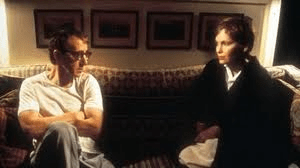
Getting Personal, a virtual season, sets out to cover the terrain of the “personal film” as practiced by a new generation of filmmakers—Noah Baumbach (The Squid and the Whale), Lena Dunham (Creative Non-fiction, Tiny Furniture, Girls); Mia Hansen-Love (Goodbye, First Love) and Joanna Hogg (Unrelated, Archipelago)—while drawing on the work of the “personal film’s” progenitors: Woody Allen’s “novels on film”, John Cassavetes’ psychodramas, and the essay-films of Chris Petit and Agnes Varda. It examines the way literature—particularly the essay—continues to influence movies, though not necessarily because of screen adaptations of books.  It asks the questions: why are these filmmakers flourishing now?  And what does our appetite for—and response to—works of a personal nature say about us?

—MM

Archipelago

Before I Forget

Content

Distant Voices, Still Lives

Goodbye First Love

Husbands and Wives

Jacquot de Nantes

Keep the Lights On

My Winnipeg

Something in the Air

The Squid and the Whale

Synecdoche, New York

Tiny Furniture

The Tree of Life

Unrelated

Weekend

DAVID MAMET’S HONEST HYPOCRITES

Whenever I watch David Mamet’s films, I am reminded of William Hazlitt’s brilliant essay on actors.  Actors, wrote Hazlitt, “are the only honest hypocrites.”  To which we might tentatively add those honorary members of the acting profession—the con man and the politician.  From House of Games to Wag the Dog, Mamet has presided over films that are like elaborate tricks, in which con-artists act out roles in exquisitely designed scams.  Whichever way you look at it, somebody is always being duped—and that includes us.

In Redbelt, Mamet’s ninth film as a writer-director, it’s Mike Terry (Chiwetel Ejifor), a jiu-jitsu instructor, who gets seduced by Hollywood-types and scammed by fight promoters, all in the name of entertainment.  Money’s involved, as it usually is in Mamet, and pride and honor is thrown into the mix.     Mike is ex-army, though what he did “out there”—presumably Iraq —is only briefly alluded to. (Mamet has always resisted back-story.) Mike runs a jiu-jitsu academy in L.A., training, among others, cops and doormen in the art of self-defense.  Two incidents early on trigger the plot. In the first, a woman (Emily Mortimer) enters the academy and (inadvertently) shoots out a window, narrowly missing one of Mike’s cop-students.  In the second, Mike comes to a movie star’s rescue in a nightclub brawl.  Both scenes establish Mike’s character—honorable and tough.  And both leave him vulnerable to outside forces.  The film charts Mike’s journey from idealist to practical idealist.

Mike’s idealism is taken for weakness, though his wife would probably call him naïve, or at the very least mock his purity.  Mike is a fighter who refuses to fight—“competition weakens the fighter”, he tells her.  His wife sees this adherence to a code as a refusal to participate in the messy business of life.  She would seem to be the practical one.  Where Mike talks in such abstract terms of not wanting to bring shame or dishonor upon the Academy, she just wants to keep the damn thing open, trading for business.  Money’s tight, a problem which becomes further exacerbated after Mortimer’s explosive entrance. When we first see Mortimer, she’s driving through LA in search of a prescription: cascading rain, agitated wipers, and deserted streets. Things are that bad you half expect her to run into Julianne Moore and Magnolia’s biblical downpour. Mamet has always loved noir’s theatrical landscape, a place where he can house his games.  Redbelt, then, has one foot in noir and the fight picture, while simultaneously reaching for the nobility of the Samurai film.  Certainly, Ejifor’s performance, and the role as written, is more in keeping with the latter. It’s a lovely performance—calm, centered, physically contained, and not unlike Val Kilmer’s Special Forces operative in Spartan, though Kilmer had his own cool, quizzical thing going on.

Although Mamet works predominantly within established genres, there is always something fresh about his approach.  He moves into genre as one might move into a listed building: he respects the architecture, the building’s history, but makes it feel like home—Mamet world—filling it with the people and the things he likes. His films constitute a democracy ruled by a tyrant: actors and non-actors happily co-exist; the movie star and the repertory player are equally at home; and there is always room for family and friends (Rebecca Pidgeon, William H. Macy, Joe Mantegna, and Ricky Jay).  But all toe the Mamet line (or lines). His famously profane speech is as distinctive and as metronomically precise as a Philip Glass score: tick-motherf***ing-tock. At its best (American Buffalo, Glengarry Glen Ross,) Mamet’s dialogue gives the impression of being ragged and wild, though it is anything but; at its most jarring, the actors speak as though listening to a click-track.  Control is Mamet’s thing, and he rarely loses it.   (Or as Mike puts it, “take the fight out of your face.”)

This extends to his mise-en-scene, which, understandably, is often overlooked because of the dialogue.  Like Robert Bresson, another advocate of non-actors, Mamet constructs sequences from uninflected shots and uninflected performances—Mamet’s dialogue is inflected enough.  But as Phillip Lopate suggested, as early as Homicide (1991), Mamet has been “evolving a personal cinema which may yet stand comparison with that of anyone of his generation.”  I agree.  Think of those modern juggernaughts of genre, the Oceans and Bourne trilogies, fast and slick, franchise-ubiquitous, whose roll-out and distribution patterns enact a kind of zoning—the Starbucks of the multiplexes. Then think of Mamet’s versions (Heist, Spartan), which are bespoke by comparison, European in sensibility, despite the Americanness of the dialogue and the roll-call of Great American Actors who have lined up to shoot his intoxicating breeze—Newman, Pacino, DeNiro, Hackman. For over two decades, Mamet, no less than John Cassavetes or even Larry David for that matter, has been making a form of home movie but without venturing into the deeply autobiographical or personal nature of his plays (The Cryptogram, The Old Neighborhood).  (Although I’ve long thought that the wonderful scenes between Philip Seymour Hoffman and Rebecca Pidgeon in State & Main were a tribute to his wife.)  And then there are Mamet’s views on acting, best exemplified by William H. Macy.  You only have to see Macy in films that aren’t by Mamet (Fargo, Magnolia, The Cooler) to see the influence Mamet exerts on American film. And where would HBO (Entourage) and Showtime (Mad Men) be without  Mamet’s Men (Piven, Slattery)?

In the same way that Virginia Woolf’s unsigned essays for the TLS were manifestos for the novel, as Woolf saw it, Mamet’s essays and books espouse a theory—his theory—of filmmaking and acting, which the films admirably demonstrate.    Mamet is the practical idealist.  The book he wrote for actors, True or False: Heresy and Common Sense for the Actor, is full of plain speaking advice: “…my views have been informed by and directed toward performance on the stage in front of a paying audience.  That is what acting is. Doing a play for the audience.  The rest is just practice.  And I see the life of the academy, the graduate school, the studio, while charming and comfortable, are as removed from the life (and the job) of the actor as aerobics are from boxing.” 

You could see this as further evidence of Mamet’s control extending beyond the confines of his film set or the rehearsal studio.  Or perhaps it’s simply Mamet’s way of keeping his own actors—his hypocrites—honest.

—Mick McAloon

NOAH BAUMBACH—Deja Vu

From its Eric Rohmer-inspired title, to its poster’s mid to late 70s art-directed aesthetic—with Nicole Kidman in profile, and that bright floppy hat a further giveaway—you could be forgiven for thinking you’d already seen Margot at the Wedding.  I know that’s how I felt prior to seeing the film at the NYFF in 2007.  I fully expected that there was going to be bookish talk by bookish people, and that the camera was going to be as skittish as Margot and her dysfunctional family.  Up on the screen it was going to look like life, while never letting you forget that you were watching a movie, with its abrupt and startling cuts which spoke of a filmmaker very much attuned to the romance of making a certain kind of film.  All at once it was going to look natural and airy, yet also muted, as though all of the colours had been drained in advance so that Noah Baumbach would never have to worry about his film becoming dated.  (It’s like longing to make a dirty-sounding record in an era of clean technology.)  In other words, Baumbach (along with Harris Savides) dated the movie himself. He did something similar with Greenberg.  The mores and manners belong to contemporary times, but the atmosphere evoked is of an earlier period of American film-making.

—MM

THE TREE OF LIFE—A Death in the Family


Terrence Malick’s The Tree of Life feels as though it has been made with a great sense of freedom.  I agree with A.O. Scott’s remark in his NY Times review that “To watch ‘The Tree of Life’ is, in analogous fashion, to participate in its making.  And any criticism will therefore have to be provisional.”  So provisionally I would say that it’s like a home movie, albeit the most expensive of its kind.  (It’s also like a dream.) The camera stays close to the actors—like a dad with his Super 8—but the actors lead the way.  Malick’s cinematographer, Emmanuel Lubezki, understands and anticipates movement with a sure sense of how something might cut together.  In that regard, it’s like an improvised dance film.   The sense of freedom is so great that it begs the following questions: Was there even a script, and if so, what did it look like?  What did the rehearsal / shooting process entail?  What constitutes the offer of a role for an actor in a TM film? And for that matter, what constitutes character? I would not be surprised to discover that there were only notes or ideas for scene.  For the film is surely process-led.  Not that the means of its making should matter—not in the end, anyway: it is what we’re left with that counts.   And what we’re left with in this instance, I would say, is a very personal film—autobiographical by all accounts—ostensibly about grief. I found it compelling, and in places very moving. Yes, the birth of creation is in there too, but to me that’s just conjecture, and Malick is free to make it, whereas the grief is palpable.

In Malick’s films people are at the mercy of the elements, mental weather included. In The Tree of Life, a middle-aged man (Penn) remembers his childhood in Waco, Texas in the 1950s.  He is still trying to come to terms with death of his younger brother, a death we never see.  He looks haunted (and Penn looks suitably ravaged).  We gather that Jack is an architect.  There are sketches of scenes in, presumably, Jack’s offices, a gleaming, glass-fronted tower in present-day Austin, Texas.  And these scenes really are sketches, the closest the film comes to a form of conventional exposition.  We see him point to blue-prints and take calls.  We see him in an apartment with a woman.   But he inhabits neither of these spaces: he is a ghost of his own life.  But the soul of the film—if a film can be said to have a soul—exists in Jack’s remembrance of childhood: his domineering but no less loving father (Brad Pitt), his beautiful and graceful mother (Jessica Chastain), and his two brothers.  This, to me, is the richest section of the film, and the most moving. And to remember it afterwards, in analogous fashion, is to participate in its protagonist’s consciousness.

Of course, that is only a nominal description of what the film is about, with the emphasis on synopsis, and the chronology ironed out.  What it is is another matter.  It is common-place for filmmakers to say that films are written three times: at the writing stage, obviously; during shooting; and finally—and perhaps, most importantly—in the editing.  I’d guess that Malick found his film during shooting and continued to find it right up until it was locked.  (Perhaps for Malick there was a reading stage–a lifetime of reading!) There is barely a conventional scene in it, and you can kiss goodbye to the notion of a three-act structure.  With his elliptical style at its most extreme, Malick’s film “flashes by” in a ribbon of images, presumably as a way of putting us inside Jack’s head: “Unless you have loved, your life will flash by”. We move from childhood to adulthood in a cut, and back again. (It is simultaneously fragmented and continuous.)   I love the way Malick’s film rustles into being, its sense of immediacy: a girl looking out of a barn window onto a field, the marriage of image and music, the sense of wonder at the world.  At its rhapsodic best, it floats free of its baggage—the profundity of its themes, the fame of its stars, the weight of (our) expectation.   It held me from beginning to end. Not that I went with everything.  The much talked about dinosaurs, for example, left me puzzled. But this was more to do with how they are rendered on screen than any philosophical inquiry on the part of Malick.  The CGI seems at odds with a filmmaker who is a natural with natural light and relishes the unplanned and unforeseen.

—MM