Program Notes: Boyhood

By virtue of its unusual production history, Boyhood gives us two films in one: a work of fiction spanning twelve years in the life of a young boy growing up in Texas; and a shadow-documentary which escorts its fictional counterpart each step of the way. How could it be otherwise given Richard Linklater’s singular decision to shoot the film over a corresponding period of time, and with the same cast? The actors age before us, though it is the evolution of Ellar Coltrane (who plays the boy, Mason) and Lorelei Linklater (his sister) that has the most resonance.

Like Truffaut’s Antoine Doinel films and Michael Apted’s Up series, Boyhood’s power is accumulative, though Linklater’s longitudinal study is a lesson in compression: he gives us the incremental bloom of Mason’s life, and all of its attendant experience, in less than three hours. The seamless and unannounced transitions that introduce each phase of his development elicit from the viewer a commensurate gasp of delayed recognition: look how he has grown! But underpinning it all is a feeling of concern and even suspense, no doubt generated by our awareness of the cast’s deep investment, as well as the onset of time: what will become of Mason/Ellar?

As we follow Mason through the commonplace rituals of an American childhood, we begin to see that one of Linklater’s achievements is to have created something unerringly specific, deeply personal, and universal. And whilst the film is something of a paean to parenthood (Ethan Hawke and Patricia Arquette are both subtle and true as the boy’s divorced parents), Boyhood’s real subject is time, unfolding as it does in a perpetual present tense.

—Mick McAloon

THE MASTER: ALL AT SEA

Paul Thomas Anderson’s new film is another strange masterpiece about two men who fulfil a mutual need. But unlike the wildcatter and the preacher in Anderson’s previous film, There Will Be Blood, the two protagonists here—a demagogue and a drifter—never quite stake a claim on what it is they actually want.  Lancaster Dodd (Philip Seymour Hoffman) takes to Freddie Quell (Joaquin Phoenix) as though he were a long lost brother, while Freddie seems bemused, if not entirely seduced, by the man known as “Master”.  And without seduction, where does that leave betrayal? Besides, Freddie just wants to believe in something, as his own self-belief seems to have been obliterated even before he saw action in WWII. That their paths should cross at all has the ring of a fairy tale, given that Freddie happens upon Dodd’s moored yacht, the Alethia, late one night. Dodd’s ship is certainly alluring—bright lights, music, revellers—and to a troubled soul such as Freddie, the promise of all of these things is enough for him to jump aboard, which Anderson covers in a lovely, fluid tracking shot that takes in Freddie’s somnambulant approach, the blur of the ship’s lights (or Freddie’s blurred vision), as well as his leap into the unknown.  “You’re at sea”, he is told on waking.

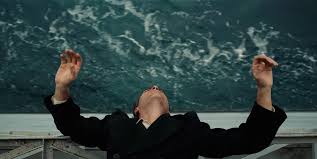
But then so much of Anderson’s movie takes place on the ocean, beginning with an image of swirling, turquoise water: hypnotic and dream-like, it’s utterly ravishing. Anderson will return to this image like a man fixated—like Freddie, perhaps—using it as a kind of poetic punctuation and as a way of binding his story’s seemingly disparate elements—its abrupt and bold narrative shifts, its sense of journeys undertaken. But the more I thought about Anderson’s film afterwards—and it’s a film that stays with you—I kept coming back to this moment. For in the context of the story he’s telling, and its deft, almost musical placement within the film’s gorgeous flow, it is arguably the film’s most essential image. Sure, there are greater sequences—as you’d expect from the director of Boogie Nights, Magnolia and There Will Be Blood. But none are as potent as this one. What is Anderson suggesting? That some people are destined to remain adrift—caught up in the current of their own longing.

—MM

DAVID MAMET’S HONEST HYPOCRITES

Whenever I watch David Mamet’s films, I am reminded of William Hazlitt’s brilliant essay on actors.  Actors, wrote Hazlitt, “are the only honest hypocrites.”  To which we might tentatively add those honorary members of the acting profession—the con man and the politician.  From House of Games to Wag the Dog, Mamet has presided over films that are like elaborate tricks, in which con-artists act out roles in exquisitely designed scams.  Whichever way you look at it, somebody is always being duped—and that includes us.

In Redbelt, Mamet’s ninth film as a writer-director, it’s Mike Terry (Chiwetel Ejifor), a jiu-jitsu instructor, who gets seduced by Hollywood-types and scammed by fight promoters, all in the name of entertainment.  Money’s involved, as it usually is in Mamet, and pride and honor is thrown into the mix.     Mike is ex-army, though what he did “out there”—presumably Iraq —is only briefly alluded to. (Mamet has always resisted back-story.) Mike runs a jiu-jitsu academy in L.A., training, among others, cops and doormen in the art of self-defense.  Two incidents early on trigger the plot. In the first, a woman (Emily Mortimer) enters the academy and (inadvertently) shoots out a window, narrowly missing one of Mike’s cop-students.  In the second, Mike comes to a movie star’s rescue in a nightclub brawl.  Both scenes establish Mike’s character—honorable and tough.  And both leave him vulnerable to outside forces.  The film charts Mike’s journey from idealist to practical idealist.

Mike’s idealism is taken for weakness, though his wife would probably call him naïve, or at the very least mock his purity.  Mike is a fighter who refuses to fight—“competition weakens the fighter”, he tells her.  His wife sees this adherence to a code as a refusal to participate in the messy business of life.  She would seem to be the practical one.  Where Mike talks in such abstract terms of not wanting to bring shame or dishonor upon the Academy, she just wants to keep the damn thing open, trading for business.  Money’s tight, a problem which becomes further exacerbated after Mortimer’s explosive entrance. When we first see Mortimer, she’s driving through LA in search of a prescription: cascading rain, agitated wipers, and deserted streets. Things are that bad you half expect her to run into Julianne Moore and Magnolia’s biblical downpour. Mamet has always loved noir’s theatrical landscape, a place where he can house his games.  Redbelt, then, has one foot in noir and the fight picture, while simultaneously reaching for the nobility of the Samurai film.  Certainly, Ejifor’s performance, and the role as written, is more in keeping with the latter. It’s a lovely performance—calm, centered, physically contained, and not unlike Val Kilmer’s Special Forces operative in Spartan, though Kilmer had his own cool, quizzical thing going on.

Although Mamet works predominantly within established genres, there is always something fresh about his approach.  He moves into genre as one might move into a listed building: he respects the architecture, the building’s history, but makes it feel like home—Mamet world—filling it with the people and the things he likes. His films constitute a democracy ruled by a tyrant: actors and non-actors happily co-exist; the movie star and the repertory player are equally at home; and there is always room for family and friends (Rebecca Pidgeon, William H. Macy, Joe Mantegna, and Ricky Jay).  But all toe the Mamet line (or lines). His famously profane speech is as distinctive and as metronomically precise as a Philip Glass score: tick-motherf***ing-tock. At its best (American Buffalo, Glengarry Glen Ross,) Mamet’s dialogue gives the impression of being ragged and wild, though it is anything but; at its most jarring, the actors speak as though listening to a click-track.  Control is Mamet’s thing, and he rarely loses it.   (Or as Mike puts it, “take the fight out of your face.”)

This extends to his mise-en-scene, which, understandably, is often overlooked because of the dialogue.  Like Robert Bresson, another advocate of non-actors, Mamet constructs sequences from uninflected shots and uninflected performances—Mamet’s dialogue is inflected enough.  But as Phillip Lopate suggested, as early as Homicide (1991), Mamet has been “evolving a personal cinema which may yet stand comparison with that of anyone of his generation.”  I agree.  Think of those modern juggernaughts of genre, the Oceans and Bourne trilogies, fast and slick, franchise-ubiquitous, whose roll-out and distribution patterns enact a kind of zoning—the Starbucks of the multiplexes. Then think of Mamet’s versions (Heist, Spartan), which are bespoke by comparison, European in sensibility, despite the Americanness of the dialogue and the roll-call of Great American Actors who have lined up to shoot his intoxicating breeze—Newman, Pacino, DeNiro, Hackman. For over two decades, Mamet, no less than John Cassavetes or even Larry David for that matter, has been making a form of home movie but without venturing into the deeply autobiographical or personal nature of his plays (The Cryptogram, The Old Neighborhood).  (Although I’ve long thought that the wonderful scenes between Philip Seymour Hoffman and Rebecca Pidgeon in State & Main were a tribute to his wife.)  And then there are Mamet’s views on acting, best exemplified by William H. Macy.  You only have to see Macy in films that aren’t by Mamet (Fargo, Magnolia, The Cooler) to see the influence Mamet exerts on American film. And where would HBO (Entourage) and Showtime (Mad Men) be without  Mamet’s Men (Piven, Slattery)?

In the same way that Virginia Woolf’s unsigned essays for the TLS were manifestos for the novel, as Woolf saw it, Mamet’s essays and books espouse a theory—his theory—of filmmaking and acting, which the films admirably demonstrate.    Mamet is the practical idealist.  The book he wrote for actors, True or False: Heresy and Common Sense for the Actor, is full of plain speaking advice: “…my views have been informed by and directed toward performance on the stage in front of a paying audience.  That is what acting is. Doing a play for the audience.  The rest is just practice.  And I see the life of the academy, the graduate school, the studio, while charming and comfortable, are as removed from the life (and the job) of the actor as aerobics are from boxing.” 

You could see this as further evidence of Mamet’s control extending beyond the confines of his film set or the rehearsal studio.  Or perhaps it’s simply Mamet’s way of keeping his own actors—his hypocrites—honest.

—Mick McAloon

NOAH BAUMBACH—Deja Vu

From its Eric Rohmer-inspired title, to its poster’s mid to late 70s art-directed aesthetic—with Nicole Kidman in profile, and that bright floppy hat a further giveaway—you could be forgiven for thinking you’d already seen Margot at the Wedding.  I know that’s how I felt prior to seeing the film at the NYFF in 2007.  I fully expected that there was going to be bookish talk by bookish people, and that the camera was going to be as skittish as Margot and her dysfunctional family.  Up on the screen it was going to look like life, while never letting you forget that you were watching a movie, with its abrupt and startling cuts which spoke of a filmmaker very much attuned to the romance of making a certain kind of film.  All at once it was going to look natural and airy, yet also muted, as though all of the colours had been drained in advance so that Noah Baumbach would never have to worry about his film becoming dated.  (It’s like longing to make a dirty-sounding record in an era of clean technology.)  In other words, Baumbach (along with Harris Savides) dated the movie himself. He did something similar with Greenberg.  The mores and manners belong to contemporary times, but the atmosphere evoked is of an earlier period of American film-making.

—MM

PREVIOUSLY…ON KEN LOACH

Few directors have been as consistent as Ken Loach in addressing present day realities.  His six-decade long career constitutes a long-running and ongoing dialogue with contemporary Britain and its place in the wider world, as though Loach himself was a kind of prestigious television serial or public broadcast service: Previously on Ken Loach.  I’ll resist calling him a brand—that would be too much for this man of the left—but with Loach you know what you’re going to get.

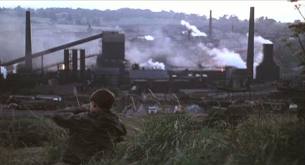
From the start Loach’s films were aligned with the working class (Cathy Come Home, Poor Cow, Kes). As such, he is the dominant figure in British social realism.  It would be easy to call him an institution were it not for the fact that he seems immune to such praise.  But there is no escaping the fact that Loach is a big-name director.  What is most remarkable is the absence of any vanity.  Loach’s directorial reticence is both his signature and his strength: the unobtrusive camera, the unadorned style, the feeling for people and place.  He has a documentary maker’s eye and a dramatist’s heart.  In that regard, he reminds me of Elia Kazan.  But whereas Kazan made stars of the wounded, Loach’s people are all too human.  So while Ricky Tomlinson (Riff Raff, Raining Stones) or Martin Compston (Sweet Sixteen) are rightly praised for their performances in Loach’s films, it is their characters’ stories that we remember afterwards: people not stars.  Some might disagree. Film critic Mark Cousins argues convincingly that cinema as a medium is inherently right-wing, and that leftist filmmakers cannot help but be affected, even Loach: “Loach’s minimally lit and designed films make heroic the Peter Mullens, Crissy Rocks and Robert Carlyles of their stories.”  But making heroes is not the same as making stars, and the left has always loved its heroes. I’d daresay Loach is one of them, but this most self-effacing of great directors would probably tell me to bugger off. Even his political epics (Land and Freedom, The Wind That Shakes the Barley) are shorn of grandeur.  Loach’s subjects are, of course, important to him—close to his heart—but his style is strictly lower-case.

—MM

ANIMAL KINGDOM—the Glamour and the Grunge


In his book ‘Cultural Amnesia’, Clive James writes that “the atmospherics of Michael Mann’s Heat affect the look of any movie made about crime: other directors, whether working out of the United States, Latin America, Europe or Hong Kong, either go with him, towards glamour, or go against him, towards grunge, but they always have his look in mind.”  There’s more than a touch of Heat to David Michôd’s Animal Kingdom, especially in its depiction of an armed robbery unit that is as wild and lawless as its quarry.  It also has that city-at-night feeling which Mann is so attuned to, though in this instance the city is Melbourne. But despite its cinematic influences (Goodfellas, Magnolia), Animal Kingdom is rooted in the real.   Michôd has spoken in interviews of wanting to “make a film that unlike, say, a Quentin Tarantino or Guy Richie crime movie, took itself seriously, and was set within a big, dark, nasty world, which was nevertheless still quite poetic and beautiful.”  In other words, Michôd goes for the glamour and the grunge.

From its stark opening (it begins with a bark) to its final confrontation (it ends with a bang), Animal Kingdom more than justifies its grand and arresting title. In its native land, it has been called “the Australian Godfather”, and one can see why: a terrific cast at the top of their game; a brilliant script which takes the sequence as its dramatic unit; a family drama in which the family’s youngest (and most innocent?) must make his way in the world.  Where it differs from The Godfather is in its sense of scale and ambition.  But then Michôd’s crime family is not as organised, nor as operatic, as Coppola’s: the Cody’s are not the Corleones, though what they lack in grandeur they more than make up for in their propensity for violence, betrayal, and incestuous feelings.

The film is loosely based on an actual incident in Melbourne’s recent history known as the Walsh Street Killings. But while Michôd uses this incident to ignite the film’s plot, he is after bigger game.  Like the recent Winter’s Bone, Animal Kingdom is about survival. Its teenage protagonist, Josh, must negotiate the perilous terrain of family—or at least his family.  His notorious uncles and grandmother, to whom he turns after the death of his mother, provide Josh with an unsentimental education: “We take it out on whoever turns up.  That’s what we do.”  It is left to Guy Pearce’s homicide detective, and the film’s moral centre, to guide Josh as best he can.  It is Pearce who supplies us with the film’s metaphor of the “animal kingdom”, telling Josh:”You’ve survived because you’ve been protected by the strong, but they’re not strong anymore.”

In case we were in any doubt about Michôd’s intentions, the film is full of bracing scenes in which the strong and the cruel survive at the expense of the vulnerable. Time and again we see goodness expunged, innocence corrupted. Watch how Michôd fixes on the smooth and youthful complexion of a rookie cop, his good manners, and his by-the-book approach as he responds to the report of a stolen car. This is just one of several extraordinary sequences. Already you sense that Michôd is one of those “sprinkler on the lawn” directors who can summon dread from the sweetest of sights. And unlike Josh, the influences that have shaped him (Scorsese, Mann, P.T. Anderson) have been all to the good. Josh has been raised by wolves and acts accordingly.

—MM