A CONVERSATION WITH KENT JONES

This interview was conducted at Film Society of Lincoln Center in June 2015 and originally published online at http://anosamoursblog.weebly.com/blog/june-08th-2016

Mick McAloon: So at what stage did you realise you wanted to be a writer?

Kent Jones: That’s funny that you should ask me that because I resisted the idea. Because I had people telling me you’re a wonderful writer. And of course when you’re young—at least that was the fashion when I was young, but that still seems to be the case because I see it in my son—but when you’re young and people tell you, “You’re great at this, and you should do this…” the response is: check: I’m not doing that. That’s off the list. Nobody gets to define me but myself. You all get to do it in public. I get to do it in private. Here’s what I’m doing. But of course: that’s just telling yourself something. So: I started writing when I was very young. And then I kept writing…

MM: What kind of writing? Was this fiction? When did the move towards writing about film happen, because I gather you’ve always loved film?

KJ: I’ve loved films since I was a little kid. But writing was separate, I think, in the sense that it was separated in the way that people talked about it. People never linked writing and film: they were two different kind of things, two different enterprises, two different worlds. For me cinema started as the faces of actors, movies on TV, and starting to see them in the theatre. But writing—I really liked just to write. It’s like Robert Creeley says: it’s not what you write; it’s the act of writing. I don’t know. I really liked writing stories, I liked writing plays. When I was a little bit older I got into writing criticism.  And then I got into criticism and was hired as a critic when I was 19.

MM: You must have been a great reader as well as a watcher of movies.

KJ: Yeah. I suppose that I was. And again it was sort of like. Why don’t you read more? OK I’m not going to read more. But, of course, I guess I did. I really loved Dashiell Hammett and Raymond Chandler when I was kid.

MM: In Physical Evidence you write of discovering or being given Andrew Sarris’s “The American Cinema” and Manny Farber’s “Negative Space”.  Both make for sophisticated reading, especially for one so young. Was the impact immediate or was it felt later?

KJ: With Andrew the impact was immediate. But it wasn’t just Andrew… it wasn’t Andrew’s writing; it was the categories, the hierarchies. As a writer, Andrew stayed within a very circumscribed territory. Even though I enjoyed reading his writing, it didn’t inspire me as writing. It was Andrew’s hierarchies and categories that got me, and they were connected with Richard Schickel’s TV show, The Men Who Made the Movies. Because the whole idea what is a director—that’s interesting, you know. What does that mean, that there’s a director? And then Manny, that’s something else. I saw the book. It had this cool cover. I bought it. And for years I would crack it open every once in a while and look at it. I had no idea what the fuck this guy was talking about. But I am intrigued. And that’s the way that it should be. If you read something and you don’t understand it, that’s fine.

MM: The intrigue is interesting to me. I didn’t discover Farber until the reprint of Negative Space in 1998. And one of my first thoughts on reading him was: Who is this guy?  Then there seemed to be a lot of activity: Chris Petit made a film…

KJ: Yes, Negative Space.

MM: …You wrote about Farber in Film Comment. He received a citation for his contribution to film criticism (1999). There was the NYFF poster 2001. Did your intrigue lead to look back and look for more? Because he wasn’t writing then…

KJ: He was teaching, in California. I lived in Massachusetts. I wasn’t going to hitchhike across the country to meet Manny Farber. But I did look for some of his stuff. I didn’t see his lecture in New York. [Farber gave a lecture at MoMA in the 1980s]  But I did look for some of his pieces in Film Comment. But that’s much later. I bought that book when I was 15. At a certain point it clicked. And again you’re dealing with the issue of understanding something. So I would read…. I would look at it on the page and [see] that’s a very attractive rhythm. That’s the thing: if you read and you try to understand absolutely everything then you’re not reading it. If you understand that writing is a matter of rhythm, and that a writer is engaged in rhythm and not just the translation of thoughts into language then you’re dealing with writing. With Manny as opposed to 90% of other critics—Pauline Kael being an exception—you’re thrust into the deep-end of rhythm right away. I related to him much more than Pauline Kael.

MM: He also had the capacity to describe movies in a tremendous visual way. Do you think that was because he was a painter?

KJ: Well, that question comes up a lot. It came up a lot for him, and he would always answer it in his combative, recalcitrant, barbing way. I think when he would say “well the two things were interchangeable”, I tend to agree with him, you know, having spent a lot of time with Manny in the last few years of his life, and Patricia [Patterson]. I think that he—he thought about writing in the same way that he thought about painting, sometimes to the detriment of the painting in the sense that some of the images that he painted were—during the period when he was relating movies to paintings—I think that those paintings were a little bit less interesting than the later stuff once he stepped away from teaching and he devoted himself to painting and he was just working with stuff from the garden and he wasn’t making calculations about how new it was, and how hip it was, and what the space was. Then I think it was different and freer. And I do think that something similar happened with the writing at a certain point. It got very self-consciously positioned in the way that it winds up in the very end, that those very last few pieces, being a little bit more dated than other pieces that he did simply because he was so conscious of what he was reacting against. Cause Manny was a very reactive guy. It was always: Who else is in the room? How can I get the drop on everybody?

MM: You recently wrote an essay about actors and film criticism which, among other things, looks at how Pauline Kael’s love of actors was central to her criticism. It also chimes with what you were talking about earlier. As actors become more career-oriented, so famous from such a young age, are the faces with experience coming through?

KJ: Every time is different, and every time has its own configuration. Those configurations are changing so quickly that people can’t always adequately describe them as they’re happening. For my generation, when we were growing up…My father was in World War II. Most people that I knew, their father was in either WWII or Korea. The faces that we identified with, the people that we identified with, Bogart in particular, whose work was very beloved on college campuses and by younger people at the time, you would see those movies in theatres playing for little runs here and there. Those were the faces that we identified with and the films that we identified with. And that was part of the idea of the world of movies—the past. Those movies were on TV all of the time.  There were posters all over the place of those guys, particularly Bogart, Cagney. I forget who else. And then you would have the actresses like Rita Hayworth, and things like that. And that was very present: Classic Hollywood, the Golden Age of Hollywood. There was the nostalgia industry. The people from WWII were getting older…And it seemed like that was always going to be there—that would be there forever.  And of course, when you’re young you think everything is going to be there forever.  And then of course as you get older you realize that things that seem like they’ll be forever won’t—may not be. Some things that seemed like they were going away come back in another form. All different kinds of things, you know, it’s the way you apprehend life. And so you had the memory—for me—I have the memory of those faces and the way that I related to them. And of course, part of it is that I’m older so I don’t relate to the face of Jake Gyllenhaal or Paul Dano the way that I do Bogart and Cagney. On the other hand, I have a different kind of relationship to Paul Dano. I’ve crossed paths with him personally a couple of times but beyond that—I’m talking about Paul Dano because I just happened to catch Love and Mercy the other night and I was amazed. I’ve always liked him. And he’s somebody who genuinely likes movies, which you can’t say of every actor. He knows his way around movie history; he reads film criticism. But I was staggered by what he did in that movie. It gave me a vision of Brian Wilson that I hadn’t really had. It’s a pretty striking movie. But he’s pretty astonishing in it. I guess it’s that sensation of getting older and the sense of time you hear people talking about. When I hear people talking about for instance Soundgarden in nostalgic terms, I find that so comical. Cause Soundgarden never meant anything to me to begin with and the idea that they’re already over and that they’re somebody to get nostalgic about is very funny. And then kind of poignant. The same thing with certain movies. I had a conversation with a cinefile that I know once and she was talking about how much she loved watching those great old 90s prints. And so, all four words together: Great. Old. 90s. Prints. She was just a younger person experiencing an emotion in the same way that I when I was younger would talk about the 1970s, when people started looking back at the 70s. That was the first series I ever programmed. [KJ programmed a series, “Out of the 70s’: An American New Wave” for Bruce Goldstein at Film Forum.] I guess that my answer to your question is that the faces that haunted me from when I was young still do pretty much. Bogart always will.  And I suppose that some people do now more than others but it’s not just their faces. I respond to the physical interaction between those people in The Best Years of Our Lives, for instance.

MM: Of course, there will always be faces coming through that we can’t take or eyes off. Joaquin Phoenix.

KJ: That’s true. You’re right. This is me personally: when I think of Joaquin Phoenix, I don’t think of his face. I think of his body in a Paul Thomas Anderson movie. I like him in other people’s movies. But in his movies, they’ve worked out something between them that I find very moving in and of itself in addition to the movie around them.

MM: In the introduction to Physical Evidence you write: “The good films in our midst—Rushmore, The Departed, Café Lumiere, Zodiac, A Scanner Darkly—are made by people who don’t so much transcend their moment as bypass its clichés, its institutionalised inhibitions and prohibitions. They fight their way through the movie, past their own certainties, preconceptions, and tricks, until they arrive in territory that is unchartered, for them and for their audience as well…” That sounds like There Will Be Blood.

KJ: I agree with you.

MM: Have you spoken to Paul Thomas Anderson about the leap he made after his first three films— with Punch Drunk Love seemingly a bridge—and which he has kept going with his recent films?

KJ: It’s astonishing. Well, in that book there was a piece I wrote about Magnolia that’s reflective of a certain time, and things that were floating round at a certain time. I felt the same way about David Fincher’s movies: I didn’t like them. It’s not true that I didn’t like them, I liked Fight Club—but Zodiac was a real shock to me. I went to see it because people were saying, “Hey, this movie is really different.” I went and for the first half hour I was like…I don’t like this. And then about 40 minutes in I had this experience that people like Schrader talks about having with Faces by Cassavetes …He said, you know, I thought I hated this and then I realized I don’t hate this at all. I think this is amazing. I remember feeling exactly the same way. With PTA it’s a little bit different in the sense that I was armed with all this cinephilic stuff. He’s copying Marty, bla bla bla. I really liked Punch Drunk Love. I thought it was a really beautiful film. There Will Be Blood I thought—as you say—I thought it astonishing. I wasn’t convinced by the ending. I now am. It’s a very unusual ending. It’s a very unusual way to think about how to end a story and what it is. And it telescopes down in a way. And it’s such a particular story that it’s almost like, you almost think to yourself: that’s a weird story for somebody to want to tell. You know, because up to the point before he’s in the mansion, everything is like, OK, I get it, the humiliation…After that, why does he want to do this?  But then there are reasons that one could get into. It is something that exists—that way of living, that way of approaching things.  I thought it was an amazing film, but I did I have that reservation. But when I saw The Master I didn’t have any reservations. And have I spoken to him? Yes.

MM: Did he read your piece?

KJ: He read my piece and he talked about it, in an interview with Cahiers Du Cinema, I think. I wrote to him and I thanked him for mentioning it.

MM: Was this the piece on The Master?

KJ: Yes. And he and I started corresponding. People have talked to me about that piece and said, “Well, you know, that’s your response to the movie. All I know is that wasn’t the movie that I saw.” Wait a minute, it wasn’t the movie that I saw either. It’s the world that the movie lived in. That’s very clear to me. All of those things that I was talking about in that piece are very much present behind the action of that movie.

MM: When I read your piece on The Master, and the way you foregrounded the film’s action, it reminded me of Greil Marcus and Invisible Republic and his writing on Dylan and The Band, particularly on the origins of The Basement Tapes. You talk about this in “Physical Evidence” where you say “the intention is to simply describe the movie itself or enlarge that description by including the circumstances under which it was made or exhibited; in other words, to describe the territory of and around and within and without the movie.” I also liked the insight that frames the relationship of the two men in the context of Lee Strasberg and Marilyn Monroe. Which comes back to acting.

KJ: They were on my mind because we were making this film about Kazan at that time.* But that led me to thinking about that stuff. Greil is involved in positing things within [the] historical continuum in a different way. But I get the relationship. Manny did something similar, but…he would do it sentence by sentence, and sort of bring in things that were outside the movie so he could give you the framework of the movie, an ever expanding framework in theory. He was very involved in that as a teacher. And then he was deeply involved in it when it came to the era when he was growing up, which was the 30s, and he gave a lecture at MoMA, in the 80s, where he actually spent a lot of time talking about movies carrying the DNA of their era. He had his own particular way of going about it.   In my case, part of what led me there in that piece is that I just thought—and there was the piece I wrote on The Tree of Life which was sort of similar in that sense—the older that I get the less I think that there is a separation between the arts. With movies people are always trying to stake out the ground: this is cinema. But that’s within the five second moral framework within human history in which cinema has existed. 100 years is nothing, or 120 years—whatever it is. It’s nothing. Absolutely nothing. I don’t even have to elaborate on that. I think that trying to figure out how the arts relate to each other—Manny was involved in that too. I just think he had a late 60s-ish, against-the-grain kind of way of going about it than I do. But I think he was right in his general orientation. When he’s describing the 1930s and what goes on in 1930s movies he’s relating it in his notes for this lecture to what Faulkner what was doing in The Sound and the Fury, what Russell Lee and Walker Evans were doing in photography, what he was seeing in the world, with the people getting in line for food and the very tight relationship to jobs. You needed a job. It meant everything. Those things are…Good criticism: there’s not an abundance of it. Let’s put it that way. But there’s not an abundance of good anything.

MM: Is there a sense also when you wear multiple hats does the programming and criticism all feed in—that you’re programming the audience in a way to come out to bat for a film? A way of saying: somebody is making valuable work here that needs to be seen, without necessarily being a salesman on its behalf.

KJ: It’s important to keep them distinct. You know, in my case there are three hats.

MM: You’re making films…

KJ: Right. One thing: On an ethical level, for instance, when I made the movie about Hitchcock and Truffaut I thought to myself, Gee, I guess if said to the selection committee, “OK, this one’s up to you…” Then I thought, wait a minute: I can’t do that. I’m not even going to entertain that. This film can’t get near this festival. It’s just that simple. How can I possibly look a documentary filmmaker, or any filmmaker, in the face and say “Sorry, I’m going to show my move but yours isn’t good enough.” …It’s just not possible. So that’s one thing. But then the other thing is what you’re talking about: which is the activity. What is it? Is it salesmanship? It’s…I mean, yeah, but not really. Salesmanship is having a job.  Here’s what you have to sell, go do it. What you feel about it is of no consequence whatsoever. Doing what Andre Bazin defined as communicating the original shock that you feel when you see something—I can get with that: that’s something else. That’s writing. It’s film-making too. There’s rhetoric about keeping stuff alive and making sure that people remember the past, or that they get to experience a film that they wouldn’t be able to see elsewhere. But really, it’s not about that in terms of the [programming] choices or in terms of the writing. If it were then it would make for a very dull film festival; it would make for very dull writing. I wouldn’t want to read it. I can’t stand it when people say to me: “I support this film for these reasons.” Why bother? But they’re distinct activities. They can blend in in one way and then in another way, because it’s all me. But they’re distinct activities.

MM:  How do balance the demands of all three activities? Or is it a case of—I came across this great Susan Sontag quote—“the day has pockets.”?

KJ: You know, I don’t believe in …what’s the line in The Age of Innocence? “How are you going to spend your day?” “I thought I’d save the day rather than spend it.” I could quote that.  I could quote the Buddha saying that you have to live your life like your hair is on fire. I remember I was with Olivier Assayas and we were in Minnesota a few years ago, and we were just kind of touring around. And we saw a neighbourhood that people tend to retire to. And he said: Can you imagine anything worse than retiring? It’s like Shangri-La by the Kinks: you’re stuck in your rocking chair. I mean, the idea of retiring is of course part of an idea of life and what it is and what it is to live life that I just have no relationship with whatsoever. So the idea that work is distinct from life is something that is not just part of my being. I share it with my children. I share it with the woman I live with. She and I both work in film. We spend a lot of time talking about movies, writing about them. But more to the point: there is no distinction between work and life. So for me, to be able to move back and forth from one thing to another, focus on multiple things, multiple projects, multiple strands—is just the way that I live. I guess for other people it’s different. They need to focus on one thing.

MM: Has making films changed your criticism?

KJ:  Making films has changed my criticism in the sense that…it’s also…I think—and I really started to think this a long time ago, and my opinion has only grown stronger as the years have gone by—that 90% of film criticism is just divorced from the actual practice of making movies. It just is. When you talk to a filmmaker about what a movie is, they’re talking about one thing. When you talk to a critic about what a movie is, you’re actively talking about something completely different. And when I say critic, what I mean is a particular stripe of critic. And this again is contingent on the time question: what era are you from. There’s the era of cinefilia—you know the lineage of it just as well as I do. And so you wind up with something that’s kind of like its own world, distinct from actual movies. It’s crossing paths with movies. But when you read a description of it, this has nothing to do with what a filmmaker is hoping for, working toward, trying to achieve, the way that they’re thinking. When you read a lot of criticism—and it’s a kind of criticism I’ve written myself, plenty of—it’s as if you’re in geometry class and you’re looking at a diagram with different points on it, and how they relate to each other spatially. Now when somebody says Jacques Tourneur has a marvellous sense of space, I know what they’re talking about. And to a certain extent I agree. But then it only goes so far. And that’s not very far at all.  And then it’s not useful anymore.  Eventually what winds up happening in the world of cinefilia is people twisting themselves into pretzels and twisting the movie into a pretzel along with them. And denying what’s right in front of them, and conjuring something that isn’t there at all.  Now I’m not saying that this happens all the time. But I’m just saying it happens more than it should. And so, I guess that I’m not sure if there ever is such a thing as a tradition of criticism—you know, I think that there probably isn’t. I don’t know if there was ever a great community of critics. I don’t think that that ever existed in any art form. There are just individuals. There’s Ruskin. Coleridge. Edmund Wilson. Manny. Geffrey O’Brien. One can remember certain instances. Obviously Cahiers Du Cinema is one of them. But that’s just like a brief moment with this genius who was dying of leukaemia surrounded by these younger men who were also geniuses for the most part, or something like that, on their way to taking their writing and using it as a declaration. But I think that by and large the way that films are generally talked about, regardless of all these bigger questions, are just off from the way that they’re made.

MM: What is it you like about Geoffrey O’Brien? Does he bring another kind of eye to it?

KJ: Geoffrey has got a completely different orientation than me. He’s very involved in the ghostly kind of after-image. He writes so movingly about that. He generates a real excitement. He does it with movies and with literature and with music.

MM: Towards the end of your essay on actors and film criticism, you write: “Film criticism skews in the direction of predictability and control and multiple conflicting fantasies of ultimate order, while film-making has been skewering over the last 40 years in the opposite direction, reaching a series of peaks with Raging Bull, Goodfellas, Jackie Brown and Paul Thomas Anderson’s last three films.” Take me through some of these peaks and what is it that these films have, particularly with regard to the acting?

KJ: Well, I have to do something immodest and talk about my film. But I’m talking about it because in my film—about Hitchcock and Truffaut—the question of acting comes up. Because of course that conversation started in 1962, and they had a little bit more of it later. You know, Hitchcock tells a very famous story about working with Montgomery Clift. “Please look up at the hotel sign.” “Well, I don’t know if my character would be looking up at the hotel sign.” “What do you mean? You don’t know if your character would be looking up at the hotel sign. You need to. And the reason you need to is that because I need to establish for the audience that the hotel is across the street, cause that’s where the rest of the movie is taking place. So please do so.” So that was Hitchcock’s first exposure to that. I know that things never work in a straight line dramatically that way. There’s always stuff that happens. But let’s say that before the 50s, before Brando and the Actors Studio, the relationship between actors and directors, the common picture was: the director said here you go, this is what I want, give it to me, Lubitsch pantomiming, bla, bla, bla. So here’s Hitchcock—and PS: Cary Grant, he’s one of the most brilliant actors in the history of the medium, but, you know, he’s not Marlon Brando; his relationship to the craft of acting is different. So with Brando, with James Dean and with all the people who came after them, with the spotlight put on acting, with the exultation of acting as an event in and of itself, as an avenue of exploration in and of itself, you’ve got a new reality to deal with. Now Hitchcock saw it and he also thought about the questions of cultural legitimacy, you know, “people might take my movies more seriously if I made a different kind of film and worked with actors in a different way.” I think he’d been thinking about this stuff before because in the 30s…as a producer, Hitchcock wanted to give John Van Druten a year to just play with a camera and microphone and some actors and develop something—the kind of thing that he himself never would have done. So that’s interesting. But the point being that [Hitchcock] arrived at this moment. And how did he deal with it? By taking an actress who was involved in that kind of thing, Eve Marie Saint, but making her into something else; by finding Tippi Hedren; by working with people like Frederick Stafford; around the edges with people like Roscoe Lee Browne. Taking Bruce Dern and not really doing much with him that was that adventurous. And I think that when the younger generation—Marty, Paul Schrader, Spielberg—came along, what made their films feel different—one of the many things that made them feel different—was that they responded to that reality. In a way that was different from say Arthur Penn and Robert Mulligan, because they both have their own ways of working with actors. So with Arthur Penn, with Cassavetes, and with Ulu Grosbard—let’s take those three directors—you’re seeing a new kind of response to acting. It’s like when the Velvet Underground came along and they mixed the drums up front, and the guitars in the background. Suddenly the acting occupied a different position in the film. With Marty, it’s absolutely staggering that he was able to take acting in Mean Streets—and it really starts with Who’s That Knocking at My Door?, you can really feel it there—but in Mean Streets he really arrives there. And he’s able to take that electricity and work from it and respond to it immediately and build the scene around it and filter it through the original impulse behind the making of the movie…and give it form and shape so that it all arrives as a piece. That’s something that nobody had done before. Coppola did something different. He yoked something big around the energy of actors. It’s a different kind of feeling. And as much as I… I guess Raging Bull is a movie where you feel like you’re in the middle of the raw essence of it. You really do.  It’s every second. Because every single gesture in that movie feels like they waited until the climate was created, the actors were allowed to fail, that they had an idea in mind that they stuck with, that the energy was cultivated very carefully. And then they hit a point, and then somebody would do something that was surprising, and they would build on that. It’s like in the Love & Mercy movie, when Brian Wilson says: “How did you just play that?” One of the musicians says, “I made a mistake.” And Brian Wilson says “You make the same mistake every four measures and it’s not a mistake anymore.” So I think that’s the kind of thing that went on with acting. I’ve never had that conversation with Marty. But you can just tell when you’re looking at Raging Bull, that’s kind of what went on.

MM: I always liked that moment where Jake watches Vicki (Cathy Moriarty) leave… and then Jake helps a bouncer evict someone from the dance. It’s so casual, seemingly off-the-cuff, but so well judged, exactly what Jake would do…

KJ: Well, it also slows down. And the speed of the music. And the slowing is different from the speed of what you’re seeing, and what he – Jake – is seeing. And they’re creating their own…they have their own relationship. The car drives away in slow motion and the guy tosses the cigarette. We were talking about rhythm and language before—that’s the kind of thing that happens in language and poetry when you have that kind of little scintillation happens with a word. And so the cigarette gets tossed, and it’s kind of to the rhythm of the music and it falls in and out of step with that rhythm. And then it shifts away from slow motion and back and the sound comes up again. Suddenly it’s, “Get the fuck…” And that guy comes out. And it’s one of those things where you see that guy’s face and you see it for about three and a half seconds and you never forget it. I can see that bouncer. Every single moment of that movie is 100% alive to every possibility of everything that’s happening. Maybe things get a little—in the scene where he’s knocking his head against the wall in the stockade—it’s a little different. It shifts registers a little bit. It shifts registers during the fight scenes too. The rhythm becomes more…What can I say? There’s a dominant idea of what the rhythm should be. And those scenes were obviously so complex to shoot they had to be stuck to more than in other scenes. But other moments, like when they’re in the hotel room, and Jake is wearing that jet black shirt, and the way the black and white is timed, it’s just a field of black. And he’s just pacing back and forth like an animal and he spits on the carpet. And there’s the shot of Vicki.  You can feel her reaction to it but she doesn’t do anything to enact it.

MM: Jackie Brown is one of those peaks you mentioned.

KJ: That’s one of the great films made by anybody anywhere. And you know, it’s so funny that it’s his best film and whenever he talks about it he speaks of it in disparaging terms, and it’s because I’m sure that he knows…

MM: I’ve seen him take issue with other critics who’ve said that to him. It’s a tremendous film.

KJ: It’s staggering. Actually, we were talking about Paul [Thomas Anderson] before. He and I did a thing here [at the NYFF] last year, a conversation. We have directors who come show scenes from other people’s movies that have affected them. And so he showed clips from other stuff. But he showed a clip from Jackie Brown. Any given moment in that movie is staggering. I enjoyed Pulp Fiction, but it was too much of a movie lovers’ grab bag for me. It was aimed too much at me. He wasn’t doing that consciously, it was just his thing. I might like it more now. I don’t know. I enjoyed it. But Jackie Brown I wasn’t excited to see it, but when I saw it, holy shit. But Robert Forster really excited me. Looking at it again, the whole movie excites me. It’s the same kind of thing as Raging Bull.

MM: I was also struck by something you said about acting teachers’ contribution to American film in the 1970s. Was there contribution one of tone / texture / energy?

KJ: Well, when you stop and realise that almost every actor, if you think about the seventies, and you think about DeNiro, Gene Hackman, Robert Duval, James Caan, James Coburn. You think about all those names and then you realize that every single one of them went through went through one of four, maybe five, acting teachers. I’m talking about Strasberg, Adler, Sanford Meisner, Sandra Seacat, and Jeff Corey in California. Jeff Corey: every single God-damn actor in Roger Corman’s…

MM: Nicholson, Robert Towne?

KJ: Nicholson. Robert Towne, yes, was very much involved. Jeff Corey was an actor who was blacklisted so in order to make money he gave acting classes and the Hollywood studios that were blacklisting him were sending people to his classes. I don’t think Bruce Dern went to him, I think he went to the Studio. They weren’t all adepts the way Paul Newman was. I think DeNiro went from place to place. It’s like Kazan said: they all had something to offer but don’t think that any of them was the way.  But really, Meisner, Strasberg, Adler, Corey and Sandra Seacat—that’s where most of the energy was. That’s why that movie In the Spirit—I don’t know if you know that film, but it’s a little film with Peter Falk and Elaine May, and Elaine May actually directed it but for some reason I think she took two years in the cutting room with it but for some reason it’s credited to Sandra Seacat. But it’s all part of that world. So when you realize that, that’s pretty staggering. Then you think to yourself, then that’s something that must be paid attention to. It just hasn’t. (He laughs.)

MM: I just want to end with a quote from Randall Jarrell from an essay called The Age of Criticism:

“Remember that you can never be more than the staircase to the monument, the guide to the gallery, the telescope through which the children see the stars. At your best you make people see what they might never have seen without you; but they must always forget you in what they see.”

KJ: I think that that’s generally true though. I think it’s true of criticism in a very particular way, and he’s right. When the critic becomes the central event, they’re not writing criticism any more. When they become the central event because of what they’re doing as opposed to the way they’re positioning themselves, that’s different. So Manny—and I’ve quoted this many times—but he said the idea is to get yourself out of it so that the object itself takes on religious awe. And he was talking about painting, but same thing with the writing. I think it’s absolutely true. It also rhymes with Bazin—prolonging the original shock of the work of art. But then at the same time, one of the things that Andrew Sarris just spent so much time promoting and a lot of people spent time promoting—I understand why it happened. We all understand why it happened in relation to the history of cinema. But along with certain pieces of terminology, one thing that I don’t think is of much use anymore is the idea of expressing your personality. Howard Hawks’ movies aren’t interesting because he expresses his personality. The expression of his personality is incidental to what is great about his great films. John Ford too. John Ford’s personality—who cares? John Ford himself probably didn’t care about his personality. Nobody does. You don’t want people to come away from a movie thinking wow what a great guy, I’d really like to meet that director. What you want them to come away from the movie is to forget that you’re there. Terrence Malick I’m sure is not thinking to himself, “Gee I want people to see The Tree of Life because I really want to be loved.” That’s not the idea. The same thing with The Master. So different things happen in your life and you have certain vanities. But the point is where you’re going, and when you’re not going there then your art isn’t interesting. I think the same thing that’s true of criticism is true of art in that instance, in that area.

—Mick McAloon

*A Letter to Elia (2010) – Directed by Martin Scorsese
A profile of Kent Jones

Kent Jones is not the first film critic to turn filmmaker. But as director of the New York Film Festival, a role he has held since late 2012, Jones’s increasingly prolific output behind the camera can, on occasion, put him in an awkward position. He has already had to recuse himself from the selection process due to his creative involvement on one film under consideration—Arnaud Desplechin’s Jimmy P, on which Jones shared a screenplay credit. But with his new film, Hitchcock / Truffaut, Jones took the matter out of the selection committee’s hands. As he told me last summer, between announcements of the festival’s main slate, “This film can’t get near this festival. It’s just that simple. How can I possibly look a documentary filmmaker, or any filmmaker, in the face and say ‘Sorry, I’m going to show my movie but yours isn’t good enough?’”

Given the film’s subject matter—the meeting of Alfred Hitchcock and Francois Truffaut in 1962 that yielded one of the great books about cinema—this might seem harsh on New York’s committed cinefile audiences. But Jones’s integrity as a programmer is consistent with his modesty as a critic, a modesty which in no way negates his passionately held positions. (He took Tarantino to task for slighting John Ford.) As a critic, Jones, to paraphrase James Wood, does not show a lot of plumage towards his subject: he is not in competition with the film under discussion. In this he follows in the footsteps of two film critics whose names crop up several times during our conversation, Andre Bazin and Manny Farber.

It was Bazin, founder of Cahiers du Cinema, who provided a stage for the most notable critics-turned-filmmakers in the history of cinema, and a rare moment, says Jones, of a critical fraternity with Bazin framed as “this genius dying of leukaemia surrounded by these younger men…on their way to taking their writing and using it as a declaration.” Those young men—Francois Truffaut, Jean-Luc Goddard, Claude Chabrol, Eric Rohmer, and Jacques Rivette—were instrumental in elevating the artistic reputations of Hollywood directors who had previously been considered light entertainers, Hitchcock being a case in point.

Manny Farber had been doing much the same thing: writing about the unseen merits of American filmmakers, though long before La politiques des auteurs made its way across the Atlantic in the guise of Andrew Sarris’s Notes On the Auteur Theory. Jones, who was born in 1960, was a teenager when he discovered both Sarris’s The American Cinema and Farber’s Negative Space, books that would affect him in different ways. “With Andrew the impact was immediate. It was [his] hierarchies and categories that got me. Because the whole idea what is a director—that’s interesting, you know. And then [Negative Space], that’s something else. For years I would crack it open every once in a while and look at it. I had no idea what the fuck this guy was talking about. But I am intrigued. At a certain point it clicked. If you understand that writing is a matter of rhythm, and that a writer is engaged in rhythm and not just the translation of thoughts into language then you’re dealing with writing. With Manny as opposed to 90% of other critics—Pauline Kael being an exception—you’re thrust into the deep-end of rhythm right away. I related to him much more than Pauline Kael.”

The lone wolf of American film criticism, Farber emerged out of one tradition of American critical prose—he replaced Otis Ferguson at the New Republic and James Agee at Time respectively—but ended up in an altogether different place. Susan Sontag called him “the liveliest, smartest, most original film critic [America] ever produced”, and in her landmark essay Against Interpretation praised him for his ability to describe films in terms of their surface and texture. But then Farber was a terrific painter who came at movies with an innate sense of the visual, and an understanding of how something is put together. If Jones has sought to emulate (though never imitate) anyone, it is Farber, as much for his approach (detail-oriented and exhaustive) as well as his style.

Jones is not a weekly reviewer as such, so he is spared from having to write about everything he sees. At Film Comment, where he is also deputy editor, he is blessed with a long lead-in time and given ample space to cover the ground of a given film or filmmaker. (And covering the ground was a Farber imperative.) His pieces are rigorous, serious without being dry, and often richly conceived. He can evoke a film’s mood or a director’s style in a sentence, which in the case of Sofia Coppola amounts to the same thing:

“Sofia Coppola is uncommonly gifted at the articulation of something so fleeting and ephemeral that it seems to be on the verge of evaporating on contact with her hovering, deadpan, infinitely patient camera eye.”

One can see that Jones has also been rigorous about his choice of subject matter: critical appreciations of leading contemporary filmmakers (Hou Hsiao-hsien, Claire Denis, Wong Kar-wei, Abbas Kiarostami, and Lucretia Martel) account for over half the pieces in Physical Evidence, his debut collection. When he began writing for Film Comment, in 1996, articles about ‘the death of cinema’ were very much in the air. But as far as Jones is concerned, the medium is still in its infancy, still vital. The writer Phillip Lopate, who included one of Jones’s essays in the Library of America’s American Movie Critics anthology, calls him “…the film critic most alive to this moment”.  Physical Evidence, published in 2007, was proof enough, but in the years since Jones’s writing has grown in authority, while his newly divergent path as a filmmaker (he co-wrote Martin Scorsese’s My Voyage to Italy and A Letter to Elia) has perhaps permanently marked his approach to writing criticism. “Making films has changed my criticism in the sense that—and I really started to think this a long time ago, and my opinion has only grown stronger as the years have gone by—that 90% of film criticism is just divorced from the actual practice of making movies.”

In terms of the position Jones presently occupies within contemporary film culture, he reminds me of Mark Cousins: wearers of multiple hats, both have run major festivals; each are quick to challenge critical orthodoxy and / or received wisdom; and while they are devoted students of film history, they are always making the case for cinema now. And as with Cousins, it’s clear that each activity—writing, programming, and making films—feeds the other. “There’s rhetoric about keeping stuff alive and making sure that people remember the past, or that they get to experience a film that they wouldn’t be able to see elsewhere. But really, it’s not about that in terms of the [programming] choices or in terms of the writing. If it were then it would make for a very dull film festival; it would make for very dull writing. I wouldn’t want to read it. I can’t stand it when people say to me: ‘I support this film for these reasons.’ Why bother?”

This uncompromising and passionate approach informs Hitchcock / Truffaut, which like Jones’s criticism, is deeply engaged and carries no extraneous weight. Jones is neither seen nor heard—there’s that modesty again—but then he doesn’t need to be. His material is gold, and he knows it. Truffaut’s book was the culmination of a kind of pursuit and an artistic debt repaid, with Hitchcock flattered and bemused, as well as moved, by the younger man’s ardour and attention. What strange path led Truffaut to Hitchcock? Well, Jones answers that too. And through the use of the original audio tapes, their voices can now be heard. Nuance, lost to the inevitable limitations of translation and transcription, is restored. We hear for ourselves how Hitchcock’s curiosity about Truffaut’s comfort with actors and improvisation led to his famous remark “actors are cattle”. It sounds far more benign on tape than it looks in print. Hitchcock, in effect, is rescued again.

But Jones opens up—extends—the conversation in another way. By turning to those filmmakers who devoured and absorbed its contents as though it were a sacred text, the film reveals the extent of the book’s (ongoing) impact—on Hitchcock’s reputation and those who followed in his wake. As you’d expect, Jones’s long-time collaborator Scorsese is on hand to talk about the book’s radicalising effect on his generation. But no less illuminating are Peter Bogdanovich, himself a great critic, Paul Schrader (ditto), Olivier Assayas, David Fincher, Richard Linklater, and Wes Anderson.  Fincher is particularly good on Hitchcock’s mastery of time and space. He also mischievously wonders how a DeNiro, Pacino, or Hoffman might have flourished under Hitchcock’s “iron umbrella”.

Jones, who writes with great insight about actors and acting, believes that Hitchcock was aware of the shifts that had taken place in American film post-Brando and “the Method”, or as Jones puts it—“the exultation of acting as an event in and of itself.” But like many of Hollywood’s old-guard, Hitchcock struggled to accommodate the modern actor’s quest for authenticity: directorial design trumped motivation; his process trumped theirs.  And the struggle made for an interesting tension in Hitchcock’s films, particularly in the era of arguably his greatest work.

Says Jones: “Hitchcock arrived at this moment—and how did he deal with it? By taking an actress who was involved in that kind of thing, Eve Marie Saint, but making her into something else; by finding Tippi Hedren. Taking Bruce Dern and not really doing much with him that was that adventurous. And I think that when the younger generation—Marty, Paul Schrader, Spielberg—came along, what made their films feel different was that they responded to that reality. It’s like when the Velvet Underground came along and they mixed the drums up front, and the guitars in the background. Suddenly the acting occupied a different position in the film.”

I get the impression that Jones could talk about cinema all day, and probably does. But he has a festival to run, and I have a plane to catch. Before I leave, I quote a passage from Randall Jarrell’s essay The Age of Criticism:

“Remember that you can never be more than the staircase to the monument, the guide to the gallery, the telescope through which the children see the stars. At your best you make people see what they might never have seen without you; but they must always forget you in what they see.”

Jones agrees. “I think that that’s generally true. I think it’s true of criticism in a very particular way. When the critic becomes the central event, they’re not writing criticism any more. So Manny—and I’ve quoted this many times—he said the idea is to get yourself out of it so that the object itself takes on religious awe. It also rhymes with Bazin—prolonging the original shock of the work of art.”

And this is where Hitchcock/Truffaut succeeds—as both a movie and as an example of criticism in action. As the film builds towards the peaks of Vertigo and Psycho, the conversation stops, and Jones returns to those images and moments that have lost none of their power. Kim Novak, say, emerging remade before James Stewart’s eyes, her appearance filtered through that strange, vertical shaft of aqua green light.  A moment that best explains, but never quite reveals, itself. And we forget we are watching a documentary ostensibly about a book, a movie about cinema, but one that effortlessly, passionately—and modestly—achieve Bazin and Farber’s critical objectives.

—Mick McAloon

To read the full interview go to http://anosamoursblog.weebly.com/blog/june-08th-2016

MY FIRST ACQUAINTANCE WITH FILM CRITICS

There is no one clear route as to how a person becomes a reader and a lover of great literature; which is just as well, as I came to literature relatively late and in a rather roundabout way.  My route was via the cinema, and specifically the work of two film critics—Pauline Kael and David Thomson. I encountered them both when I was in my early twenties, at a crucial time in my life, and just prior to going to university.  Their work ignited something in me, and fired my imagination: how to think and talk about a work of art. But more than that, their work led me to other writers, as I began to discover, sometimes inadvertently, who had influenced them.  Reading became a way of connecting the dots, of tracing literary style across generations and genres. The field of my interest opened up: fiction, poetry, criticism, essays. And so did my life.

Although I read Kael before I read Thomson, and for many years would speak of Kael as my favourite critic, it is Thomson who has had the most lasting impact. Why this should be the case, I’m not so sure: I’m still trying to figure it out.  Kael’s style was conversational and had great immediacy, though I would later learn that she worked hard on these aspects of her writing.  Kael also benefited, especially in her early days, from writing film reviews for her own radio show; so from the start her writing had tremendous clarity and was geared to conversation. Here she is in 1963 ostensibly writing about the film Hud:

“The summer nights are very long on a western ranch. As a child I could stretch out on a hammock on the porch and read an Oz book from cover to cover while my grandparents and uncles and aunts and parents didn’t stir from their card game. The young men get tired of playing cards. They think about sex or try to do something about it. There isn’t much else to do—the life doesn’t exactly stimulate the imagination, though it does stimulate the senses.”

Like Hemingway and Raymond Carver, her style did not daunt those readers-cum-admirers hoping to emulate her—she seemed within reach. But for those very same admirers, the problem of influence arose later. For there was something about Kael’s rhythms—at once muscular and brusque and easy-going—that seeped into her protégés’ writings: not only did they ‘sound’ like her, it seemed as though they thought like her, too. Whereas Kael didn’t ‘sound’ or think like anyone except herself.  (Indeed, whenever I read Kael I am reminded of Saul Bellow’s The Adventures of Augie March and its famous opening sentence: “I am an American, Chicago born…and go at things as I have taught myself, free-style, and will make the record in my own way.”  Kael certainly did that—go at things her own way, and her record is considerable—though she was born not in Chicago but thirty miles north of San Francisco.)

But when it comes to writing—or anything creative for that matter—we’ve all got to start somewhere; I started with Kael. What I admired—and loved—about Kael’s writing was its idiomatic verve, its freedom, its lack of strain: her relaxed learning. For a long time, I didn’t read any other film critic. But I realized early on that I was susceptible to her influence: fledgling attempts at writing film reviews for the college magazine were full of Kael’s cadences.  My brother must also have recognised that I had a problem. As though staging a literary intervention, he bought me Thomson’s biography of Warren Beatty, though initially I would have read it only because in those days I was more interested in movie stars than in books—which is something I  later came to regret. But reading, and then re-reading, Warren Beatty and Desert Eyes: A Life and a Story, something clicked.  What was it?  Kent Jones, another great American film critic, says that Thomson’s is the “most seductive voice in film criticism.” So let’s just say that I was seduced, and that Thomson’s gorgeous style took hold: the warm and intimate tone; the playfulness and provocative re-imagining of film-makers and movie stars.  Here is Thomson on James Cagney:

“Cagney is charged with restlessness, and yet he always contrives to discharge the agitation daintily or with conscious style…No one could move so arbitrarily from tranquillity to dementia, because Cagney was a dancer responding to a melody that he alone heard.  Like a sprite or a goblin he seemed in touch with an occult source of vitality.”

But unlike Kael, Thomson has rarely held a regular film reviewing position, though he has written on and about film for numerous publications (The Guardian, Independent on Sunday, and The New Republic).  Indeed, I once heard Thomson publicly declare that he is “not a film critic”, which might seem perverse given his status within film criticism circles.  So what does he do, exactly? Perhaps the answer can be found in his most famous and influential book, A Biographical Dictionary of Film, and the entry on Graham Greene.  Of Greene’s film criticism, Thomson writes: “The reviews are good reading still because of Greene’s range and the bite of his observations. The films were a trigger for life, or for his novelizing alchemy.”  It’s that “novelising alchemy” that is at the heart of what Thomson does—that “trigger for life.” He’s said as much himself. Referring to the Dictionary’s beginnings and its continuing appeal, Thomson described it as “somewhere between a memoir and a novel disguised as a reference book.  It’s meant to be read, in a way that you would read fiction.”  Or as the unreliable narrator in Thomson’s 1985 novel Suspects would have it: “poetry lurks in reference-book style.”

Of course, when I first read Thomson I was unaware of all this.  I simply fell under his spell.  I was also in that great position of discovering a writer in mid-career, so not only could I look forward to his new books (of which there have been many), but there was a back catalogue that I could work my way through.  I was able to see how he arrived at…himself.   So a new influence took root in the garden that Kael cultivated.  But as Thomson himself once told me, as if sensing how much his work meant to me:  “I think when a writer immerses himself in some other writer’s work, you’ve got to be very careful—you’ve got to keep a towel with you to dry it off.”

—Mick McAloon

AVAILABLE LIGHT

All of the faculty were excited, none more so than David.   He’d volunteered to make the six- hour round trip from Dartmouth to Great Barrington. It would be no trouble, he told his colleagues.  Besides, it would give him a chance to get to know Pauline.

He loved driving, especially the longer journeys.  Indeed, since arriving in America, it was one of the things he loved most, the feeling of no limits, expansiveness, freedom.  Back home, a journey like this—London to Birmingham, say—would have filled him with dread, but not here, in New Hampshire.  For one thing, the quality of light was different, and he had always loved American light, even though it meant he’d had to spend too much time in the dark in order to see it.  You see, in England he went to the movies; in America he took to the road.

As he followed the signs for the Berkshire Trail, David thought of Howard Hawks’s Red River.  He’d seen the film as a boy, but felt its impact all his adult life.  Pauline, he knew, was not a fan of westerns.  He guessed it was a question of temperament—plus, she had grown up in the real west. Still, she liked Hawks, particularly the comedies, and so did he; there’d be common ground. 

In one sense he felt as though he already knew her.  After all, he’d been reading her for years, first in Sight & Sound, where she would appear sporadically but always with an attendant fuss in the following month’s letters page—mostly by earnest young men offended by the force and confidence of her opinions. And he’d seized upon her first book, with its delicious, punning title. Now that he was in America, and she was at The New Yorker, he could pretty much read her every week and usually did. It wasn’t as though he always agreed with her—far from it—but she was lively and provocative and seemed—on the page, at least—to have nothing between herself and her voice: she came through unmediated.  He wondered where this quality came from—was it inherently American?  He had wanted to do something similar with his own writing—had longed to—but felt, until recently, that he was holding back.  Still, he was getting used to driving on the other side of the road… He caught himself in the mirror. One thing he was sure about: as much as he loved her work, he never felt the need—unlike some—to imitate her; he had his own thing going on and it had brought him this far: a new life in America, and all that that entailed—upheaval, people left behind, pain certainly, but most of all a newfound sense of himself. Besides, his book was out—his crazy book!—and it was causing a stir.  Elia Kazan had threatened to sue—now that was inherently American—while Michael Powell felt that, finally, someone understood him.  Both responses thrilled him, especially Mickey Powell’s, though he felt, mischievously perhaps, that Kazan’s litigious response was actually tacit confirmation of David’s instincts: he’d nailed the son of a bitch!

He’d had such a blast in the writing, though there were times when he thought the publisher might turn it down, that it was not what they’d signed up for—what kind of dictionary is this?—that it was not what he’d signed up for, but he couldn’t stop writing, making it more personal.  Night after night he acquired more pages, new entries, and all after long days spent teaching—and American students at that, far from home, as if in anticipation of his life to come.  And now the book was out there, blazing a trail, picking up its own passengers.

Had Pauline read it, he wondered. They’d spoken briefly on the phone the night before—she hadn’t mentioned his book, nor had he—but their conversation was just enough to get a further sense of the woman behind that voice.  He liked her, or so he thought. And it made him almost giddy to think he was going to have her all to himself for however long the journey took.  He couldn’t help but frame their imminent trip as a scene in a film.  He had always done this—life as movie, singular.  He chuckled to himself. He knew that Pauline was more “It Happened One Night” than “Journey to Italy”.  Still, it was the latter he had in mind as he turned down Route 102, deep in the heart of the Berkshires, with the rear projection for once looking like the real thing.  

—MM

AN INTERVIEW WITH DAVID THOMSON

MM: I’d like to read you something from your novel Suspects that I think applies to the Biographical Dictionary of Film. “There can be a lurking poetry in reference-book style…” Poetry lurks on every page—was this always the intention?

DT: Not originally. The dictionary was a very important book for me in that it was a learning experience about how to find a new voice for writing about films. The book, when it was planned, was meant to be a much more conventional reference book, to have a much more neutral, objective tone. But once I started working on it, I became bored with that, or I didn’t like it. So I began to generate a new voice, I suppose. And what I came to, I think, is a tone of voice that is much more like that of fiction, or maybe gossip. It’s as if the book is sort of saying, “We all know these people, let’s talk about them, let’s dish a little bit …. Let’s say what we really think about them.” It’s sort of like that. So I would say now, looking back on the Dictionary, it’s kind of somewhere between a memoir and a novel disguised as a reference book. It’s meant to be read, in a way that you would read fiction. And it’s very definitely, for good or ill—you might not like it always—it’s very definitely written. It’s quite mannered in terms of the way it’s written.

MM: Can you remember which entry first galvanised you, made you think that such a venture was possible?

DT: I think there were probably several. I knew increasingly as I went along on the book, and this was in the early 1970s really, that I was trying to get away from the voice of film criticism as known in England at that time. I wanted it to be more passionate. I wanted it to be funnier. I didn’t want it to be respectable. You ask about particular entries. I think that people like Cary Grant, Mitchum, John Wayne were helpful—and also I think the Marx Brothers. That was an entry I puzzled over a lot, because I’m a great lover of Groucho and I wanted to do something that was Grouchoesque. And I remember taking several shots at it before I got it right, and once I got it, there was a tone that I knew was going to help in other entries. So that was important. Also, a silly thing but not unimportant, the Angie Dickinson entry. I was crazy about her. I realise it was a daft sexual obsession, but why not say it? You know, because all of us I think have somebody like that—maybe more than one person—that we’re just daft about, and we know it’s not really entirely defensible or rational, but I think that’s how people are at the movies: we’re in love with certain people. So those entries, I would say, were all very helpful in getting towards a style of voice.

MM: Of course they’re all American. Was the fact that they were American influence the way you approached them in terms of the energy of the prose? Because there’s quite a marked difference between the style of your first book, Movie Man, and the Biographical Dictionary. What liberated you? Were there any English entries where you felt held back?

DT: Oh God, it’s a crucial question. You see, there was a very strange thing happened. When I undertook to do the book in the early Seventies, I had not been to America at all. I had the kind of sense of America that anyone has from Hollywood films, which is not necessarily accurate but quite deep. However, as I began working on this book, I began teaching American students—and these were students who had been sent over to England for a year abroad, that kind of program from a college in New England. I was teaching them film on an English campus …

MM: Where was this?

DT: The English Campus of the New England College in Arundel, Sussex. So I was suddenly in the middle of classes of American kids. And I had in my life before then encountered a few Americans—only a few. Now suddenly I was reading papers by, and talking to, people who talked American. Now that meant that they did not often talk very good English. And in terms of their being students, I was having to work on their English a lot. BUT it was wonderful because there was a return reward. Because the very language  that when they served it up in papers I would say, “No,no, no, there’s no verb in that sentence…”, I was actually feasting on it, because of the very things you’re talking about: that there is a kind of idiomatic immediacy that is wonderfully liberating. So it was a rich experience, and had a lot to do with the book. And then, of course, just after the first edition was published, I actually went to America. That was the beginning of what would become living there. When I went to America, I suddenly realised that if I was going to stay there, then I really faced seriously the question that I had discovered back in England: was I going to write English or American? Well, I think now I write something that’s in between, but I know that by the Eighties— it took that me long, it took five or six years—I felt I could write American talk, American dialogue. So that I couldn’t have written a book like Suspects until then because I just did not have the confidence to invent American voices and American talk. Now I’m not saying that all the American voices in Suspects are right, and that an American reader wouldn’t know it was an Englishman trying on the style. But I had got the confidence to do it, you know. And, for me, over the years, learning how to use American-English has been a tremendously exciting thing, because all those things—the wildness, the irreverence, the humour, the passion— it sort of helps them all [the entries].  And Americans interrupt each other a bit more than English people do—they shouldn’t, it’s rude in a lot of ways—but there’s an energy and an excitement. So you’ve put your finger on a very big thing for me. That’s sort of an explanation of the way the Dictionary’s gone.

MM: There seems to have been a split early on: Having to chose between going to Oxford or Film School. England and America. And clearly a love of literature and writing and a love of film. When you made the decision to turn down Oxford, did that trouble you at all?

DT: Yes, partly because it clearly troubled everyone else. My schoolteachers, who’d been preparing me to go to Oxford, and were doing a good job, were amazed and they thought it was crazy. And in a way it was, because the film school I went to—this was the London School of Film Technique—it’s improved, I think, a lot—but when I went there it wasn’t a very respectable school in that it was really up to the students to make the best of it. The teaching was not first rate, the equipment was not, and it was just not very well organised. And I know when I first got there—I knew what Oxford teaching was like because I’d been up there and taken some exams—I thought, “Oh my God, did I make the wrong decision here?” And also I would have to say for a long time afterwards, I was in a lot of ways set back a step, because the people I had grown up with, in three years, had university degrees which could get them jobs of the kind I couldn’t get. And there were times when I regretted it, when I thought I’d made a crazy decision. I certainly from the beginning had many arguments offered to me about how it was the wrong thing to do. But I’ll tell you frankly, I was just a bit bored with the way things were taught in school, and I thought three more years of that is not what I’m looking forward to. And although film school was a very chancy and inefficient place, the truth is I learned an amazing amount there. I fell in with a group of students, a lot of whom were older than I was—the students were often mature students. They had many more technical skills than I had. Many of them had done a lot of camera work and editing and sound. But the one thing I could do in this group that no one else in the group could do was think of a story. It was the thing that pointed me to the way writing might be where I should go. You know, I made a very big discovery in just a year. But yes, I had many doubts, and I still regret that I didn’t have those three years where you can read far and wide and the way you could just experiment. The split between a love of film and literature is still there.

I love films still. And I look forward, every time I go to the movies, to that great experience. I think I get it less often than I used to.  So that when you go to the movies, it’s a bit more of a gamble. But overall I am very suspicious about what over 100 years of film has done to our culture and our education. When I think of my own young children, TV obsessed, taking in an enormous amount of TV but not reading very much, it troubles me. And when I think of the whole culture, it troubles me. And I’m not sure when it is all said and done that it has been a great, good thing. And historically, I think that’s one of the most interesting questions. It’s a very old fashioned question, but I think it’s really worth asking. Something like: After 100 years do we think that movies have been for the good or for the bad? I think that’s a fascinating question. And I could go on arguing that with people for a long time, and I don’t know the answer. But I increasingly feel that while I can, I’d like to write a few more books, and they don’t have to be about film. I’d like to try and put them on the shelf. And yes, it’s been a great delight in recent years to begin to discover some writers I neglected probably because I was so into films.

MM: You talk about what 100 years of film has done to the culture. Martin Amis says Andy Warhol got it wrong: people won’t be famous for 15 minutes, they’ll be famous all of the time, in their own heads. Do you think that’s a condition directly related to the movies?

DT: I think that is a very good comment, and that is certainly something I was trying to get at at the thing at the ICA. I do think film has permitted and offered the ways and strategies for all of us to live in fantasy. And … when you see a thing like the sniper in the Washington area recently, I think that’s a very good example, because I think that’s probably an unhappy fantasist who gets pushed to the point of acting out. And America’s a country where that sort of thing happens a lot. Why it should be so is a huge question— you’d need an awful lot of space to go into it. But there’s something about the opportunity that America has offered to hitherto deprived or oppressed or underprivileged people that really seems to say, “You could be a contender, you could be big.” It’s like ‘the pursuit of happiness’. European countries that are much more cynical and seasoned and experienced wouldn’t dream of using a phrase like ‘the pursuit of happiness’ in their plans for how to live. Americans do it absolutely: they think they’ve got it. That’s the question: the pursuit of happiness.  And for a lot of people who are never going to be rich—and by definition only a few can be rich—never going to be beautiful, the same thing, never going to be famous—fantasy is the realm in which happiness is most possible. If you can believe you’re happy, in other words, if you’re king in your fantasy world, then you’ve made it, you’ve got somewhere. And, you know, this guy is famous now. I thought that Bonnie and Clyde was a movie that got it beautifully. I don’t know if the real Bonnie and Clyde were like this necessarily, but I think that Beatty got the way in which these were kids who wanted to be in the papers, who wanted to be famous, they wanted to get out of that anonymity. That’s a real ongoing drama in America, and fantasy—living out your dreams and sort of almost hardly realising how damaging the reality of your dreams maybe to others. I’m not defending this sniper, but I can believe that he hardly grasped the damage he was doing. He looked at those figures in the distance he was just dropping. And we’ve all seen movies that do that.

MM: Talking of fantasy and living in your head, were you ever tempted to include an entry on Bill Clinton?

DT: That is a brilliant question. I wish to God I’d thought of it, because I’d do it like a shot now. But what a great idea. I wasn’t smart enough to think about it.  I’ve written about Clinton, but that would be so suggestive of where we are now in the way in which public figures are actors, and he’s as good an actor as there’s ever been, in a way. God, next edition, he’s in.

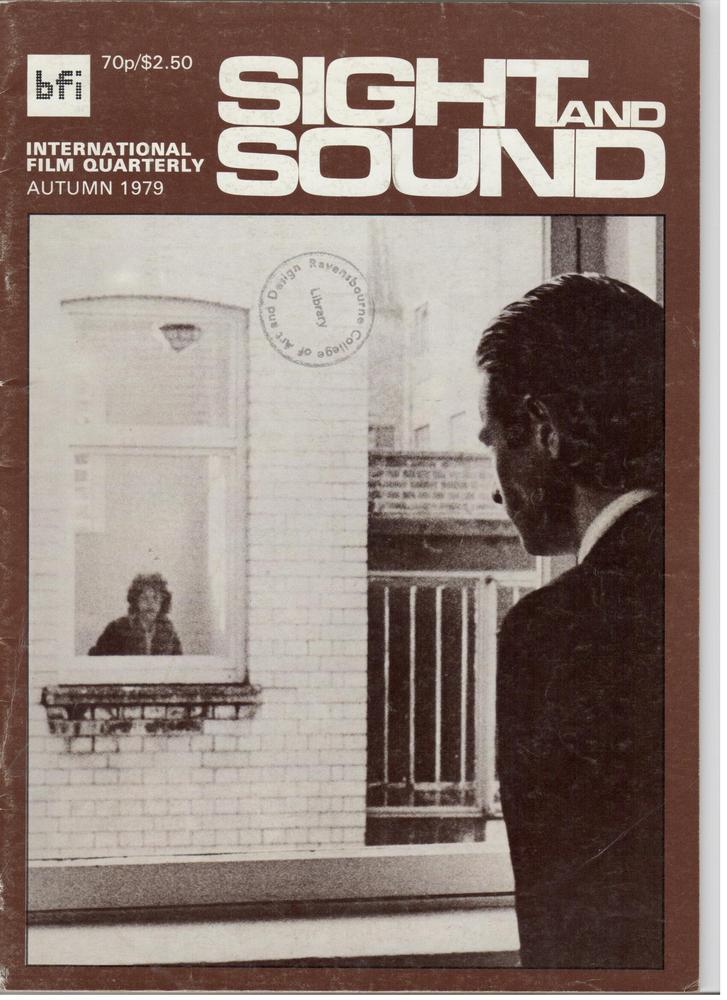
MM: Do you remember this Sight & Sound? It’s a piece on Nicholas Ray. [Autumn, 1979]

Sight__sound_autumn_1979_001
In_a_lonely_place_-_david_thomson_001

DT: Yes, sure.

MM: It starts in a very personal vein where you reveal your unhappiness with writing and movies, and you reveal the content of a letter from the then editor of Sight & Sound, Penelope Houston. For someone who has professed to being so shy, where does that urge come from to reveal oneself in criticism, and do you like to read it in others?

DT: Yes, I do. Where it comes from is…I don’t know that I can explain it. Something I didn’t say in the thing on Sunday [at the ICA], but which if I were to do it again I think I would because I think it’s important. As a child I stammered very, very badly and it was a real problem at school. It held me back a lot and I was naturally timid, shy—that sort of personality—but this intensified it. But I really got to the point where I didn’t want to go to school because I was just so worn out with being laughed at and being in these situations where I had to speak and the humiliation of it. Although I never wanted to be an actor, I do think that the fluency that actors have with words fascinated me and appealed to me enormously. And I think that most shy people long to tell their story. I think it can be overdone. I think that you have to be very careful. I think there’s a point at which the vanity of it becomes tedious and boring and you really have to keep a very sharp eye on it to keep it under control. But, for myself as a reader, I do love writing where the author somehow— and there’s a lot of different ways it can be done—where the author takes you, or plays the game of taking you, into their confidence—because it may be just a trick—about what they were thinking and feeling and what this piece or story meant to them. I’ll tell you a book that had a very big impact on me. Norman Mailer did a collection of his own writing in the Sixties called Advertisements for Myself. Do you know this book? Because I loved the way there was a kind of life story so that you had placed in perspective, in context, what these pieces had meant to him. And I met Mailer— later on, not until the Eighties—and we’re not close at all but I think we would think of each other as on good terms. But I’ve had a couple of really good conversations with him and I like him very much. I don’t think he’s the great American writer, but I love the way he works at writing and the way he’s happy to let that show.

MM: Did Mailer’s style influence you. I’m thinking particularly of his review of Last Tango in Paris, his book on  Ali-Foreman The Fight and Marilyn, where he does certain things that remind me of you.

DT: Definitely. Once I found Advertisements for Myself, which I think was the very first Mailer book I read—I might be wrong—which obviously had extracts from a lot of the earlier books, I just went back and read everything, and discovered The Deer Park. Do you know The Deer Park?

MM: I’ve got it. I’ve never read it.

DT: Well, I think you’d like it. It’s one of the best Hollywood novels. So I read everything, and I was very much under his influence for a while. You know, I think always when a writer immerses himself in some other writer’s work, you’ve got to be very careful—you’ve got to keep a towel with you to dry it off. Yeah, he meant a lot to me. There were a few American writers like that. He’s certainly one of them.

MM: At the end of your essay “In A Lonely Place” you write, “I was dismayed by the wave of shallow energy in young directors.” If you felt that then, in 1978/1979, when you were at the tail end of what is now considered a golden age in American cinema—how do you feel now?

DT: (laughs ruefully) Well, I … it’s horribly prophetic, it’s ghastly. I think that shallowness has become a personal style. It’s not just a handicap of character—it is actually brandished as a sign of virtue. There are people who believe to be shallow and to be flip about it is post-modern, ironic. And I think it’s horrible. There are some exceptions. I think there are some people around now who are different. But a lot of those directors of the 1970s burned out one way or another. And I think you can make a very fair case that the general factor that contributed to it was that they weren’t mature enough. They never found a way to mature. And I would say this: that I know more film-makers than writers probably, but the writers I know, and have known for a time—not always happily and well—they really have matured. They’ve grown sadder, wiser, darker—but they’ve grown. And you feel they’ve grown older. And you feel that the whole burden of experience has contributed to what you’re getting. And there’s a wonderful thing with a guy like Mailer, where you see his own youth bruised and battered. Whereas with the film-makers—there are exceptions—but with a lot of them you feel the grisliness with which they’ve tried to cling on to youth, to resist the growing older.

MM: He’s a great film-maker, but you’re tough on Martin Scorsese. Stephen Frears recently said in an interview that Scorsese had been heroic to have made the films he has within the Hollywood system. Do you agree?

DT: Yes. (pause) But I don’t think that’s the whole story. I think that he has also been tortured by not being able to make hits, by not being recognised by the Academy, by the box office at the level of, say, someone like Spielberg and Lucas. I think there is a very brave, almost reckless, side in Scorsese, but I do think also that he remains locked in this subject matter of wild young men, and as that he gets older, it begins to look and feel a bit more contrived. So, you know, with Gangs of New York—which I think is a really hugely important test film in so many ways—I would love to think that [it] will have the energy, the violence, the danger of Taxi Driver, say, and at the same time give you a real understanding of how a big American city evolved, so that you feel the history of it. I fear that it could be just another rhapsodising over wild young men. And I think he needs to get past that to make something else. So I am tough on him because I think he’s the very best. Mean Streets, Taxi Driver, New York, New York—a film I love—Raging Bull—great films, great films.

MM: You’ve said elsewhere that you’ve feared you were like Orson Welles, but in some ways do you see yourself in Scorsese—the child attracted to Hollywood. In America in the Dark, you describe Hollywood as a “fraudulent Eden” and talk of movies and the rapturous effect they had on you, and yet this seems to have troubled you, and in some ways your work is defined by this life long scepticism about movies. Scorsese seems to have had a similar experience, but whereas his rapture/love turned to making films, you turned to writing. Could you have gone down that route?

DT: I don’t know. I don’t have the constant, unflagging, outward energy that you need to get a film set up. I don’t have the patience to stick with a project for years when everything’s against it, and I’m probably not as natural collaborator in the way any film-maker has to be. But I’ve been drawn to that. I mean, I went to film school thinking in a very vague, idealistic way that that’s what I was going to do. I think I discovered that I was a much more solitary person, who works best on his own. But I think the task of making a film is fascinating. I love to watch the people who are doing it, see what happens to them. And I think it’s a very tough to sustain a career. When you look back to the so called golden days when people like Hawks just kept going, went from one studio to another, but it doesn’t seem to have effected him too much. I think what you forget is they had the assistance of a system. Every film now is set up uniquely, and so laborious. I like to curl up with a pad and a pen, you know, and start to invent. I’m not suited to that. I’ve done some directing of actors in the theatre and I’ve loved it. I would say it’s one of the most enjoyable experiences I’ve ever had.  

MM: You made some films with your friend Kieran Hickey, who is one of the entries in the Biographical Dictionary. Are they available?

DT: They’re in the Irish Film Archive. I know you can get them… I also did a documentary about the making of Gone With the Wind, which I enjoyed doing very much, although it was a different kind of film.

MM: In America in the Dark, you write of Citizen Kane ” I wandered into it because it happened to be showing at a local cinema” and that “It was like seeing the ocean for the first time…” There’s your physical response to it—you didn’t wander into the theatre, you wandered into Kane

DT: I had heard about Kane. I had been trying to read about the history of film and I had found a book that talked about it, and it sounded amazing. And all of a sudden the Classic in Tooting—it doesn’t exist anymore, I don’t think—suddenly announced—this was the mid- 1950s and I think it was because—I didn’t know this at the time—Orson Welles was in London working on stage and I suspect it was because he was causing a bit of a stir on stage that someone thought, “Let’s bring that film back”, you know. But, in those days, old films didn’t get revived very much. So if you hadn’t seen it when it came out, you went on hearsay. And I went down to this theatre the very first screening, and I was the only person there. But it was—I’m not the only person in the world of film who will tell you about the way their life was changed the first time they saw that film.

MM: You say” I wandered into Kane.” How can anyone of a certain age now wander into Kane with the same sense of surprise given its reputation and the Sight & Sound lists etc?

DT: Of course. And it’s the saddest thing about Citizen Kane that it’s become “Oh, that film.” And kids probably feel, “Well everyone knows that’s great, I’m not going to bother with it”, because kids like to discover things for themselves, and they should. It’s a real problem, and I don’t know what you do about it. I’m not saying that it shouldn’t be the best film. It’s a silly game, but it’s as good a candidate as any you’re going to find. And yet it’s turning the film into the very opposite of what it is. It’s turning it into a statue; it’s turning it into a dead monument. A young generation is going to suffer from that and probably, ultimately, it’s going to forsake the film, abandon it so that then in another—I don’t know how many years— it will be rediscovered. I think it has to happen. Because I agree with you entirely. A film only stays alive if enough young people are crazy about it. And at the moment, Kane has got such a vast cloak of respectability and prestige attached to it, that you can’t get at the real thing.

MM: In Rosebud you write: “I fear I’m like him. That Orson Welles took my life. By the time I realised it was too late to go back.” In what sense do you think you’re like him?

DT: The sort of jokey, playful, teasing manner that actually gets bored quickly with people. I always found Welles, from the first time I saw him on screen as a person—which I think must have been Harry Lime—I found him an unbelievably charming figure. He just seemed to me so seductive and appealing. And I collected Welles’ appearances, many of which are not very good in the obvious sense. But I loved him as a person and it has to be some very primitive response. I cannot verbalise it. There were ways in which I saw myself—in the youthfulness that has a hard time growing up, the charm that can turn very cold and bored: defects that I recognise in myself. Things like that. Immense concentration followed by irresponsibility. I’ve got some of those things. I don’t know… I’ve always felt an intimate involvement with him.

MM: When I saw you at the ICA, I was interested to hear you say that you do not consider yourself a film critic. I was talking to a friend about Jonathan Rosenbaum’s digs at you in Movie Wars, and I said, “Well, I think Rosenbaum’s missing the point: Thomson’s not strictly a film critic.” Then I saw the new entry on Graham Greene where you say of Greene’s film criticism that “the films were a trigger for life, or for novelising alchemy.” Could the same be said of you?

DT: I know that’s why I’m drawn to Greene, and so on. You know, I don’t know Jonathan, I’ve met him once or twice. He has a taste in films that is more avant garde than mine and I admire him for that, although we have some tastes that overlap. I think what he says is fair enough, because I lament the poor quality of many American films and don’t in turn spend enough time praising and sending people to the very experimental and non-English language films he loves. It’s a fair point; I accept it. But the fact is that I don’t like all of those films as much as he does, and also I’m very interested in mainstream films. I think that if film becomes as rarefied a form as, say, painting or theatre, then film will have lost a great deal. The question behind film and cinema is can it usefully and well serve everybody. I think that was always the great excitement in film at the beginning, and I think it’s vital to what it could do still.

MM: This time round, there are entries on film critics: James Agee, Graham Greene, Pauline Kael, Andre Bazin. What about Manny Farber and Robert Warshow?

DT: Manny Farber nearly went in. I mean, Warshow, again, could have been. When you’re doing this book, there’s always a deadline moment when they say “come on, come on, we’ve got to go, we’ve got to really put this in type.” And you race to get as many in as
you can, and there’s always someone left out. And I apologise for the omissions. I think Manny Farber should be in the book. He’s a wonderful writer. I’ve met him and I like him very much, and if I do it again there’d be some more people like that in there, and he would be there for sure. But I’ve begun to include film critics.

MM: Of Pauline Kael, you say you didn’t like her as a person but you loved her work. What did she think of your work? Did she ever comment on your work?

DT: No. She did not comment on my work, not that I’m aware of, not publicly. She didn’t like me; we didn’t get on.  She, quite early when I was at Dartmouth, she came up to lecture to a basic film history class. She had been invited by someone else on the campus she was friendly with. She lived close to Dartmouth, and I drove down to Massachusetts to pick her up, because I really wanted to meet her. So I drove her up—it was a several hour journey— but we were talking all the way and it seemed to be a perfectly agreeable conversation. And she came up to the class and she spoke—she spoke wonderfully—and then there was a sort of tea/meeting after the class, informal, not the lecture situation, where she was taking more sustained questions  from people. And it was a conversation, you know, and I chipped in a few times and disagreed with her a couple of times, and she really didn’t like it. Well, you know, I think in an academic setting you’ve got to be able to handle disagreement. When I ran a classroom, I tried not to run the classroom. I wanted the kids to say what they thought. I didn’t want them to feel like, “I can’t say that because I know he doesn’t agree and he’ll make fun of me”, and that sort of thing. That’s the very opposite of education. And I was really startled at her sort of nasty response, and we fell out from then on. She had a great need for followers who were obedient, and some young film writers went along with it, and they were on the phone to her all the time, and they echoed her views. And I just didn’t like that. I have never done anything to encourage that kind of following. You know, there are some young film writers—I think they like what I do a lot and we talk and that’s great; but, you know, I wouldn’t dream of the kind of policy statements she effectively issued. And I didn’t like it, and I thought that the more I learned about her, the less I liked her personally. BUT: she was a fabulous writer—I loved her writing very much. I didn’t always agree, but, you know, I don’t think that matters. I think that if you read something that’s well written, and if you disagree with every thought, you’re having a great time.

MM: The literary critic James Wood says that there’s a certain kind of novelist/critic who cannot resist “showing a little plumage” towards their subject.”  Does that go with the territory?

DT: There are some critics who are encouraged to be more showy than they ought to be.

MM: This is where I act like an aggrieved parent. Wes Anderson—only three lines, yet he’s made the same number of films as Tarantino, one less than PT Anderson.

DT: I miscalculated that. What I was trying to say was, “I think this guy is going to be wonderful.” But it came off with a different tone that was just bad writing. I know a couple of people who have said to me that what I’ve said is a little bit mean about him. And I didn’t mean that. I meant to say, “You like what you’ve seen so far? Yeah, me too. But it’s going to be better.” I think the two Andersons, I would say, are great reasons for hope. I think very highly of both of them.

MM: Do film-makers ever get in touch regarding things you’ve written about their work? I’m thinking in particular of a piece on Leaving Las Vegas, which was in Film Comment a few years back. Did Mike Figgis ever get in touch?

DT: He did. He was very grateful. [the studio] thought it was impossibly dark. And it happened at that time there was a publicist, a woman called Susan Pile, who was one of the great studio publicists in the game, with whom I’d worked in the past. And she got a notion to show me the film early. And she said, “I’m going to show you the film early, and if you don’t like it, ok, forget it, but if you like it—and I think you might—will you do an early piece on it that would give us a chance; because I need a strong piece in defence of the film to make the studio believe in it.” And I loved the film. And I did the piece, and it came out in the magazine, and she took the piece to the studio: “Look, we can build a campaign around this.” You know, they got three Oscar nominations. It didn’t work out badly. That was one of those moments when I felt I served a real purpose, but which I don’t think critics do often.

 —Mick McAloon

©


“CRITICAL INTELLIGENCE IN THE IMAGINATIVE POSITION” #1: PAULINE KAEL

The Library of America is finally bringing out a collection of Pauline Kael’s selected writings, The Age of Movies.  It will be interesting to see how Sanford Schwartz’s selection compares with For Keeps, the anthology that Kael published not long after her retirement in 1991.   Kael’s personal selection was organized chronologically except for the book’s first piece — Hud: Deep in the Divided Heart of Hollywood.  This is one of my favourite Kael essays, though not necessarily for what she has to say about Hud.  I think it says a lot about the way in which Kael appeals to readers, while simultaneously infuriating film-makers and her detractors.    The latter would no doubt say that such a piece is all about Kael.  But she was actually quite sparing with her autobiographical reminiscences, which consequently made me want more.

 “The summer nights are long on a western ranch.  As a child, I could stretch out on a hammock on the porch and read an Oz book from cover to cover while my grandparents and uncles and aunts and parents didn’t stir from their card game.   The young men get tired of playing cards.  They either think about sex or try to do something about it.  There isn’t much else to do—the life doesn’t exactly stimulate the senses…

My father who was adulterous, and a Republican who, like Hud, was opposed to any government interference, was in no sense and in no one’s eyes a social predator.  He was generous and kind, and democratic in the western way that Easterners still don’t understand: it was not out of guilt or condescension that mealtimes were communal affairs with the Mexican and Indian ranch-hands joining the family, it was the way Westerners lived.”

Notice how Kael’s voice pulls you in?  It reads like fiction — the beginning of a short story, perhaps.  It would not be out of place in Joan Didion’s Where I Was From, which is ironic given Kael’s put-down of Didion’s style in her review of the film adaptation of Play It As it Lays.  I also think it’s a lovely example of what David Shields, in his book Reality Hunger, refers to as “critical intelligence in the imaginative position”.

—MM