
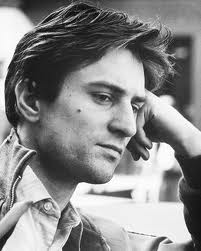
Robert De Niro is regarded as one of the finest actors of his generation, but why was he so compelling?
Dear S,
It’s interesting how you frame the question in the past tense, as if De Niro no longer compels our attention. You’re not alone: David Thomson has spoken of De Niro’s “grievous decline”. Perhaps it’s true and for me to insist otherwise would be foolish and sentimental. I do know that your question is sincere. You’re a lot younger than me and I guess you’re genuinely curious about De Niro’s early appeal. Not that my youth coincided with De Niro’s great years: I came in at the tail-end—Once Upon A Time in America, Falling In Love—when video stores were in the ascendant, and it seemed as if there was an inexhaustible supply of great performances, in great films, that one could rent night after night. I remember being thrilled by each new discovery and buoyed by the prospect of there still being more to come. It was an education, of sorts. Already you can see that I am being sentimental; I’m certainly romanticising my youth and the great days of Selecta Video. So perhaps you were right to use the past tense. So where do we start?
De Niro was the A-list anti-star, but a star nonetheless. His reputation is built on that great run of films beginning with Mean Streets and ending with Once Upon A Time in America. In between came The Godfather II, Taxi Driver, New York, New York, The Deer Hunter, 1900, Raging Bull, and The King of Comedy. You have to admit that’s a hell of a run. And it’s not that he hasn’t done good work in the years since—Brazil, Falling in Love, Midnight Run, Heat, Casino, Jackie Brown, Silver Linings Playbook—it’s just that decade-long run was truly special. For one thing, he worked less, averaging a film about every eighteen months. He was more selective about who he worked with: Scorsese x 5, Coppola, Cimino, Bertolucci, Leone. The climate encouraged maverick talent; novelists and filmmakers were central to the culture; film critics had influence—and an audience. (Or should that be the other way round?)
But what was it about De Niro that made him so compelling? On screen, he seemed incapable of false moments (he still does), even in films that are beneath him, such as New Year’s Eve. Off screen, he made himself scarce, rarely doing press. Of course, like most well-known actors or movie stars, especially those with long careers, he can be reduced to a set of ticks and mannerisms. But can’t we all?
When I think of De Niro, I think of his fierce artistic will—how else do you account for that great run of films as well as the physical transformations? And I think of his soulfulness. There was something mysterious about him—his stillness, his watchfulness. I think of his eyes, particularly in Taxi Driver and Once Upon A Time in America. And I think of the choices he makes within a given role, which speaks of his special insight into the character he’s playing, or perhaps I should say “becoming”. It could be an item of clothing, a gesture, or simply his way of listening to another person. Over the years I got so bored with journalists’ tired run-throughs of De Niro’s method acting resume, but without any corresponding insights. So they might tell you that he learned to play saxophone for New York, New York, but they never point out that his timing is off when he counts in the band—a rare lapse. Or that he trained to be a boxer for Raging Bull, without acknowledging the way he moves when he’s not in the ring. And all that tired talk of De Niro’s weight-gain but no mention of Jake’s laboured breathing. (De Niro is one of cinema’s great listeners and breathers.)
So perhaps the best thing I can do is refer you to the films themselves, and to some of his most inspired choices, where De Niro is more than just the actor of his generation. He’s that rare beast—the actor as artist, where the choices he makes are invariably true, unerringly specific, and so vital to these movies’ artistic accomplishments that it’s hard to imagine them having been made with anybody else. Would it be wrong to say that he’s as much a presiding intelligence in these films as his directors? De Niro as auteur? I’ve heard Tarantino make that argument—and he’s not far wrong.
Mean Streets (1973) —
Did he ever act with such wild abandon again? Of course, Scorsese gives him a helping hand, not one explosive entrance, but two: the first, literally, as Johnny blows up a mailbox, and the second to Jumping Jack Flash: Has there ever been a character in all of Scorsese’s oeuvre and his extensive use of the Stones back-catalogue more suited to their ramshackle symmetry?
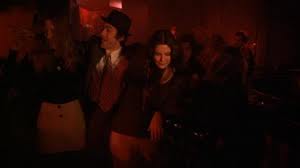
Inspired moment #1: Johnny Boy dancing to Mickey’s Monkey outside the car when it’s all falling apart. Johnny Boy’s the joker in the pack, and De Niro the movie’s wild card! Sometimes, even Harvey Keitel can only look on in astonishment and wonder at De Niro, as if to say, where did this kid come from? But it would be wrong to talk about De Niro’s performance here without acknowledging Keitel’s great work, his simplicity and rock-solid presence. The entire movie is a beautiful duet, best summed up by two scenes: the ‘improv’ in the “back room” early on, and the way they each lay out handkerchiefs on the gravestones in the cemetery—the Abbot and Costello of the Lower East Side.
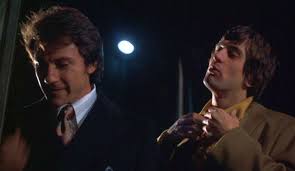
De Niro & Costume
De Niro’s choice of costume for his characters has always been impeccable. Johnny Boy may be wild, but he’s fastidious about the way he looks, and you can see this is not only in the way Johnny Boy dresses but in the way he readies himself in preparation to greet his friends in that second entrance—that is, once he’s put his trousers back on. But there are countless examples of De Niro’s great costume choices: in Goodfellas, for example, when De Niro’s Jimmy Conway is arrested. What struck me about De Niro’s costume choice here—a yellow jersey, jeans—was the level of detail for such a seemingly offhanded moment that takes place within a montage of arrests. It can only be for a few seconds of screen time, but that yellow jersey speaks volumes.
De Niro & Detail
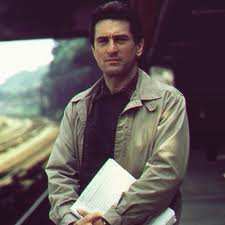
Talking about De Niro’s wardrobe tests for Falling in Love, and how he finally decided on the type of jacket his character would wear, Meryl Streep said… “[the jacket] was tan, it was ignorable, but that’s different from unimportant. Details are important, and Bob knows that.”
Taxi Driver (1976) —
Inspired moment #2: After shooting Sport (Keitel), Travis sits down in the middle of the street, between parked cars; it’s a strange and disconcerting moment—Travis’s body descending into trauma?—all the more so for being so unexpected. Where did this detail come from? It seems so unforced: an actor’s truth transcending genre and pulp style. In Scorsese’s early movies, life is always intervening and his actors respond in kind—at least that’s what it feels like. But we’re also watching hungry, ambitious actors at the top of their game. Manny Farber and Patricia Patterson described Taxi Driver as “buzzing with star-turn acting”, which it is, though I’d call it an anti-star-turn very much attuned to a specific time and place: New York, 1970s, the Actor’s Studio: from street to (acting) class to screen, and hipper than anything Hollywood had to offer. It was Farber/Patterson, in the same article, who wrote one of the best things I’ve ever read about De Niro: they refer to him as “a high-class actor…whose acting range is always underscored by a personal dignity.” We must not forget that Farber, a great painter and critic, moved in the same circles as De Niro’s artist parents and would have recognised a fellow artist’s dedication to the truth: Negative Space, Farber’s singular collection of film writing, is dedicated to De Niro’s mother, Virginia Admiral; while De Niro, in those days, was the actor as termite-artist, prestige-resistant, burrowing through the Hollywood canvas. (cf. New York, New York.)
Raging Bull (1980) —

Inspired moment #3: When Jake and his brother Joey (Joe Pesci) attend St Clare’s annual summer dance, Jake sees Vicky (Cathy Moriarty) leave with a local mobster (Frankie Vincent). But it’s what happens next, when Jake helps a doorman evict someone from the club: it’s another lovely detail—casual, off the cuff, and exquisitely judged—that tells us about Jake’s place and standing within the community. Detail in service of the truth. And let’s not forget Jake’s culinary advice—written or improvised?—to his first, beleaguered wife, as she cooks a steak: “don’t overcook it—it defeats its own purpose.”
The King of Comedy (1983) —
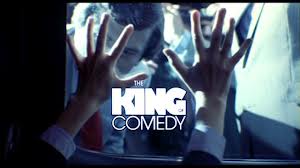
From its homage to John Cassavetes’ Opening Night—a freeze-frame of a fan’s hands pressed against the window of a limousine—to its dissection of fame in the 20th Century post John Lennon’s assassination, The King of Comedy is a forerunner to Larry Sanders, with its behind-the-scenes look at a talk-show, and celebrities playing versions of themselves. Which makes Rupert Pupkin the patron saint of cable and reality television. So an argument could be made that Scorsese and De Niro’s fifth collaboration—and a commercial failure on its release—is the cornerstone of HBO’s present dominance. And—Hey Now!—don’t we see traits of Rupert Pupkin in Jeffrey Tambor’s Hank? (Check out Season 2 episode Hank’s Wedding.) Rupert could certainly have played the role of Larry’s sidekick, if he hadn’t harboured such crazy ambitions to be out there on his own. And Rupert is out there—a more psychotic version of David Brent, which brings us back to Larry Sanders (cf. The Office), HBO and the question of influence. (And I haven’t even mentioned The Sopranos.) This is one of De Niro’s greatest performances, perhaps his best: inspired, uncompromising and—pre Midnight Run—very funny.
True Confessions (1981) —
Falling in Love (1984) —
Two Ulu Grosbard films. True Confessions was written by husband and wife team John Gregory Dunne and Joan Didion, and based on Dunne’s novel. Tonally it belongs to the 1970s—Chinatown is in its sights. You believe De Niro’s priest has said a thousand masses, and heard a thousand confessions; while Falling in Love is like a made-for-television movie devised by Lee Strasberg. Which is to say that Grosbard, a man of the theatre, is an actors’ director: the performances are full, rich, nuanced and textured. De Niro and Streep are heavy-weights in fluff and the film as comfort-inducing as the best carrot cake and coffee, but I much prefer it to Brief Encounter, to which it is often, and unfavourably, compared.
Heat (1995) —
Talking about the differences between De Niro and Pacino, Michael Mann described them in terms of colours: Pacino is “deep red”, De Niro “cool blue”. For me, “cool blue” takes it. Pacino rips and roars—“Sit down, Ralph!”— while De Niro gives one of his great minimalist performances: his presence balancing Mann’s tendency towards verbosity: who needs Mann’s inflated dialogue when you’ve got De Niro? Mann certainly doesn’t. But then the abiding impression the film leaves is a wash of “cool blue”.
Casino (1995) —
Aside from a rare moment of levity—once again suited up but with his trousers off (cf. Mean Streets)—De Niro’s Ace Rothstein is cold, dead-eyed, cool and controlling, and Sharon Stone’s Ginger like a slot machine that can’t stop giving out, much to Ace’s displeasure. Was this his last great leading role?
Jackie Brown (1997) —
“Sadness” is not a word one normally associates with the exuberant Quentin Tarantino, but there it is…Jackie Brown is both lovely and tough and features one of De Niro’s (and Tarantino’s) saddest characters. Louis Gara (De Niro) gives off a sadness that I don’t remember from Elmore Leonard’s novel, Rum Punch. It’s as if he’s experienced so great an internal collapse—too many joints, too much time in the joint—that death would be a welcome relief. And when it comes, it’s heartbreaking: filmed from behind, a static camera, we don’t even see De Niro’s face: it’s all in his back and shoulders—forfeit, collapse, resignation.
—MM
 Running From The Reels