
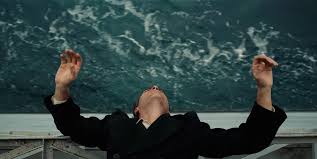
Paul Thomas Anderson’s new film is another strange masterpiece about two men who fulfil a mutual need. But unlike the wildcatter and the preacher in Anderson’s previous film, There Will Be Blood, the two protagonists here—a demagogue and a drifter—never quite stake a claim on what it is they actually want. Lancaster Dodd (Philip Seymour Hoffman) takes to Freddie Quell (Joaquin Phoenix) as though he were a long lost brother, while Freddie seems bemused, if not entirely seduced, by the man known as “Master”. And without seduction, where does that leave betrayal? Besides, Freddie just wants to believe in something, as his own self-belief seems to have been obliterated even before he saw action in WWII. That their paths should cross at all has the ring of a fairy tale, given that Freddie happens upon Dodd’s moored yacht, the Alethia, late one night. Dodd’s ship is certainly alluring—bright lights, music, revellers—and to a troubled soul such as Freddie, the promise of all of these things is enough for him to jump aboard, which Anderson covers in a lovely, fluid tracking shot that takes in Freddie’s somnambulant approach, the blur of the ship’s lights (or Freddie’s blurred vision), as well as his leap into the unknown. “You’re at sea”, he is told on waking.
But then so much of Anderson’s movie takes place on the ocean, beginning with an image of swirling, turquoise water: hypnotic and dream-like, it’s utterly ravishing. Anderson will return to this image like a man fixated—like Freddie, perhaps—using it as a kind of poetic punctuation and as a way of binding his story’s seemingly disparate elements—its abrupt and bold narrative shifts, its sense of journeys undertaken. But the more I thought about Anderson’s film afterwards—and it’s a film that stays with you—I kept coming back to this moment. For in the context of the story he’s telling, and its deft, almost musical placement within the film’s gorgeous flow, it is arguably the film’s most essential image. Sure, there are greater sequences—as you’d expect from the director of Boogie Nights, Magnolia and There Will Be Blood. But none are as potent as this one. What is Anderson suggesting? That some people are destined to remain adrift—caught up in the current of their own longing.
—MM
 Running From The Reels