
It could be something out of a Preston Sturgess movie. A bookish, young American is travelling alone from London to New York. His preferred means of travel: an ocean liner, the QE2 no less. That there are people waiting for him in London — anxious business associates, attuned to modern ways — doesn’t worry him; he is impervious to such distractions. His name is Wes Anderson, and judging by his movies, as well as the cover of a recent Film Comment, he’s in a world of his own.
There was no high-jinx on-board Anderson’s first Atlantic crossing, no rapacious beauties intent on bagging a husband and a fortune. What Anderson got was closer to one of Andy Warhol’s films — one set-up, a continuous take — than to the giddy heights of a Sturgess comedy: for the duration of Anderson’s voyage, and for anyone willing to watch, a CCTV camera relayed its static view of the ocean back to the ship’s monitors—a movie without end. Its title? “A View from the Bridge”. It was the bleakest journey of Anderson’s young life.
Anderson is only 31, not that age should matter where talent is concerned. But consider that by 1970, the year Anderson was born, Martin Scorsese and Peter Bogdanovich had each made one film and were at the vanguard of the New Hollywood. It is a measure of Anderson’s prodigious gifts that he can count both directors as admirers. After seeing Bottle Rocket, Anderson’s first feature, Scorsese wrote the young Texan a fan letter; while Bogdanovich wrote the introduction to the published screenplay of The Royal Tenenbaums.
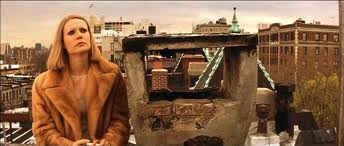
Anderson’s third film is his most successful to date, and to this observer as good as the brilliant Rushmore. How much Anderson draws from life, I’m not so sure. His literary influences, however, are clear for all to see. Anderson’s inspiration is the literature of the East Coast—the New York stories of Wharton, Fitzgerald and Salinger, as well as a host of New Yorker writers. But all of the above influences are filtered through a filmmaking sensibility that owes much to his mentors. So while the Tenenbaums themselves feel like the inhabitants of Old New York, they actually reside in a dilapidated version of the city that has more in common with the Chelsea Hotel than the Algonquin. But I guess that’s modern filmmakers for you. Anderson, like Tarantino, is a child of the movie brats. And indeed The Royal Tenenbaums displays the same love of the medium as Bogdanovich’s early work, though it is Scorsese’s rhythms that lie behind it—from The Big Shave to The Age of Innocence. Think of it as Pulp Fiction’s preppy kid brother: more refined, less brash. Like Pulp Fiction, it’s the sum of its youthful maker’s dreams and obsessions: New Yorker Fiction, if you like.
—MM
 Running From The Reels