
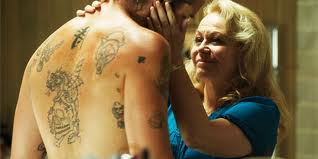
In his book ‘Cultural Amnesia’, Clive James writes that “the atmospherics of Michael Mann’s Heat affect the look of any movie made about crime: other directors, whether working out of the United States, Latin America, Europe or Hong Kong, either go with him, towards glamour, or go against him, towards grunge, but they always have his look in mind.” There’s more than a touch of Heat to David Michôd’s Animal Kingdom, especially in its depiction of an armed robbery unit that is as wild and lawless as its quarry. It also has that city-at-night feeling which Mann is so attuned to, though in this instance the city is Melbourne. But despite its cinematic influences (Goodfellas, Magnolia), Animal Kingdom is rooted in the real. Michôd has spoken in interviews of wanting to “make a film that unlike, say, a Quentin Tarantino or Guy Richie crime movie, took itself seriously, and was set within a big, dark, nasty world, which was nevertheless still quite poetic and beautiful.” In other words, Michôd goes for the glamour and the grunge.
From its stark opening (it begins with a bark) to its final confrontation (it ends with a bang), Animal Kingdom more than justifies its grand and arresting title. In its native land, it has been called “the Australian Godfather”, and one can see why: a terrific cast at the top of their game; a brilliant script which takes the sequence as its dramatic unit; a family drama in which the family’s youngest (and most innocent?) must make his way in the world. Where it differs from The Godfather is in its sense of scale and ambition. But then Michôd’s crime family is not as organised, nor as operatic, as Coppola’s: the Cody’s are not the Corleones, though what they lack in grandeur they more than make up for in their propensity for violence, betrayal, and incestuous feelings.
The film is loosely based on an actual incident in Melbourne’s recent history known as the Walsh Street Killings. But while Michôd uses this incident to ignite the film’s plot, he is after bigger game. Like the recent Winter’s Bone, Animal Kingdom is about survival. Its teenage protagonist, Josh, must negotiate the perilous terrain of family—or at least his family. His notorious uncles and grandmother, to whom he turns after the death of his mother, provide Josh with an unsentimental education: “We take it out on whoever turns up. That’s what we do.” It is left to Guy Pearce’s homicide detective, and the film’s moral centre, to guide Josh as best he can. It is Pearce who supplies us with the film’s metaphor of the “animal kingdom”, telling Josh:”You’ve survived because you’ve been protected by the strong, but they’re not strong anymore.”
In case we were in any doubt about Michôd’s intentions, the film is full of bracing scenes in which the strong and the cruel survive at the expense of the vulnerable. Time and again we see goodness expunged, innocence corrupted. Watch how Michôd fixes on the smooth and youthful complexion of a rookie cop, his good manners, and his by-the-book approach as he responds to the report of a stolen car. This is just one of several extraordinary sequences. Already you sense that Michôd is one of those “sprinkler on the lawn” directors who can summon dread from the sweetest of sights. And unlike Josh, the influences that have shaped him (Scorsese, Mann, P.T. Anderson) have been all to the good. Josh has been raised by wolves and acts accordingly.
—MM
 Running From The Reels